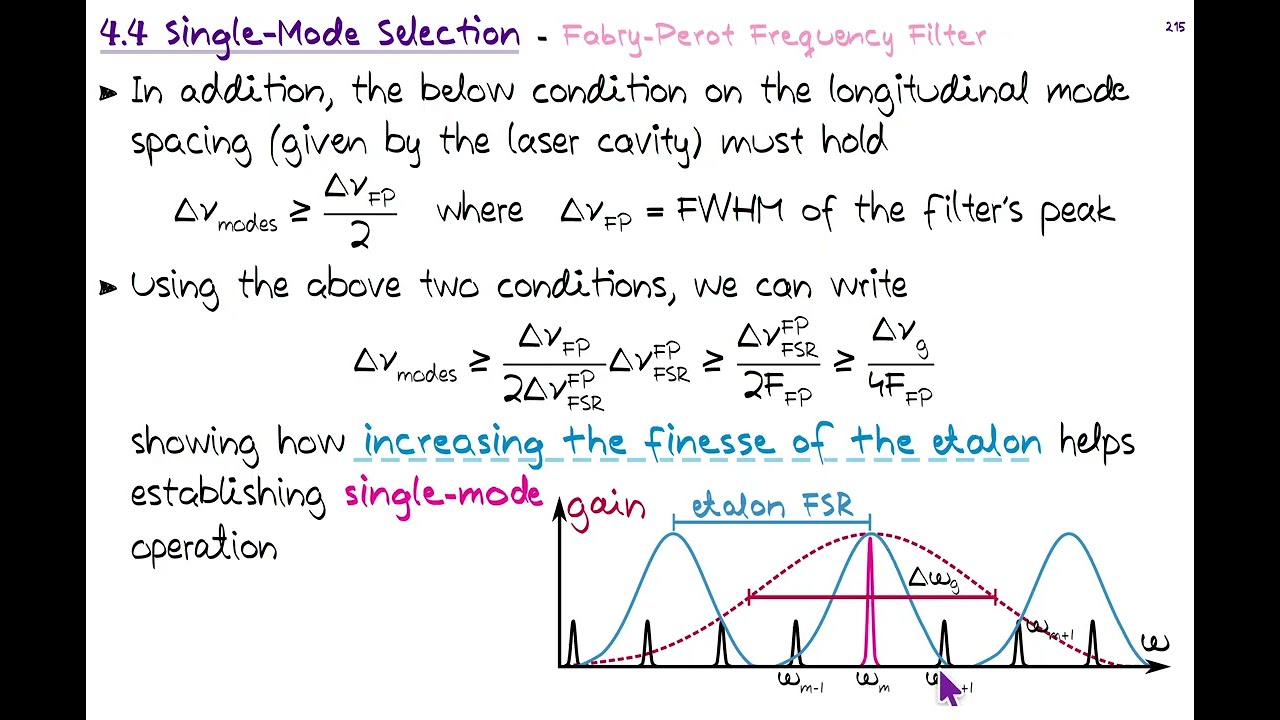
FYS.510 Laser physics 4.4 Single-Mode Selection
Keywords
Summary
118 words
Critical Evaluation
Value of the Information & Strength of the Argument
The value of this lecture lies in its systematic explanation of mode selection, bridging theoretical conditions with practical implementation. The argumentation is solid, deriving constraints from fundamental resonator physics and illustrating with realistic parameters. The presenter effectively uses diagrams to clarify conditions, and the discussion of both longitudinal and transverse modes provides a comprehensive view. The reasoning is sound, though the delivery is somewhat informal with frequent hesitations, which may reduce clarity but not the accuracy of the content.
Scientific Rigor, Source Quality, Title Accuracy
The lecture is scientifically rigorous, presenting standard equations and conditions for single-mode operation. It does not cite external sources explicitly, but refers to prior optics coursework, implying reliance on established knowledge. The title accurately reflects the content, which is a focused tutorial on mode selection. The presentation style is educational, and the explanations are consistent with known laser theory. No funding or conflicts are disclosed, and the content appears unbiased.
164 words
Title / Content Match
The title accurately reflects the content, which focuses on techniques for achieving single-mode operation in lasers.
Quality & Reliability
8/10
The lecture presents standard laser physics concepts accurately, with clear explanations and mathematical conditions. The content aligns with established knowledge in optical resonators and mode selection techniques.
Key Moments
Markers derived by PSI from the transcript: the creator did not define chapters.
- Introduction and motivation for single-mode operation
- Short cavity approach: condition on cavity length
- Insertion of frequency-selective filter (etalon) into cavity
- Derivation of conditions for etalon free spectral range and finesse
- Concepts of transverse modes and beam divergence
- Aperture as spatial filter and instabilities due to incorrect sizing, summary
Contribution & Novelties
This lecture synthesizes classical techniques for achieving single-mode laser operation, making them accessible for students. It bridges theoretical conditions with practical design parameters, demystifying the engineering trade-offs. The treatment of both longitudinal and transverse modes provides a unified perspective.
Pour aller plus loin :
- Fabry–Pérot interferometer — Directly relevant to etalon filtering and mode selection.
- Optical cavity — Basics of resonator modes and stability.
- Gaussian beam — Fundamental transverse mode properties and beam divergence.
- Free spectral range — Key parameter for mode separation.
83 words
Radar Profile
The radar profile shows high scores in technical level and reliability, indicating a dense and accurate educational resource. Information quantity and quality are also strong, though slightly lower, reflecting a focused scope without extraneous material.