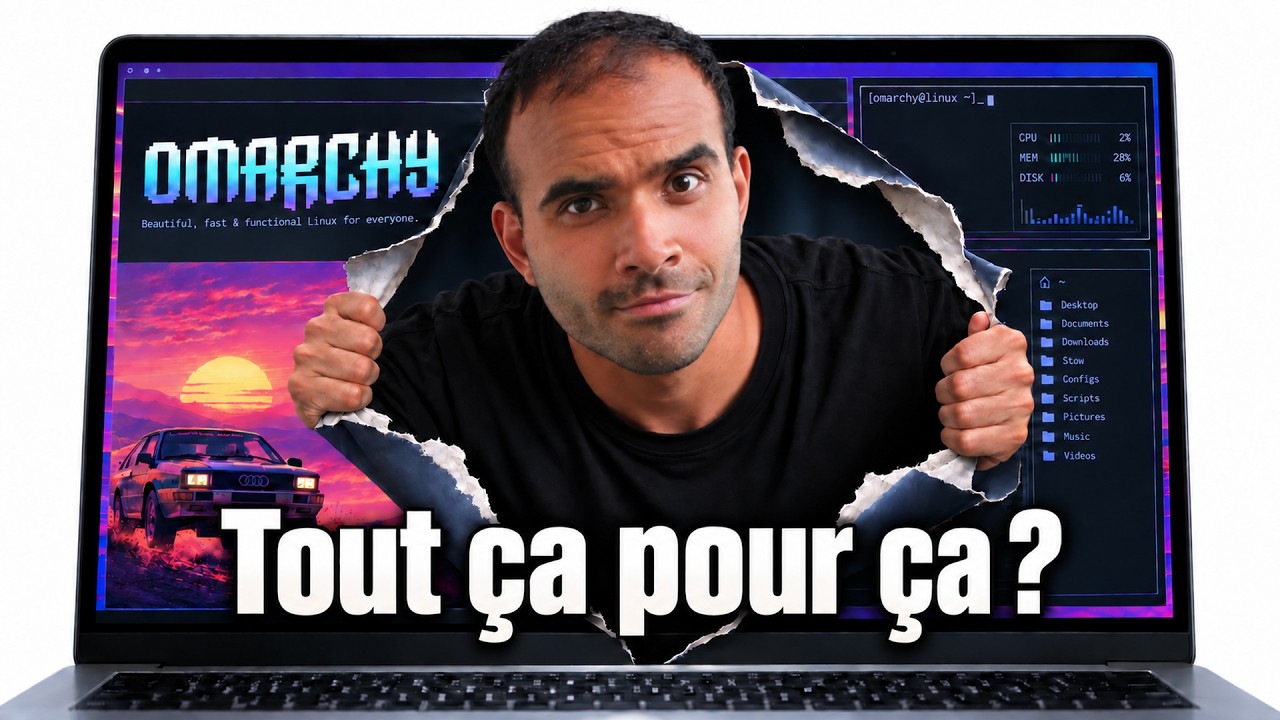
Omarchy : révolution ou simple hype ?
v5 Omarchy 1
Keywords
Summary
198 words
Critical Evaluation
Value of the Information & Strength of the Argument
The video provides genuine hands-on experience, offering practical observations that are both positive and negative. The argumentation is coherent: the author systematically tests features, then weighs them against typical daily needs. He supports his ‘hype’ conclusion by noting that Omarchy replicates existing Linux features (like tiling) and adds an AI wrapper, but does not fundamentally innovate. However, the reasoning relies heavily on personal preference (e.g., liking keyboard shortcuts) and lacks deep technical analysis or comparative benchmarks. The discussion of security is brief, mentioning flaws but without investigating them. Overall, the value lies in giving a realistic user perspective, though the argumentation is more opinion-driven than evidence-based.
Scientific Rigor, Source Quality, Title Accuracy
The video does not cite scientific sources; it relies on the author’s own testing and anecdotal evidence. The only links provided are personal promotional pages (newsletter, workshops, social media), which do not serve as references for the claims. The title accurately reflects the content, and the author clearly ’estimates’ the hype level. The rigor is moderate: he distinguishes between personal impressions and technical limitations, but does not provide external verification or in-depth source analysis. The security mention lacks detail. Overall, the title and content match well, but the sourcing is weak for a scientific evaluation.
216 words
Title / Content Match
The title directly matches the content: the author tests Omarchy and delivers a verdict on whether it is a revolution or just hype. The answer is nuanced, but clearly addressed by the end.
Quality & Reliability
6/10
The video is a hands-on review based on personal experience, with practical insights but no in-depth technical analysis or external verification. It acknowledges both strengths and weaknesses, though conclusions remain subjective.
Chapters
- 200 000 téléchargements en 18 jours
- Anti Hype : le principe du format
- Omarchy, DHH et les millions de la Silicon Valley
- Le tester sans rien installer : Try Omarchy
- Premier contact : bureau, tiling, raccourcis clavier
- Claude lancé directement dans l'OS
- Les thèmes et la navigation 100 % clavier
- Ce qui est moche et ce qui bugue
- Mon passé sur Arch, et pourquoi j'aime Linux
- Ce que je ne pourrai plus installer : Notion, AirDrop, mon casque
- L'écosystème de plugins et la barre personnalisable
- Le vrai piège : passer sa vie à configurer son bureau
- Le verdict : hype ou pas hype
- Ce que je vous conseille de faire à la place
- Un OS écrit par des agents : les failles de sécurité
Cited Sources
- Sharma's private masterclass waiting list — Referenced in the video description as a way to sign up for workshops, not as a content source.
- Shubham Sharma's newsletter — Mentioned in the description for newsletter subscription, unrelated to the video's scientific content.
- Shubham Sharma's LinkedIn — Social media link provided in description, not a source for the review.
- Shubham Sharma's website — Personal website for following the author, not a source of technical information.
Contribution & Novelties
The video contributes a practical, user-level review of Omarchy, filling a gap between marketing claims and real-world usage. It offers concrete impressions on performance, customization, and integration, and raises valid concerns about the ‘agentic’ label and security implications of AI-generated code. It also helps potential users decide whether to explore the OS.
Pour aller plus loin :
- David Heinemeier Hansson — Background on Omarchy’s creator, relevant to understanding his motivations.
- Tiling window manager — Core feature of Omarchy; explains the concept and history.
- Arch Linux — Base distribution, known for its complexity and customization; Omarchy is based on it.
- Large language model agents — Context on what ‘agentic’ typically means, and how Omarchy uses it.
115 words
Radar Profile
The radar shows moderate scores across information quantity and quality, with a technical level that is accessible but not deep. Reliability is average, reflecting the subjective nature of the review, while the overall global score is slightly above neutral, indicating useful but not essential content.