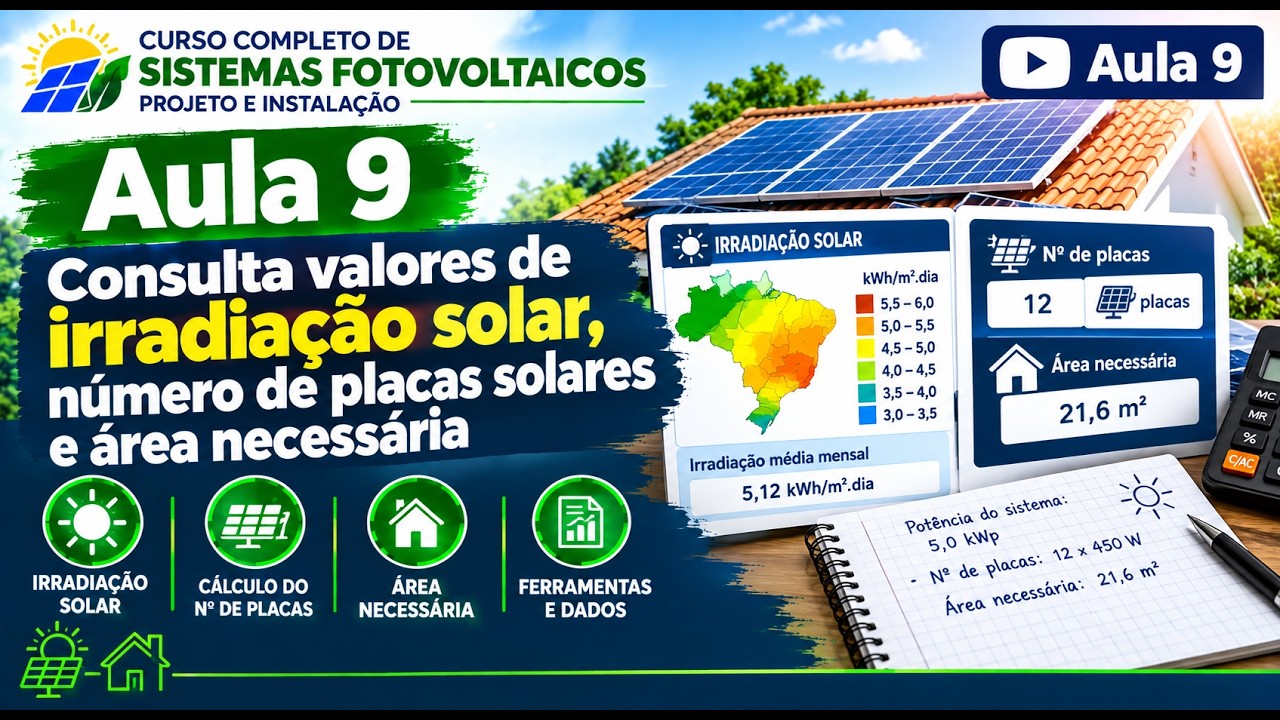
Aula 9_Consulta valores de irradiação solar, número de placas solares e área necessária
Class 9_Check solar irradiation values, number of solar panels and required area
Keywords
Summary
160 words
Critical Evaluation
Value of the Information & Strength of the Argument
The video provides a clear, practical methodology for sizing photovoltaic systems, which is directly applicable to real-world projects. The instructor explains the reasoning behind each step, such as why the angle equal to latitude is optimal and how to use the solar abacus to correct for non-ideal orientations. The argumentation is coherent and based on standard engineering practices, though it relies on the instructor’s expertise rather than citing specific studies or standards. The demonstration of the CRESESB tool is valuable, as it is a free and authoritative source for solar data in Brazil. The inclusion of regional average irradiation values and international comparisons adds context and reinforces the potential of solar energy in Brazil. The video does not delve into potential sources of error or alternative calculation methods, but for its intended purpose, the information is solid and well-presented.
Scientific Rigor, Source Quality, Title Accuracy
The video uses the CRESESB website as its primary source for solar irradiation data, which is a reputable Brazilian institution. The instructor also references the solar abacus and mentions standards like NBR 5410 and NBR 16690 in the course description, but these are not explicitly cited in the video itself. The title accurately reflects the content, as the video indeed covers consulting irradiation values and calculating the number of panels and area. The presentation is methodical and easy to follow, though it lacks formal citations to academic literature or technical standards. The video is a tutorial, so it does not present original research, but it does provide a practical application of established knowledge. The instructor’s explanations are consistent with common practices in the solar industry, and the use of a real example (Belo Horizonte) enhances the credibility of the demonstration.
294 words
Title / Content Match
The title accurately reflects the content: the video covers consulting solar irradiation data and calculating the number of panels and required area.
Quality & Reliability
7/10
The video provides a practical, step-by-step tutorial on using the CRESESB database and performing manual calculations for photovoltaic system sizing. The methodology is sound and aligns with common industry practices, but it lacks formal citations and does not address uncertainties or alternative approaches in depth.
Key Moments
Markers derived by PSI from the transcript: the creator did not define chapters.
- Introduction to the lesson objectives: calculating the number of solar panels and required area.
- Explanation of the importance of solar irradiation data and introduction to the CRESESB website.
- Demonstration of how to obtain latitude and longitude from Google Maps.
- Step-by-step guide on using the CRESESB website to find solar irradiation values for a specific location.
- Interpretation of the irradiation data, including monthly averages and the delta value.
- Explanation of how to adjust for non-optimal roof orientation and tilt using the solar abacus.
- Discussion of common solar panel power ratings and the difference between monofacial and bifacial modules.
- Manual calculation of the number of solar panels needed based on energy consumption and irradiation.
- Calculation of the required installation area and verification of roof space.
- Conclusion and preview of the next lesson using the spreadsheet for automated calculations.
Cited Sources
- CRESESB - Centro de Referência para Energia Solar e Eólica Sérgio de Salvo Brito — Used to obtain solar irradiation data for a specific location based on latitude and longitude.
Concurring Sources
- CRESESB - Centro de Referência para Energia Solar e Eólica Sérgio de Salvo Brito — The video uses this source for solar irradiation data, which is consistent with standard practice in Brazil.
Contribution & Novelties
The video provides a practical, step-by-step methodology for sizing photovoltaic systems, which is valuable for professionals and students. It demonstrates the use of a free, authoritative tool (CRESESB) and explains how to interpret the data. The inclusion of regional average irradiation values and international comparisons adds context. The video also clarifies the distinction between monofacial and bifacial modules, which is useful for decision-making.
Pour aller plus loin :
- CRESESB - Potencial Solar — Official tool for solar irradiation data in Brazil.
- Photovoltaic system sizing - Wikipedia — General overview of PV system sizing principles.
- Solar irradiance - Wikipedia — Background on solar irradiance and its measurement.
106 words
Radar Profile
The radar profile shows high scores in quantity of information and technical level, indicating a detailed and practical tutorial. The quality of information and reliability are also strong, though slightly lower due to the lack of formal citations. Overall, the video is a solid educational resource for solar system sizing.