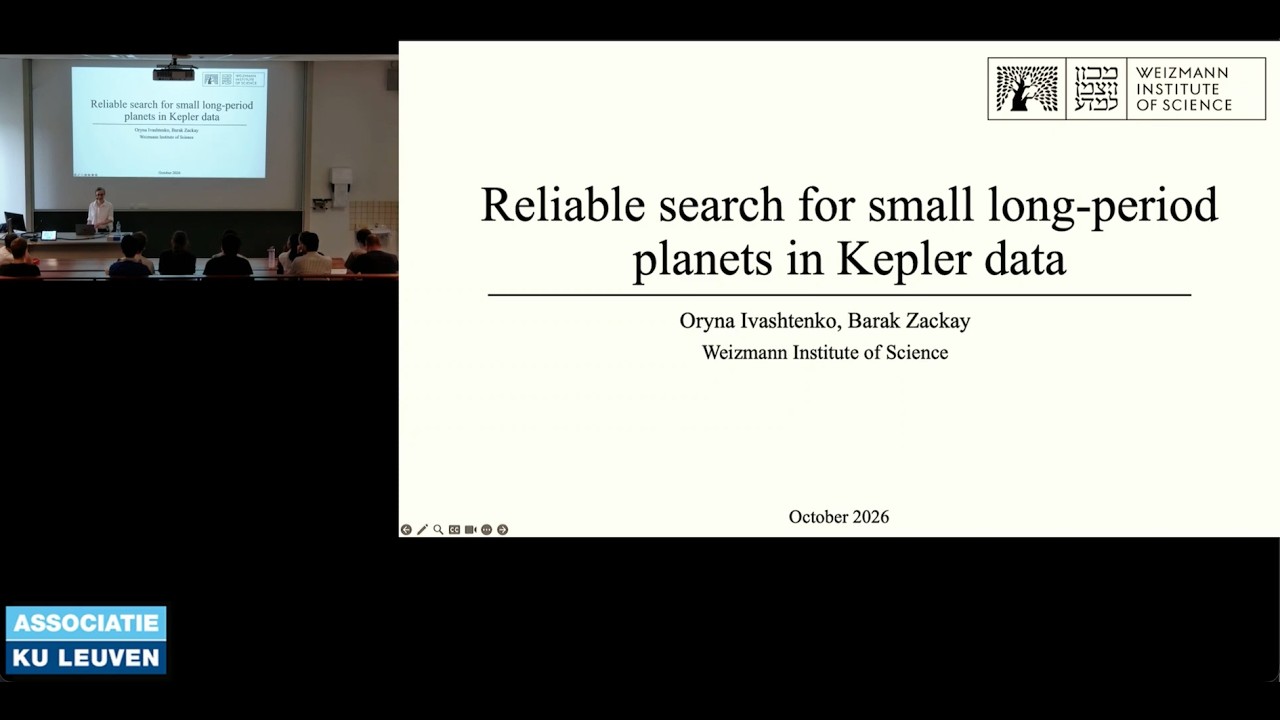
IvS Seminar: Oryna Ivashtenko(01/10/2026)
Keywords
Summary
188 words
Critical Evaluation
Value of the Information & Strength of the Argument
The value of the information is high: the talk provides a comprehensive, technically detailed account of a novel detection pipeline that directly addresses a known deficiency in the Kepler catalog. The argumentation is logically structured: the speaker identifies the problem (contamination from non-Gaussian noise), explains the theoretical foundations (optimal detection theory, matched filtering), and demonstrates the solution with empirical validation against confirmed planets. The use of scrambling and injection-recovery to estimate noise and signal distributions adds methodological rigor. The speaker also honestly addresses the limitations, such as reduced completeness for long periods, and frames the work in terms of a reliability-completeness tradeoff, which strengthens the persuasiveness of the argument.
Scientific Rigor, Source Quality, Title Accuracy
The scientific rigor is evident: the methodology is based on established statistical detection theory and carefully validated with both simulated injections and real Kepler data. The speaker draws on methods from gravitational wave analysis, showcasing cross-disciplinary rigor. However, specific references are not named or cited directly in the video, and no sources are listed in the description; the work is presented as original but without external citations in the talk. The title closely matches the content: it announces a ‘reliable search for small long-period planets in Kepler data,’ which is exactly what the presentation covers. The presentation is aimed at a specialized audience, but the evaluation does not penalize this; the content itself is of high quality.
241 words
Title / Content Match
The title accurately describes the seminar: Oryna Ivashtenko presents her team's reliable search for small, long-period planets in Kepler data, matching the content.
Quality & Reliability
8/10
The talk presents original research with a well-structured methodology, including statistical modeling of noise, non-Gaussianity correction, and injection-recovery tests. The speaker, a PhD candidate, demonstrates deep technical expertise. The work appears solid but is not peer-reviewed in this format; some details are omitted for brevity.
Key Moments
Markers derived by PSI from the transcript: the creator did not define chapters.
- Host welcomes attendees and introduces the speaker, Oryna Ivashtenko.
- Speaker introduces her research group and explains the motivation for a reliable planet search.
- Overview of exoplanet parameter space and the Kepler mission's sensitivity limits.
- Explanation of the contamination problem: real noise distribution has a tail that mimics planetary signals, leading to false alarms.
- Derivation of optimal detection statistic using inverse covariance matrix and template bank for transit shapes.
- Introduction of the non-Gaussianity correction to downweight events likely arising from correlated, non-Gaussian noise.
- Calculation of P_planet via injection-recovery and scrambling to estimate background and signal distributions per star.
- Validation against confirmed Kepler planets, showing high recovery rate but missing a notable habitable-zone planet.
- Discussion of completeness and reliability tradeoff, comparing pipeline performance with Kepler's official catalog.
- Summary of pipeline detection efficiency and outline of next steps for occurrence rate estimation.
Contribution & Novelties
The main novelty of this work lies in the development of a detection pipeline that explicitly models and corrects for non-Gaussian, correlated noise in Kepler data, enabling a reliable search for small long-period planets. Unlike the official Kepler pipeline, which relies on a predicted Gaussian background, this approach empirically estimates per-target noise distributions and uses a non-Gaussianity correction, leading to a cleaner background and a direct probability that each candidate is a real planet (P_planet). This contributes to more reliable occurrence rate measurements in a parameter space that is otherwise poorly constrained.
Pour aller plus loin :
- Kepler space telescope — Provides context on the mission and its data, essential for understanding the dataset used.
- Transit method — Explains the detection technique on which the entire analysis is based.
- Matched filter — The optimal detection statistic concept used in the pipeline; relevant for signal detection in noise.
- Occurrence rate of exoplanets — General overview of exoplanet statistics; occurrence rates are the ultimate goal of this work.
166 words
Radar Profile
The radar profile shows uniformly high scores, with the lowest being 'qualite_information' and 'fiabilite_globale' at 8, while 'quantite_information' and 'niveau_technique' reach 9. This indicates a highly dense and technically sophisticated presentation with abundant content, though slightly lower scores on information quality and reliability due to the lack of explicit citations in the talk.