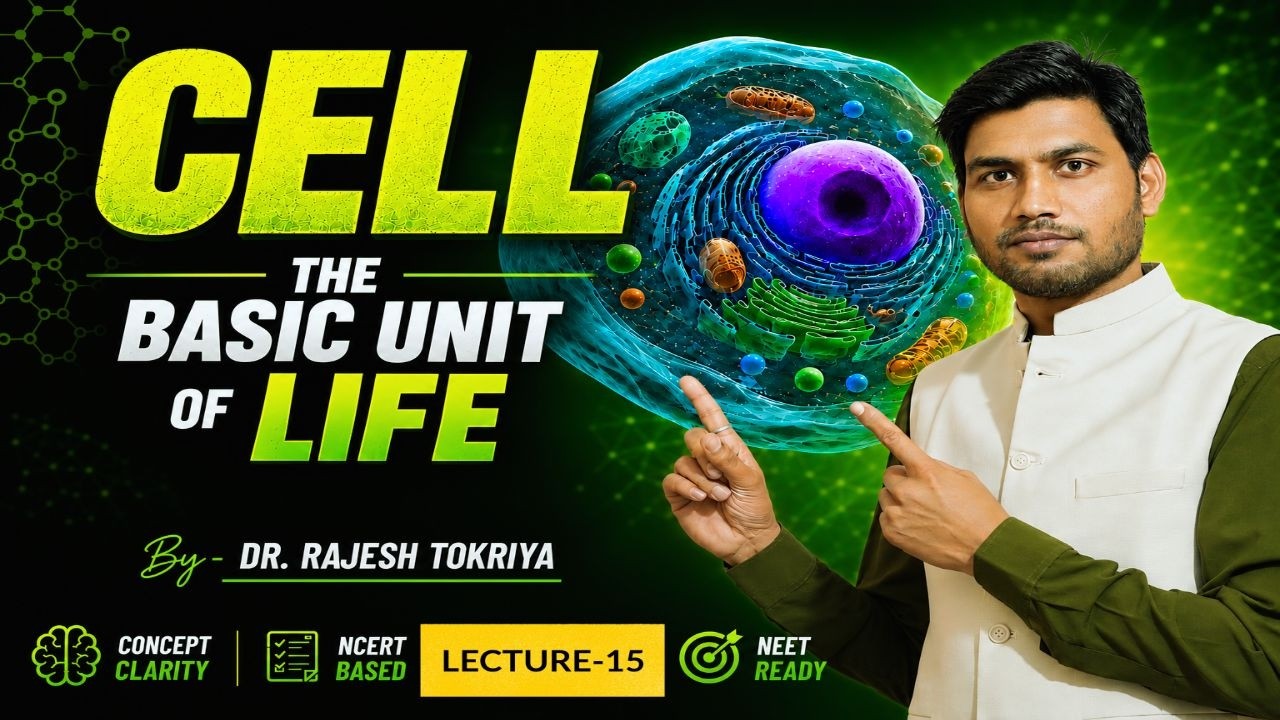
L-15 (Part-1) Membrane Permeability, Passive Transport & Its Types
Keywords
Summary
155 words
Critical Evaluation
Value of the Information & Strength of the Argument
The video provides a clear and structured introduction to membrane permeability and passive transport. It uses relatable analogies (open window, plastic sheet, mosquito net) that effectively illustrate the concepts for learners. The argumentation is logical, moving from basic definitions to types of membranes and then to transport mechanisms. The instructor emphasizes key points for competitive exams, such as the fact that the plasma membrane is selectively permeable, and corrects common misconceptions (e.g., semipermeable vs. selectively permeable). The use of visual aids and step-by-step explanations enhances understanding. However, the presentation could benefit from more quantitative data or molecular-scale illustrations to deepen scientific rigor, but for the target audience (NEET aspirants), the level is appropriate.
Scientific Rigor, Source Quality, Title Accuracy
The content is based on NCERT Biology, a recognized standard for Indian school and competitive exams. The instructor does not cite specific research articles, but the explanations are consistent with established cell biology knowledge. The title precisely matches the covered topics, and no misleading claims were found. The video structure follows a logical progression, and the analogies used are accurate in conveying the fundamental principles. The lack of direct source citations beyond NCERT is offset by the well-established nature of the subject matter. Overall, the scientific rigor is satisfactory for an introductory lecture, and the title accurately represents the content.
228 words
Title / Content Match
Title accurately reflects the content: membrane permeability, passive transport, and its types are the core topics discussed.
Quality & Reliability
8/10
The content is based on NCERT concepts, clearly explained with analogies and examples. No contradictions with standard biology textbook material, and the presentation is pedagogically sound for NEET preparation.
Key Moments
Markers derived by PSI from the transcript: the creator did not define chapters.
- Introduction and overview; recap of cell membrane structure and fluid mosaic model.
- Explanation of permeability and the roles of solute and solvent; analogy of gatekeeper.
- Introduction to types of membranes: permeable and impermeable with examples (open window, plastic sheet).
- Semipermeable and selectively permeable membranes explained; distinction between them.
- Detailed discussion on why gases and steroids pass easily, but ions and large polar molecules do not.
- Introduction to passive transport, definition, and characteristics; start of simple diffusion explanation.
- Facilitated diffusion and osmosis covered, including the role of channel and carrier proteins.
Cited Sources
- NCERT Biology — Mentioned in the video description as the basis for concepts taught.
Concurring Sources
- NCERT Biology — Standard textbook used in Indian schools; the video directly follows its syllabus.
Contribution & Novelties
The video offers a structured, exam-oriented explanation of membrane permeability and passive transport, emphasizing NCERT-aligned content. Its contribution lies in simplifying complex concepts through analogies and explicitly distinguishing semipermeable from selectively permeable membranes, which is often a source of confusion. For further study, the following resources provide additional depth:
- Cell membrane - Wikipedia — Comprehensive overview of membrane structure and function.
- Semipermeable membrane - Wikipedia — Explanation of semipermeability with examples.
- Facilitated diffusion - Wikipedia — Detailed description of channel and carrier-mediated transport.
83 words
Radar Profile
The radar profile shows a balanced lecture with high information quantity and quality, moderate technical depth suitable for undergraduate exam preparation. Reliability is strong due to adherence to standard curriculum.