Introduction to University Mathematics (2026), Lecture 2. First Year Student Lecture
Keywords
Summary
135 words
Critical Evaluation
Value of the Information & Strength of the Argument
The lecture provides a solid foundational understanding of relations and equivalence relations. The argumentation is rigorous, with definitions stated formally and proofs worked out step by step, such as verifying the properties for congruence modulo n. The use of multiple examples, including the chess players relation to show a relation lacking all nice properties, helps solidify the concepts. The distinction between symmetric and antisymmetric is clarified, and the notion of vacuous truth is explained in context. The value lies in the clarity of exposition and the careful construction of mathematical ideas from basics to more advanced topics.
Scientific Rigor, Source Quality, Title Accuracy
The content is based on standard mathematical curriculum and aligns with typical introductory university mathematics. Sources mentioned include the course materials and playlists on the Oxford Mathematics YouTube channel, which are reliable institutional resources. The title accurately reflects the content as a first-year lecture on fundamental set theory concepts. The lecture is well-structured, with definitions, examples, and proofs presented in a logical sequence. No external references are cited beyond the course materials, but the mathematical content is self-contained and rigorous.
192 words
Title / Content Match
The title accurately describes the content: a first-year introductory university mathematics lecture covering relations and equivalence relations.
Quality & Reliability
9/10
Lecture from Oxford Mathematics, a prestigious institution, presented by a lecturer who provides precise definitions, proofs, and examples. The content is mathematically rigorous and pedagogically sound.
Key Moments
Markers derived by PSI from the transcript: the creator did not define chapters.
- Introduction to section 2.0: definition of a relation and examples.
- Discussion of trivial relations and the chess players example.
- Section 2.1: properties of relations (reflexive, symmetric, antisymmetric, transitive) with examples.
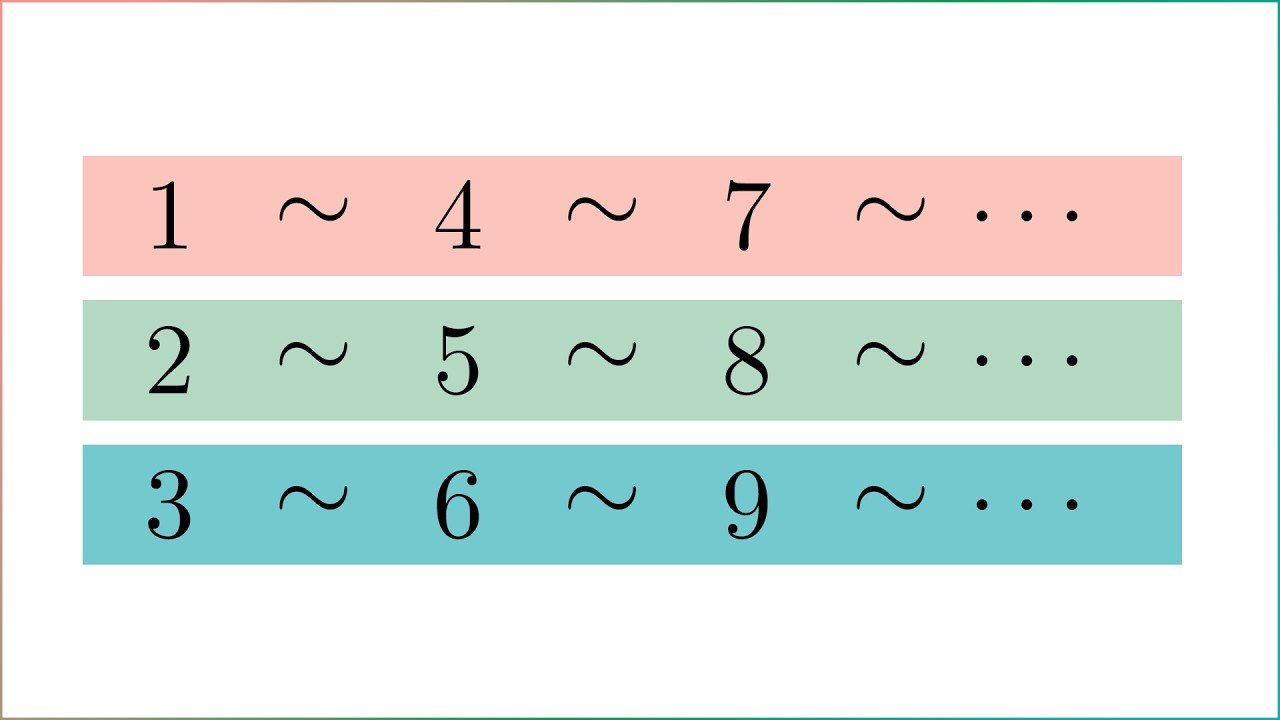
- Section 2.2: equivalence relations, equivalence classes, and quotient sets, including proof for congruence modulo n.
- Summary and conclusion, emphasizing the importance of equivalence relations in mathematics.
Cited Sources
- Course materials: Introduction to Mathematics — Linked from the video description as course materials
- Playlist of lectures in this course — Linked from the video description for other lectures
- Main student lectures playlist — Linked from the video description for other student lectures
Concurring Sources
- Oxford Mathematics Student Lectures — The lecture is part of a series; other lectures likely cover complementary foundational topics.
Contribution & Novelties
This lecture provides a clear and rigorous introduction to relations and equivalence relations, a fundamental topic in mathematics. It presents the formal definition of a relation as a subset of the Cartesian product and systematically works through properties, illustrating with examples and proofs. The lecture’s novelty lies in its pedagogical clarity, especially the discussion of antisymmetry and vacuous truth, which are common points of confusion. It sets the stage for more advanced topics in algebra and set theory.
Pour aller plus loin :
- Equivalence relation — Wikipedia article giving a broader overview and further examples.
- Partition of a set — Closely related concept; equivalence classes partition the set.
- Modular arithmetic — The congruence modulo n example is a cornerstone of modular arithmetic.
122 words
Radar Profile
The radar profile shows high scores in quality and reliability, with slightly lower technicality due to the introductory nature. The lecture is well-balanced, providing thorough explanations without excessive complexity.