MESSIDORE | Sarcomes : une innovation pour améliorer la prise en charge des patients
MESSIDORE | Sarcomas: an innovation to improve patient care
Keywords
Summary
157 words
Critical Evaluation
Value of the Information & Strength of the Argument
The value of this presentation lies in its detailed exposition of a novel medical technology that addresses a genuine clinical need. The argumentation is solid: the speaker systematically presents the clinical problem, the technological solution, the experimental design, and the results, including internal and external validation. The use of independent cohorts and blind testing strengthens the credibility of the claims. The technology shows substantial promise in improving surgical outcomes, and the multidisciplinary approach is well-justified.
Scientific Rigor, Source Quality, Title Accuracy
The scientific rigor is high: the project is funded by a national program (MESSIDORE), involves recognized centers (Oscar Lambret, Bergonié, Pierre Fabre), and has led to peer-reviewed publications in journals such as Cancer Cell and Bioinformatics. The speaker directly addresses methodological challenges, such as handling FFPE tissues and batch effects, which indicates careful experimental planning. The title accurately mirrors the content, as the presentation focuses on innovation in sarcoma care. However, the talk provides limited external references beyond the project’s own outputs; the only provided link points to the MESSIDORE program page, which serves as a general reference.
188 words
Title / Content Match
The title accurately reflects the content: the presentation focuses on the MESSIDORE project, a collaborative research effort to improve sarcoma treatment through an innovative medical device.
Quality & Reliability
8/10
The presentation describes an original research project with clear methodology, validation on independent cohorts, and results reported with high accuracy. The speaker is an expert, and the work has been published in peer-reviewed journals. However, only one external link is provided, limiting verifiability.
Key Moments
Markers derived by PSI from the transcript: the creator did not define chapters.
- Introduction of the clinical need for real-time molecular information during cancer surgery.
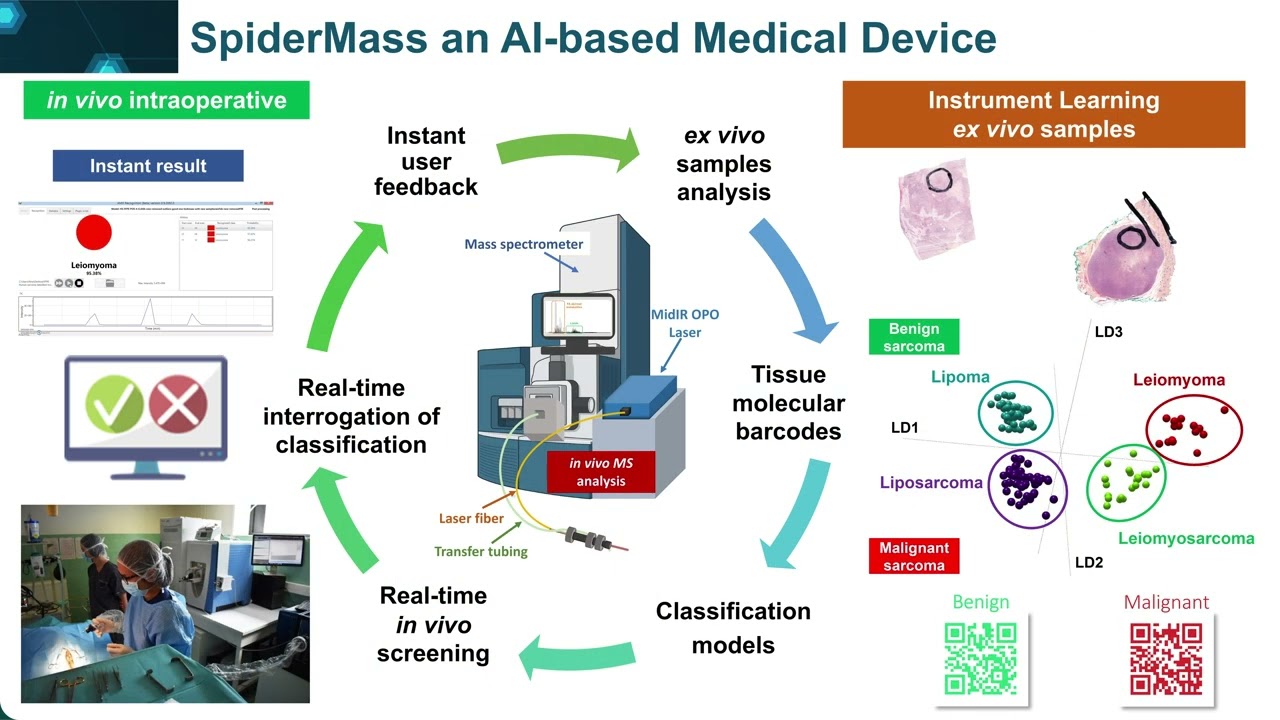
- Description of the SpiderMass technology: laser ablation coupled to mass spectrometry for intraoperative tissue analysis.
- Presentation of AI-based classification models and proof-of-concept studies in veterinary and human skin contexts.
- Overview of the MESSIDORE project on sarcomas: collaboration, objectives, and cohort acquisition.
- Results of classification models on sarcoma tissues: 100% accuracy for tumor vs non-tumor and malignant vs benign distinctions.
- Analysis of immune cell infiltration and development of immunoscore from spectral data, providing added prognostic value.
- Description of the ongoing extempore clinical validation phase and launch of the spin-off company Cosmo.
Cited Sources
- MESSIDORE – 4 years of research and innovation (IReSP page) — Official event page for the MESSIDORE project, providing context and program details.
Contribution & Novelties
The presentation introduces a significant technological breakthrough: the integration of mass spectrometry into the operating room via the SpiderMass device, enabling real-time molecular analysis of tissues without compromising surgical workflow. This approach has the potential to overcome limitations of conventional extemporaneous pathology, which is often delayed and limited to morphological examination. The validation of the technology on a large cohort of sarcomas, including FFPE samples, demonstrates its robustness and feasibility. The project also contributes to the growing field of artificial intelligence in pathology, using machine learning classifiers to interpret complex spectral data.
Pour aller plus loin :
- Mass spectrometry — Essential technique for molecular analysis; here used for tissue characterization.
- Sarcoma — The cancer type targeted by this project; understanding its heterogeneity is crucial.
- Machine learning in medicine — Application of AI algorithms to clinical data, as demonstrated by the classification models in this study.
145 words
Radar Profile
The radar profile shows high scores across all dimensions, reflecting a well-structured and technically rich presentation. The balance between information quantity and quality is strong, with a slightly lower score for quantitative volume due to the focused scope, but overall the talk exhibits excellent scientific and technical depth.