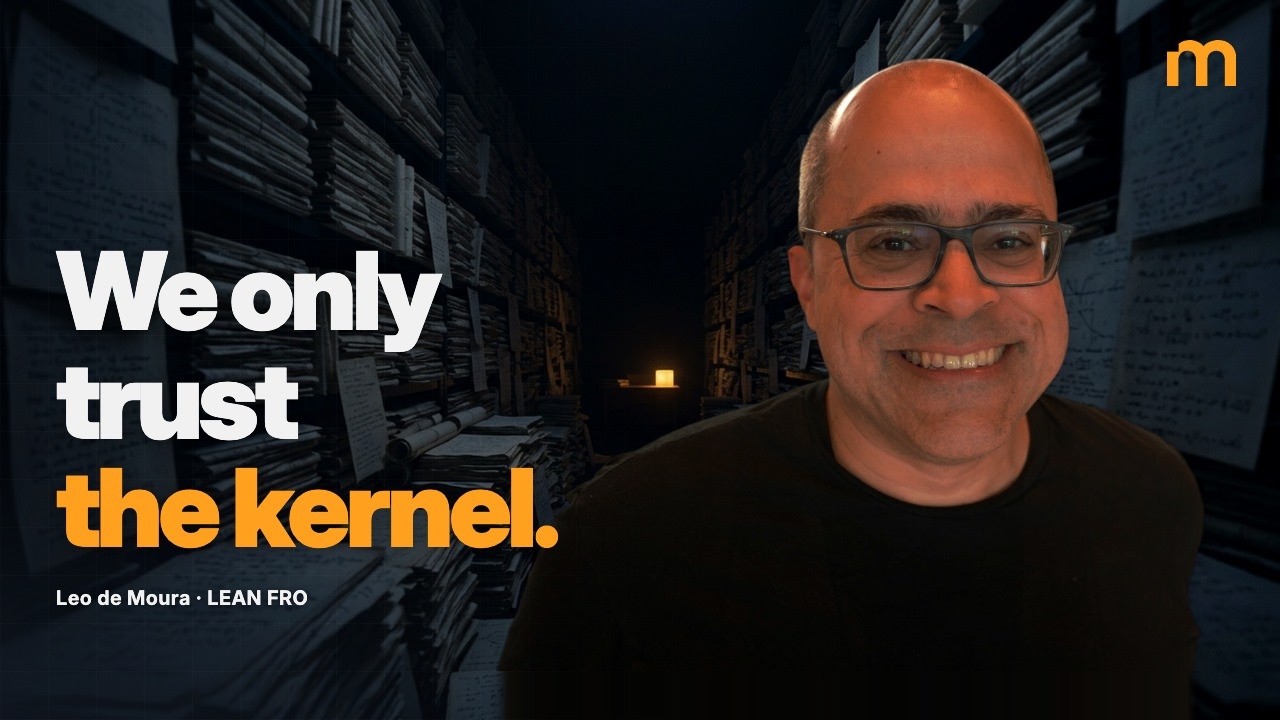
The Programming Language That Referees Mathematics — Leo de Moura
Keywords
Summary
256 words
Critical Evaluation
Value of the Information & Strength of the Argument
The video offers exceptional value by granting access to the creator’s perspective on current events and future directions in formal verification and AI. De Moura’s arguments are well-structured and supported by concrete examples, such as the Collatz exploit and the zlib proof, which illustrate both the power and the pitfalls of AI-assisted formalization. He defends the cathedral model with clear reasoning about software engineering and community dynamics, and his anti-obfuscation stance on kernel security is compelling. The dialogue with Scarfe adds depth, with questions that push for nuance and logical consistency. The argumentation is solid, though sometimes de Moura’s opinions (e.g., on transparency) are presented as principled stands rather than empirical conclusions, but they are coherent and well-articulated.
Scientific Rigor, Source Quality, Title Accuracy
The scientific rigor is high: de Moura references specific repositories, issues, PRs, and documented incidents. He distinguishes between verified and non-verified components, and discusses the limits of current verification approaches. The sources cited in the description are comprehensive and directly relevant, including Lean, Mathlib, nanoda, Lean4Lean, and related projects. The title ‘The Programming Language That Referees Mathematics’ is apt and not overstated; the episode indeed explores Lean’s role in mathematics and the challenges of certification. There are no comments provided, so no public sentiment analysis is possible. Overall, the episode is rigorous and trustworthy, coming from the primary authority on the subject.
235 words
Title / Content Match
The title accurately captures the central theme: Lean as a language that 'referees' mathematics, with a focus on its kernel, correctness, and role in formal verification.
Quality & Reliability
9/10
Interview with the creator of Lean, providing unique first-hand insights into the design, security, and governance of the proof assistant. The discussion is technically deep and grounded in specific incidents (e.g., Collatz exploit, zlib proof) and references to official repositories and publications.
Chapters
- Cold open: the green checkmark can lie
- Cathedral or bazaar: who controls Lean's core?
- Why Lean's core stays small and protected
- The Slack purge, Brandolini's law and the Lean FRO
- The Collatz exploit: two kernels, two bugs
- More kernels, reward hacking and safety by transparency
- Sponsor: Parallel
- Kim Morrison, Claude and the zlib proof
- Can we specify complex systems?
- Specs change: proofs are cheaper to redo with AI
- From Lean 1 to Lean 4
- Dependent types in plain terms
- Lean 4's extensibility and Mathlib's growth
- Mathlib as infrastructure: Formal Frontiers
- Creativity, abstraction and nut-sniping
- Breadcrumbs, not learning: what AI agents lack
- Competence without comprehension, and verified guardrails
- Is the human still the author?
- AlphaProof, LLMs and why certificates still matter
- What's next for Lean, and its legacy
- How to start learning Lean
Cited Sources
- Lean — Official Lean home page, referenced at 00:00:48 as the proof assistant developed by de Moura.
- Mathlib — Community-maintained mathematical library for Lean, discussed at 00:01:24 as the main repository of formalized mathematics.
- nanoda_lib — Independent kernel written in Rust, referenced at 00:12:09 in the context of the Collatz exploit.
- CollatzLean — Repository containing the purported Collatz disproof, discussed at 00:12:19.
- Lean issue 14576 — Issue reporting the bug in the official kernel exploited by the Collatz proof, referenced at 00:13:06.
- Lean pull request 14577 — PR fixing the kernel bug, referenced at 00:13:21.
- nanoda_lib pull request 22 — PR fixing a bug in nanoda, referenced at 00:13:45.
- Lean comparator — Tool for cross-checking proofs with independent kernels, discussed at 00:15:33.
- Lean4Lean — Kernel written in Lean, intended to be proven correct, referenced at 00:18:02.
- lean-zip — Kim Morrison's Lean implementation of zlib, discussed at 00:21:59.
- CompCert — Verified C compiler, mentioned as an example of formal verification in safety-critical systems at 00:29:45.
- seL4 — Verified microkernel, mentioned as an example of formal verification at 00:29:45.
- Z3 — SMT solver co-created by de Moura, referenced at 00:30:23.
- Veil — Verification tool built on Lean, referenced at 00:38:10 as an example of Lean extensibility.
- Velvet — Another verification tool, referenced at 00:38:10.
- Brandolini's law — Referred to at 00:10:05 to explain the difficulty of debunking false claims.
Concurring Sources
- Lean official site — Confirms the existence and features of Lean as discussed.
- Mathlib repository — Confirms the scale and community nature of Mathlib.
External References
Contribution & Novelties
The video provides a rare insider perspective on Lean’s development, its security incidents, and the intersection of formal verification with AI. The novelty lies in the detailed account of the Collatz exploit, the challenges of kernel trust, and the demonstration of AI’s ability to generate verified code (e.g., zlib). It also clarifies philosophical positions on transparency and governance. These insights are valuable for researchers and practitioners.
Pour aller plus loin :
- Formal verification — Overview of the field where Lean operates, providing context for the video’s claims.
- Lean (proof assistant) — Detailed history and features of Lean, complementary to the conversation.
- De Bruijn criterion — Concept related to the ‘small trusted kernel’ design discussed in the episode.
- Collatz conjecture — The mathematical problem central to the exploit incident; essential background.
- Proof assistant — General context for interactive theorem proving.
139 words
Radar Profile
The profile shows a high level of technical depth (9) and information quality (9), with a slightly lower but still strong quantity (8) and reliability (8). This reflects a dense, expert-level discussion that is trustworthy but assumes prior knowledge.