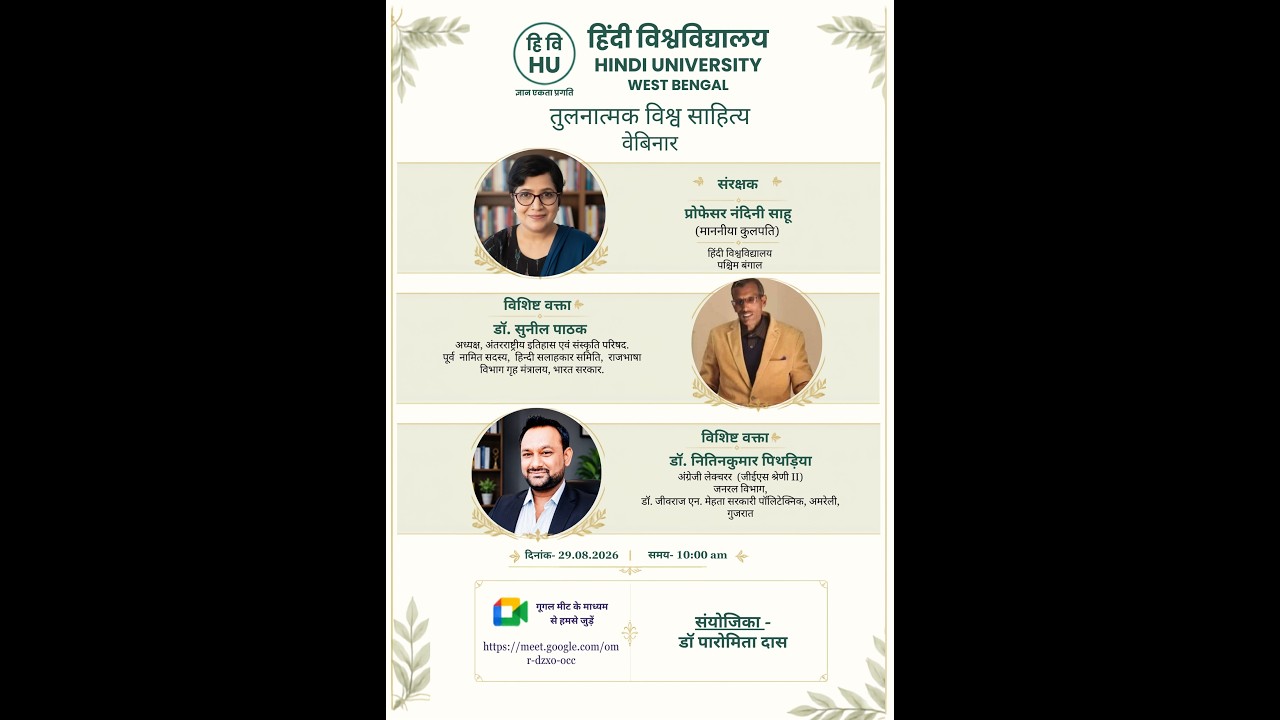
LECTURE: 54- COMPARATIVE WORLD LITERATURES SERIES.
Keywords
Summary
169 words
Critical Evaluation
Value of the Information & Strength of the Argument
The lectures provide a valuable overview of the historical development of comparative literature, from its European origins to its global and Indian contexts. Dr. Pithadiya’s argument that AI redefines comparison from textual proximity to algorithmic connectivity is thought-provoking and opens new avenues for research. However, the argumentation is largely descriptive and lacks critical engagement with specific AI applications or case studies. The discussion of Indian literary theory, such as the concept of ‘vishwa sahitya’ and the network model of literary relations, adds depth and challenges Eurocentric frameworks. The second lecture on Ram Katha offers an interdisciplinary perspective, but its argumentation is more general and less theoretically rigorous. Overall, the value lies in the synthesis of ideas rather than in novel empirical findings.
Scientific Rigor, Source Quality, Title Accuracy
The lectures demonstrate a reasonable level of scientific rigor, with references to key figures and works in comparative literature, such as Goethe, René Wellek, and Henry H.H. Remak. However, specific citations are sparse, and the lectures rely heavily on general knowledge rather than on detailed source attribution. The title accurately reflects the content, which is a lecture in a series on comparative world literatures. The inclusion of two distinct lectures within the same video is coherent with the series’ theme. The webinar format and the presence of a Q&A session suggest an academic context, but the lack of detailed references limits the overall reliability.
241 words
Title / Content Match
The title accurately reflects the content, which is a lecture in a series on comparative world literatures.
Quality & Reliability
6/10
The lecture provides a broad historical overview of comparative literature and its intersection with AI, but lacks detailed citations and empirical evidence. The arguments are conceptually sound but rely on general knowledge rather than specific sources.
Key Moments
Markers derived by PSI from the transcript: the creator did not define chapters.
- Introduction by Professor Nandini Sahu, Vice-Chancellor of Hindi University, West Bengal.
- Dr. Nitinkumar Pithadiya begins his lecture on 'From World Literature to AI'.
- Discussion on the evolution from national literature to world literature, referencing Goethe's concept of 'Weltliteratur'.
- Overview of the institutionalization of comparative literature in Europe and America.
- Introduction of Indian comparative literary thought, including Tagore's 'vishwa sahitya' and the multilingual literary traditions.
- Discussion on the impact of generative AI on comparative literature, redefining comparison as algorithmic connectivity.
- Dr. Sunil Pathak begins his lecture on 'Ram Katha', situating the Ramayana within text, archaeology, history, and memory.
- Exploration of the Ramayana as a dynamic and plural tradition across regions and languages.
- Concluding remarks and vote of thanks.
Cited Sources
- Conversations with Eckermann — Mentioned by Dr. Pithadiya in reference to Goethe's statement on world literature.
- Acta Comparationis Litterarum Universarum — Mentioned as the first international journal of comparative literature, founded in 1877.
- The Crisis of Comparative Literature — Referenced in the discussion of René Wellek's critique of comparative literature.
- Comparative Literature: Its Definition and Function — Referenced in the discussion of Henry H.H. Remak's broadening of the field.
Concurring Sources
- World literature - Wikipedia — Supports the historical overview of world literature as presented in the lecture.
- Comparative literature - Wikipedia — Aligns with the lecture's description of the discipline's development and methods.
Contribution & Novelties
The lecture offers a contemporary perspective on comparative literature by integrating generative AI as a new epistemological condition for literary comparison. It challenges traditional Eurocentric frameworks and highlights the contributions of Indian literary theory and multilingual traditions. The discussion of algorithmic connectivity as a new mode of comparison is a novel contribution to the field.
Pour aller plus loin :
- World literature - Wikipedia — Provides an overview of the concept and its historical development.
- Comparative literature - Wikipedia — Offers a comprehensive introduction to the discipline.
- Digital humanities - Wikipedia — Relevant to the intersection of technology and literary studies.
- Ramayana - Wikipedia — Provides background on the epic and its various versions.
114 words
Radar Profile
The radar profile shows moderate scores across all dimensions, indicating a balanced but not exceptional lecture. The highest score is in quantity of information, reflecting the broad historical coverage, while the lowest is in technical level, as the discussion remains largely conceptual without deep technical detail.