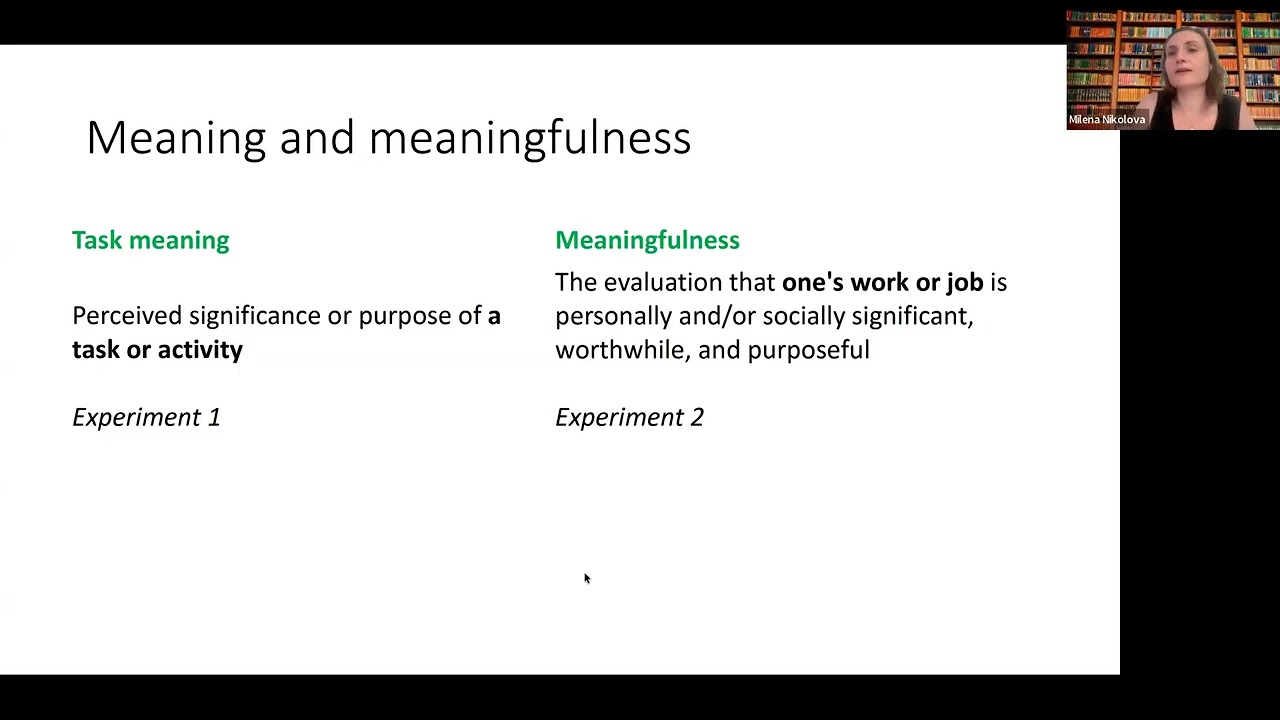
Milena Nikolova (University of Groningen and GLO) || Meaningful Work and AI
Keywords
Summary
286 words
Critical Evaluation
Value of the Information & Strength of the Argument
The informational value of this seminar lies in its careful framing of a question that is often treated anecdotally: what happens to the meaning and effort of work when AI enters the production process. Nikolova does not claim that AI destroys jobs or meaning; she positions her contribution precisely in the gap left by employment and productivity studies, namely job quality and the day-to-day experience of ordinary workers. The distinction between task meaning and work meaningfulness is analytically useful and clearly operationalised, and the choice of two novel roles for AI, creator and safety supervisor, is a genuine conceptual advance over the older mechanisation-and-automation framing. The argumentation is notably disciplined. The speaker reports null and small results honestly, explains that the individual samples are underpowered, and justifies pooling on the grounds of identical survey protocols and experimental procedures. She also acknowledges that the formal test of differences between samples is hard to interpret when both are imprecise, and that composition differences between the US and Dutch samples exist even if controls do not change the conclusions. The effort result is the strongest and most persuasive element: a 3.4 percentage point decline in the probability of writing one’s own slogan, evaluated against a sample mean of about 25%, is a substantively meaningful effect. The main weakness of the argument is the artificiality of the manipulation. Participants never perform the upstream creative task themselves; they only assess slogans whose alleged author varies, and the slogans are in fact identical and human-written. Several audience interventions press exactly on this point, asking about complementarity between human and AI inputs, about the difference between delegating a task to AI and receiving AI output, and about whether the experiment captures real workplace dynamics such as managerial appreciation. The speaker concedes these limits openly and frames them as next steps rather than dismissing them. The result is an argument that is credible within its narrow scope but explicitly not generalisable to the full work process, and the seminar is stronger for saying so.
Scientific Rigor, Source Quality, Title Accuracy
The methodological rigour is high for a seminar presentation. Both experiments are pre-registered, run on nationally representative samples through Understanding America Study and the LISS panel, with identical survey structures designed by the same person, and analysed with straightforward OLS regressions that include and exclude controls without materially changing results. The speaker reports balance tables, acknowledges imbalance in the Dutch sample, and is transparent about underpowering and about the fragility of the pooled specification. The literature review is compact but well targeted, citing adoption surveys, experimental productivity studies, population-level work on life and job satisfaction, and a small-scale experiment suggesting AI reduces work meaningfulness. The main limitation on source quality is that this is a working-paper presentation rather than a peer-reviewed publication, so the evidence has not yet passed formal review, and the second experiment is only announced rather than fully presented. On title-content adequacy, the title is a plain seminar label naming the speaker and the topic, and the content matches it directly: the talk is about meaningful work and AI, with no gap between promise and delivery. No comments were provided for analysis, so no audience-trend assessment is offered.
542 words
Title / Content Match
The title accurately announces a seminar on meaningful work and AI, and the content delivers exactly that through two survey experiments on task meaning, work meaningfulness, effort, trust and job satisfaction. The fit is direct and honest, with no overpromising.
Quality & Reliability
8/10
The presentation reports two pre-registered, nationally representative survey experiments with roughly 3,600 participants, uses standard OLS specifications with and without controls, and transparently discusses underpowering, sample imbalance, and the limits of external validity. The speaker explicitly flags that effects on task meaning are small and not statistically significant in individual samples, and that pooling is debatable. This is a high standard of methodological candour, though the work is still a seminar presentation of unpublished/working papers rather than a peer-reviewed publication.
Key Moments
Markers derived by PSI from the transcript: the creator did not define chapters.
- Opening tribute to Ira Gang and moment of remembrance by the GLO community.
- Overview of AI adoption: 43% of US workers and over a third of Dutch workers have used generative AI, but intensive use is only around 2% of working hours.
- Review of the literature: large experimental productivity gains, small aggregate effects, and no evidence of massive job loss.
- Statement of the research gap: little rigorous evidence on how AI affects job quality and work meaning.
- Conceptual distinction between task meaning and broader work meaningfulness, and why meaning matters economically (reservation wages, effort, willingness to give up up to 9% of wages).
- Design of the first experiment: identical public-health slogans labelled as written by a marketing professional or by AI software.
- Audience challenge on substitutability versus complementarity of human and AI inputs in the production process.
- Presentation of country-by-country results: negative but non-significant effects on task meaning, and a decline in effort in the Dutch sample.
- Pooled results: task meaning declines by about 7% of a standard deviation, effort by 3.4 percentage points, roughly 13% at the sample mean.
- Discussion of underpowering, sample composition differences, and the limits of the experimental manipulation.
Contribution & Novelties
The originality of this work lies in shifting the AI-and-labour debate from employment and productivity to job quality, and in operationalising two genuinely new roles for AI in the production process: AI as creator of content and AI as safety supervisor. Rather than asking whether AI replaces workers, the experiments ask how the perceived origin of work output changes the meaning workers attach to a task and the effort they are willing to invest. The finding that meaning effects are small while effort effects are comparatively large is a useful and non-obvious result, and the two-country design with identical protocols offers a rare opportunity to test whether such effects travel across institutional contexts. The candid reporting of underpowering and of the artificiality of the manipulation is itself a contribution to how this literature should be read.
Pour aller plus loin :
- Meaningful work — Overview of the concept and its measurement, directly relevant to the task meaning versus work meaningfulness distinction.
- Generative artificial intelligence — Background on the technology whose adoption and labour-market effects frame the talk.
- Survey methodology — Useful for understanding pre-registered survey experiments, sampling and power considerations.
- Understanding America Study — The US panel used in the first experiment.
- LISS panel — The Dutch panel used in the first experiment.
- Pre-registration — Explains the pre-registration practice the authors rely on to discipline their analysis.
227 words
Radar Profile
The profile is that of a solid empirical seminar: high on information quantity and quality, with technical level reflecting competent but not exotic econometrics, and reliability supported by pre-registration and transparent reporting. The weakest dimension is the strength of the causal claims, constrained by underpowered samples and an artificial manipulation, which the speaker acknowledges rather than hides.