The extent of Gas, Dark Matter and stellar light in halos by Sushmita Adhikari
Keywords
Summary
210 words
Critical Evaluation
Value of the Information & Strength of the Argument
The value of this work lies in its systematic analysis of halo boundaries using large cosmological simulations, providing a statistically robust picture of the gas-dark matter offset. The argumentation is well-structured: it starts with theoretical expectations from self-similar solutions, then confronts those with hydrodynamical simulations, and finally discusses observational implications. The speaker carefully explains methodological choices (e.g., using entropy maxima to trace shocks, radial velocity dispersion for splashback) and acknowledges limitations. The reasoning is solid, grounded in established physics of collisionless vs collisional fluids, and the conclusions are presented as a step toward understanding the physical mechanisms setting these boundaries. The work is clearly a step forward in connecting theory to upcoming survey data.
Scientific Rigor, Source Quality, Title Accuracy
The talk is scientifically rigorous, drawing on well-known cosmological simulations (Illustris TNG, Omega500) and classic theoretical works (e.g., self-similar collapse solutions). The methods are standard in the field, and the speaker is transparent about uncertainties and the need for better tracers. The title accurately reflects the content, which explicitly focuses on the extent of gas, dark matter, and stellar light in halos, with an emphasis on boundaries. The presentation includes no obvious sensationalism, and references to observational surveys (DESI, Euclid, eROSITA, etc.) are relevant and appropriately contextualized. The link in the description points to the program page, which is appropriate for a conference talk, but no direct external sources are given in the description; the talk itself mentions key papers and simulations orally.
252 words
Title / Content Match
Le titre reflète exactement le contenu, centré sur les extensions relatives du gaz, de la matière noire et de la lumière stellaire dans les halos, avec un accent sur les frontières.
Quality & Reliability
8/10
The talk presents original research based on state-of-the-art cosmological hydrodynamical simulations (Illustris TNG, Omega500) and compares with established theoretical models. The methodology is clearly described, and the results are placed in the context of ongoing observational surveys. Some claims about offsets rely on average quantities and simulation assumptions, but the reasoning is rigorous and well-referenced.
Key Moments
Markers derived by PSI from the transcript: the creator did not define chapters.
- Introduction to dark matter halo boundaries and historical overdensity definition
- Definition of splashback radius as the edge of the orbiting region, identifiable via density slope change
- Comparison between dark matter and gas boundaries in idealized self-similar collapse models
- Presentation of simulation results (Illustris TNG, Omega500) showing offset along void directions
- Methodology for directional shock detection using entropy maximum and velocity dispersion
- Statistical analysis of boundary offset as a function of mass and accretion rate
- Discussion of merger-driven differential response between gas and dark matter
- Observational prospects for detecting gas boundary with thermal SZ profiles
Cited Sources
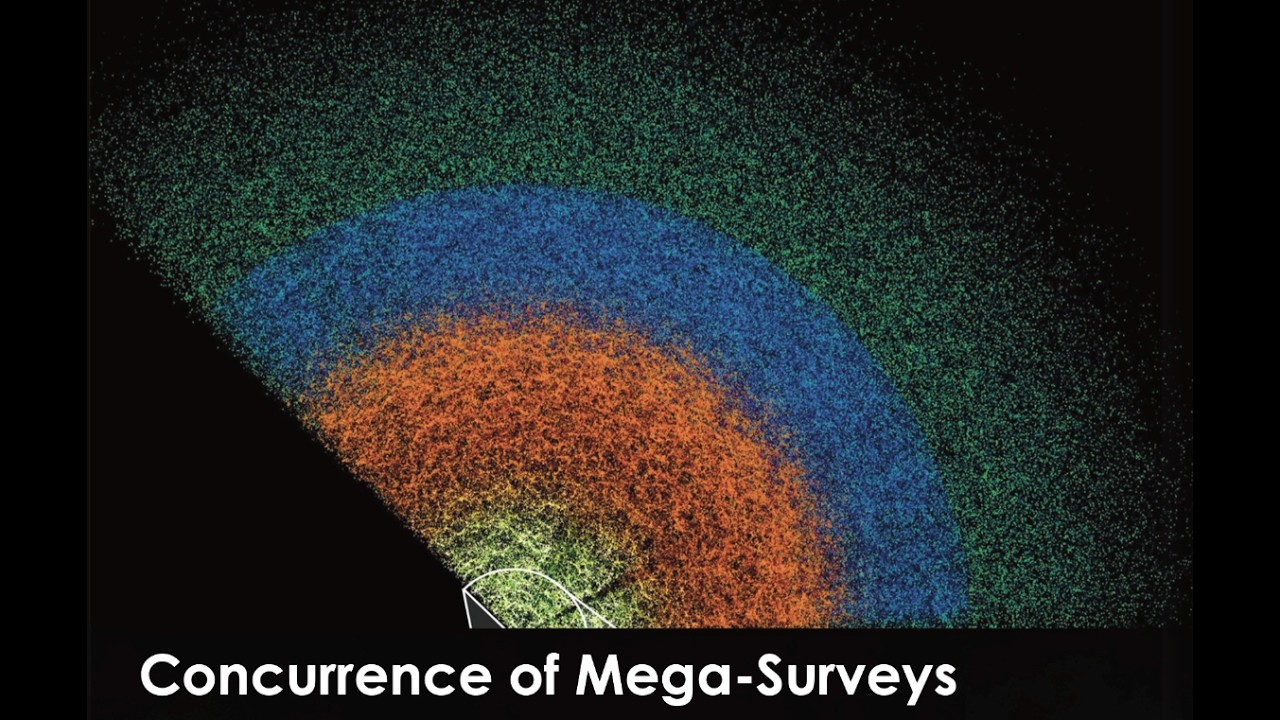
- The Concurrence of Mega-Surveys (Workshop program) — Program page for the workshop where this talk was given, providing context and links to the broader event.
Contribution & Novelties
The talk provides new quantitative evidence that the gas boundary (accretion shock) extends significantly beyond the dark matter splashback radius, especially along void directions. It highlights a novel methodology for directionally measuring these boundaries in simulations, and links the offset to merger-driven dynamics. This advances our understanding of the physical processes shaping the outer regions of galaxy clusters and has implications for interpreting upcoming survey data.
Pour aller plus loin :
- Dark matter halo — Overview of the standard structure of dark matter halos.
- Accretion (astrophysics) — Context on accretion shocks and gas infall in astrophysical systems.
- IllustrisTNG project — Official site of the IllustrisTNG simulations used in the talk.
110 words
Radar Profile
The radar profile is strongly skewed toward high technical level and information quality, with slightly lower scores in quantity of information due to the condensed nature of a conference talk. The overall reliability is high, reflecting the use of established simulations and methods.