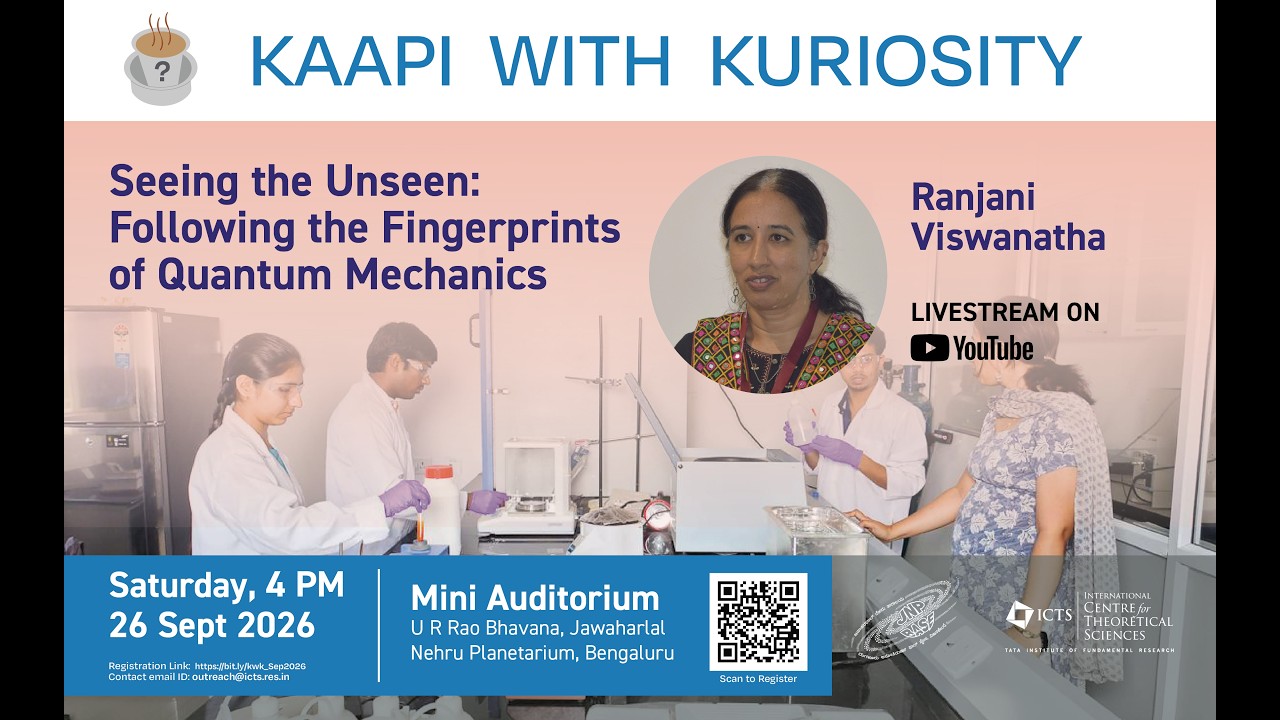
Seeing the Unseen: Following the Fingerprints of Quantum Mechanics by Ranjani Vishwanatha
Keywords
Summary
182 words
Critical Evaluation
Value of the Information & Strength of the Argument
The talk offers a fresh pedagogical perspective by framing quantum mechanics as a language instead of a set of postulates. Its value lies in making abstract concepts accessible through intuitive analogies and live demonstrations, particularly the polarization and double-slit experiments. The argumentation is logically structured: starting from classical wave behavior, introducing quantization, then reconciling particle and wave aspects via the wave function. The speaker’s reasoning is coherent and well-supported by experimental evidence, though it does not delve into mathematical derivations. The approach successfully demystifies core ideas and provides a mental framework that reduces the perceived weirdness of quantum mechanics.
Scientific Rigor, Source Quality, Title Accuracy
The scientific rigor is solid: the speaker is an established researcher, and all presented phenomena are standard textbook results. However, she does not cite specific papers or provide references, relying instead on well-known experiments (e.g., Hitachi’s electron double-slit). The title ‘Seeing the Unseen: Following the Fingerprints of Quantum Mechanics’ is apt and accurately summarizes the talk’s goal of inferring quantum behavior from indirect observations. The content stays true to this title throughout, never straying into unverified claims. The presentation is scientifically sound, though it intentionally avoids technical details, which is appropriate for a general audience.
209 words
Title / Content Match
The title accurately reflects the talk's focus on identifying quantum phenomena through indirect evidence ('fingerprints'), and the content consistently delivers on this promise.
Quality & Reliability
8/10
The speaker is a professor at JNCASR with expertise in quantum-confined materials. The conceptual content is accurate and well-presented, though it lacks explicit citations to literature. The demonstrations and analogies are sound and physically correct.
Key Moments
Markers derived by PSI from the transcript: the creator did not define chapters.
- Speaker begins with the analogy of learning a new language, setting up the framework for understanding quantum mechanics.
- Live demonstration and explanation of wave interference and polarization using polarizers and diffraction gratings.
- Introduction of quantization as the first 'new word', contrasting continuous classical spectra with discrete atomic lines.
- Presentation of the Hitachi electron double-slit experiment, showing electron interference and the wave-particle behavior.
- Discussion of the wave function as the proper description for quantum objects, moving beyond the wave-particle duality debate.
- Concluding remarks encouraging the audience to embrace the new language and learn through observation rather than equations.
Cited Sources
- Hitachi electron double-slit experiment — Referenced to illustrate the particle-like and wave-like behaviour of electrons in a single experimental setup.
Contribution & Novelties
The talk’s original contribution is its pedagogical framing: presenting quantum mechanics as a language-learning process, focusing on intuitive recognition of patterns (spectral lines, interference) before introducing formal mathematics. This approach lowers the barrier for newcomers and reframes wave-particle duality as a vocabulary issue rather than a paradox. The explicit suggestion to use ‘wave function’ as the primary descriptor for quantum objects is a novel conceptual simplification.
Pour aller plus loin :
- Wave–particle duality — This article provides a historical and technical overview, deepening understanding of the concept she addresses.
- Double-slit experiment — Essential background for the electron interference experiment she discusses.
- Wave function — A detailed explanation of the mathematical object she promotes as the core quantum concept.
118 words
Radar Profile
The radar profile shows high qualitative information and quality but lower technical level, reflecting a science communication talk that prioritizes conceptual clarity over mathematical depth. Fiabilité is moderate, consistent with an expert-led presentation that does not provide literature references.