Model-agnostic Cosmological Inference from the Redshift-space BAO Feature by Aseem Paranjape
Keywords
Summary
192 words
Critical Evaluation
Value of the Information & Strength of the Argument
The value of this work lies in proposing a genuinely model-agnostic methodology that avoids the reliance on a specific fiducial template, thereby reducing potential systematic biases. The argumentation is solid: the speaker builds from physical first principles (Zeldovich approximation, peaks theory) to motivate the form of the model, then demonstrates its accuracy on realistic simulations. The inclusion of scale-dependent bias and mode coupling is crucial and well-motivated. The use of machine learning to learn basis functions is innovative and shows practical advantages over ad hoc polynomials. The presentation is technically detailed, but the logic is clear, and the validation steps are convincing.
Scientific Rigor, Source Quality, Title Accuracy
The talk is scientifically rigorous: it references key literature (e.g., Eisenstein, Zel’dovich, and recent DESI results) and presents validation on large simulations. The speaker acknowledges limitations and outlines the framework’s assumptions. The title accurately describes the content. No sources are cited beyond the program link in the description, but the talk itself mentions several papers; however, no explicit URLs are provided. The methodology aligns with current cosmological research and the results are consistent with published work. The adequacy between the title and the content is excellent, as the entire talk focuses on the model-agnostic inference from the BAO feature in redshift space.
219 words
Title / Content Match
The title precisely reflects the content: a presentation of a model-agnostic inference method for the BAO feature in redshift space.
Quality & Reliability
8/10
The talk presents original research with rigorous methodology, validated on simulations and supported by public code. The arguments are coherent and the approach is physically motivated, although the presentation assumes a high level of background knowledge.
Key Moments
Markers derived by PSI from the transcript: the creator did not define chapters.
- Introduction to BAO and typical template-based analysis
- Motivation for model-agnostic approach and potential biases
- Zeldovich approximation and bulk flows; smearing of BAO
- Incorporating redshift-space distortions and anisotropic broadening
- Impact of scale-dependent bias and mode coupling
- Machine learning basis functions for linear correlation function
- Validation on simulations and cosmological parameter inference
- Conclusions, public code and future prospects
Cited Sources
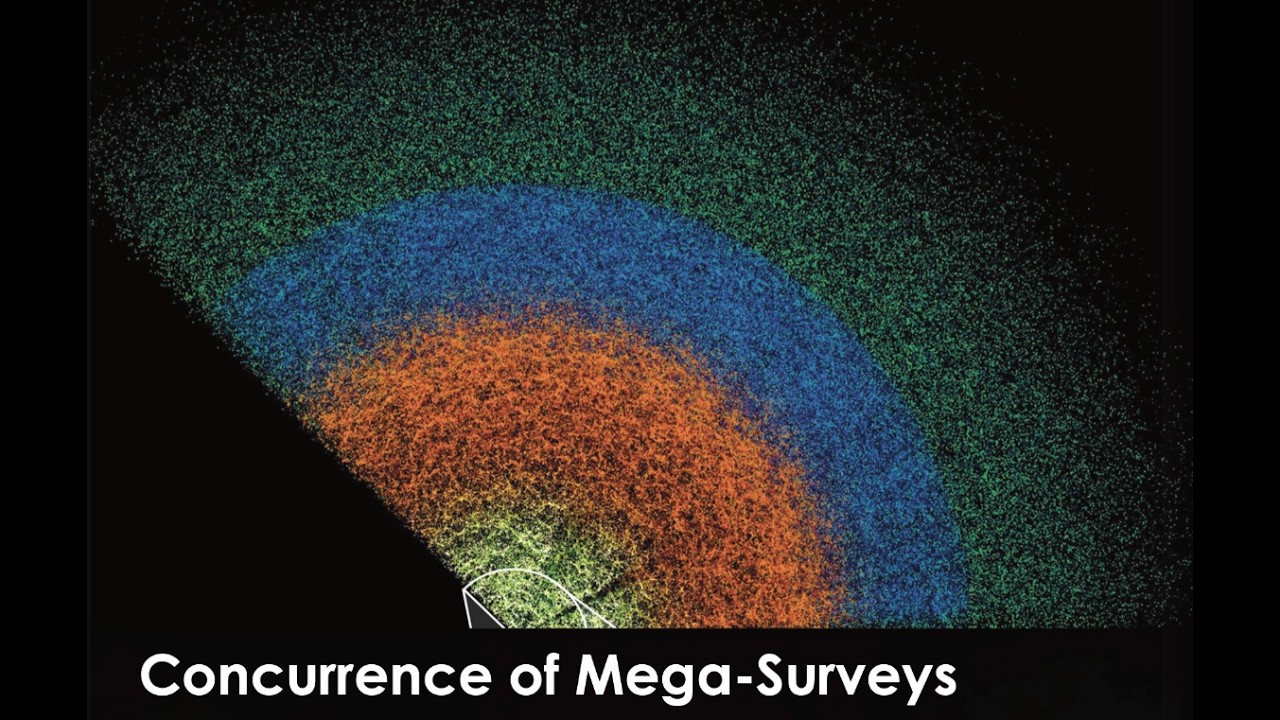
- Program: The Concurrence of Mega-Surveys — Workshop description and context for the talk
Contribution & Novelties
The primary contribution is a fully model-agnostic approach to BAO-based cosmological inference, eliminating the need for a specific cosmological template. The method uses a machine-learned basis function decomposition of the linear power spectrum, combined with a physically motivated model of nonlinear evolution (Zeldovich approximation and its extensions). This allows for unbiased reconstruction of the linear correlation function and cosmological parameter estimation without assuming a particular dark energy model or other priors. The framework also addresses key systematic effects such as scale-dependent bias and mode coupling, and is validated on realistic simulations (AbacusSummit). The public release of the code encourages reproducibility.
Pour aller plus loin :
- Baryon acoustic oscillations — Standard cosmological ruler used in this work.
- Redshift-space distortions — Key effect that the model incorporates.
- Zel’dovich approximation — Theoretical basis for the smearing model.
134 words
Radar Profile
The profile shows very high technical level and quantity of information, with slightly lower but still strong scores on quality and reliability. This reflects a dense, specialized presentation that is rigorous but assumes a high level of prior knowledge.