Exploring Self-regulation in the Evolution of the Edge Transport Barrier by Yasmin Andrew
Keywords
Summary
181 words
Critical Evaluation
Value of the Information & Strength of the Argument
The information presented is highly valuable for the plasma physics community, as it directly addresses critical challenges in compact tokamak design—specifically, controlling power exhaust and achieving H-mode access. The argumentation is well-supported by experimental evidence from multiple machines (JET, DIII-D, MAST-U) and comparisons with theoretical models, such as the predator-prey paradigm and gyrokinetic simulations. The speaker systematically connects observations (e.g., X-point emissivity rise, variation in power threshold) to physics mechanisms (e.g., shear flow generation, neutral interactions), building a coherent and plausible picture. The primary strength lies in the integration of diverse diagnostics and long-term research across two decades, lending credibility to the claims. However, some interpretations remain speculative (e.g., the role of magnetic shear vs. neutral effects), and the talk acknowledges unresolved issues, such as the opposing trends in power threshold with X-point height in different divertors.
Scientific Rigor, Source Quality, Title Accuracy
The scientific rigor is exemplary for a research seminar. All statements are grounded in established plasma physics concepts and supported by experimental data. The speaker cites specific experiments, diagnostic setups, and numerical codes (e.g., JAZELA) without overstating conclusions. The quality of sources is high, referencing major fusion projects (ITER, SPARC, MAST-U) and peer-reviewed publications (though specific DOIs are not given). The title accurately reflects the content, neither overpromising nor underdelivering. The presentation does not include unverified claims or hypothetical leaps; it clearly distinguishes between established results and open questions. The only minor caveat is the lack of in-text citations to specific papers, but given the technical audience, this is acceptable.
262 words
Title / Content Match
The title closely matches the content, which focuses on self-regulation and the evolution of the edge transport barrier in magnetically confined plasmas.
Quality & Reliability
8/10
The talk is based on peer-reviewed research, presents detailed experimental and theoretical results, and includes multiple citations to specific facilities and studies. The speaker is an established researcher in plasma fusion. Limitations include lack of access to full data or detailed methodology in the talk itself, but the presentation is scientifically sound for a specialized audience.
Key Moments
Markers derived by PSI from the transcript: the creator did not define chapters.
- Introduction to the talk structure and outline.
- Discussion of power threshold experiments varying magnetic null point height on JET and DIII-D.
- Presentation of the dithering phase experiment on MAST-U and limit-cycle oscillations.
- Emissivity measurements showing localization at the X-point before transition.
- Doppler backscattering diagnostics of perpendicular velocity and radial electric field, and future work.
Cited Sources
- EAST tokamak (Institute of Plasma Physics, China) — Mentioned as an example of a superconducting tokamak, precursor to the BEST device.
- MAST Upgrade (UKAEA) — The spherical tokamak where the dithering phase experiments were performed.
- SPARC (Commonwealth Fusion Systems) — Cited as a compact high-field, high-density tokamak example.
- Fusion for Energy (EU) — Provides context for European fusion energy initiatives and ITER collaboration.
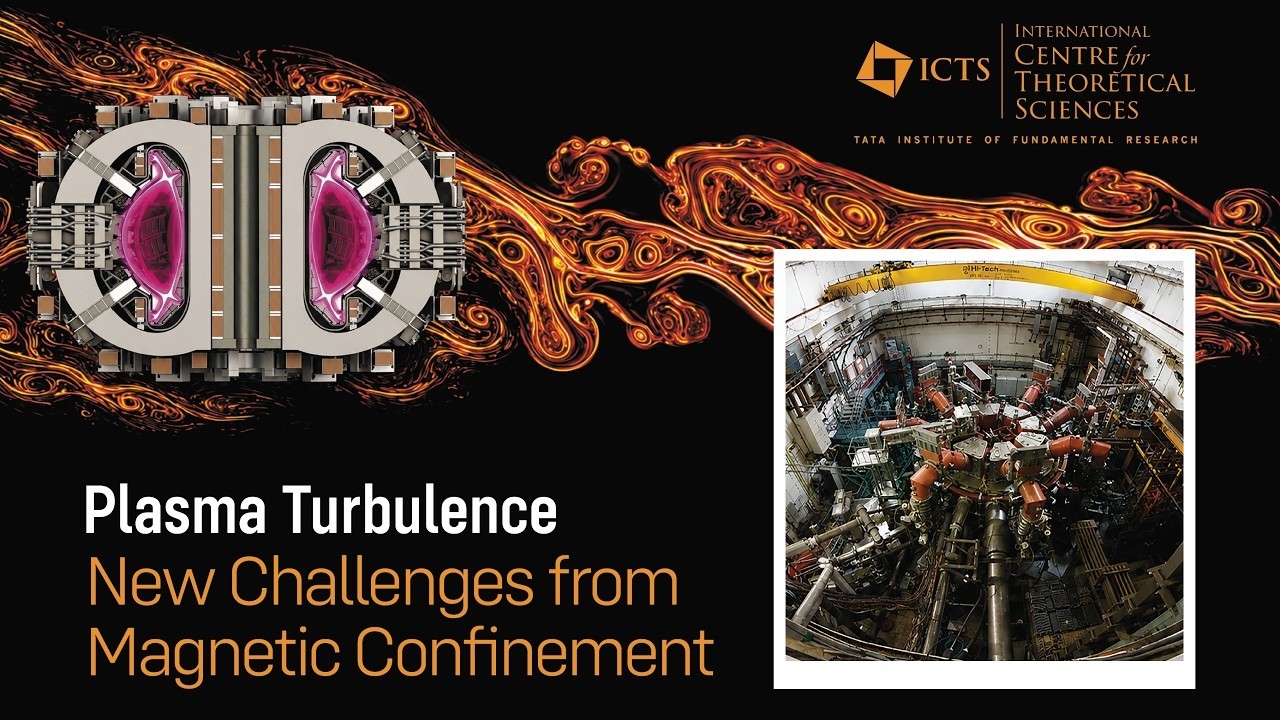
- ICTS Program: Plasma Turbulence: New Challenges from Magnetic Confinement — The workshop where this talk was presented, with program details.
- NIF Fusion Ignition (LLNL) — Referenced as an example of inertial confinement fusion approaches.
- Helion Energy — Listed as a commercial compact fusion reactor development.
- ITER organization — Mentioned as the world's largest fusion experiment, used as a baseline for conventional tokamaks.
- MIT Plasma Science and Fusion Center – SPARC — Related to the SPARC design and Alcator program heritage.
Concurring Sources
- ITER Organization — Supports the context that large tokamaks are challenged by power handling, aligning with the talk's motivation.
- MAST Upgrade (UKAEA) — The experimental device where the presented results were obtained, reinforcing the claims.
Contribution & Novelties
The talk’s original contribution lies in systematically linking magnetic null point configuration to L-H transition power threshold across multiple tokamaks, and in providing new MAST-U observations of emissivity localization during the dithering phase. These findings refresh the understanding of how boundary geometry and neutral physics regulate edge turbulence, and offer predictive insights for compact fusion devices like SPARC and STEP. The work underscores the necessity of controlling turbulence, not just confinement, in future reactors.
Pour aller plus loin :
- Edge transport barrier - Wikipedia — Explains the L-H transition and barrier formation, relevant background.
- L–H transition - Wikipedia — Detailed description of the transition and power threshold physics.
- Zonal flow (plasma) - Wikipedia — The key turbulence suppression mechanism discussed in the talk.
- ITER website — Reference for conventional large tokamak context.
132 words
Radar Profile
The radar profile shows a highly specialized, technical talk with very strong scores in technical depth and information quality, but slightly lower in accessibility and generalizability. The high niveau_technique and qualite_information indicate a presentation aimed at experts, with a solid evidentiary base.