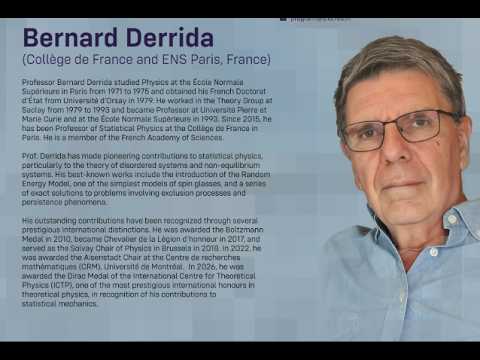
Overlaps in Spin Glasses and Models of Evolution by Bernard Derrida
Keywords
Summary
158 words
Critical Evaluation
Value of the Information & Strength of the Argument
The lecture’s value lies in its clear demonstration of a deep connection between statistical physics and evolutionary biology through the concept of overlap. The argumentation is solid, building from the definition of overlap to the predictive power of Parisi’s theory, and then showing how a minimal Poisson model reproduces the same distribution. Derrida’s step-by-step reasoning from the Random Energy Model to the universal distribution is compelling and well-supported by references to seminal papers. He effectively argues that the apparent complexity of the overlap distribution has a simple origin, and he extends this to evolution models, showing analogous behavior in genome space. The arguments are rigorous and grounded in exact calculations, making the content highly valuable for researchers and advanced students.
Scientific Rigor, Source Quality, Title Accuracy
The scientific rigor is high, with proper attribution to key contributions from Edwards, Anderson, Sherrington, Kirkpatrick, and Parisi. Derrida frequently cites his own works and those of collaborators, such as the Random Energy Model and recent work with Peter Motisho. The sources are appropriate and within the field. The title accurately describes the content; the lecture indeed covers overlaps in spin glasses and models of evolution. No comments are provided, so no public tendencies can be analyzed.
212 words
Title / Content Match
The title accurately reflects the content, covering overlaps in spin glasses and models of evolution as presented by the speaker.
Quality & Reliability
9/10
The lecture is delivered by a leading expert in statistical physics, Bernard Derrida, with rigorous mathematical exposition, clear explanations of complex concepts, and references to seminal works. The content is accurate and well-structured, suitable for an advanced scientific audience.
Key Moments
Markers derived by PSI from the transcript: the creator did not define chapters.
- Introduction of the speaker and start of the lecture, overview of the talk's plan.
- Definition of overlap in spin glasses and its importance in describing rugged energy landscapes.
- Parisi's replica theory and prediction of the overlap distribution; discussion of non-self-averaging effects.
- Connection to the Poisson process and derivation of the universal distribution from the Random Energy Model.
- Application to evolution models; similarity of overlap statistics in genome space and discussion of speciation.
Cited Sources
- Sherrington-Kirkpatrick model — Mentioned as the 1975 mean-field model of spin glasses with random interactions.
- Edwards-Anderson overlap — Introduced in 1974 to measure similarity between spin configurations.
- Parisi's replica theory — Predicted the universal distribution of overlaps in mean-field spin glasses.
- Random Energy Model — Introduced by Derrida to simplify spin glass theory, showing independent energy levels.
Concurring Sources
- Edwards and Anderson (1974) — Foundational paper introducing the overlap parameter.
- Parisi's replica theory (1979-1980) — Predicted the overlap distribution that is the focus of the talk.
Contribution & Novelties
The contribution of this lecture is to present a unified picture connecting spin glass theory and evolution models through the statistics of overlaps. Derrida emphasizes that the universal distribution predicted by Parisi is simply explained by a Poisson process with exponential density, a result from the Random Energy Model. He extends this to populations evolving in time, showing similar overlap statistics arise from the branching of common ancestors. The lecture also highlights recent generalizations with Peter Motisho and presents a simple framework that captures the essence of Parisi’s theory.
Pour aller plus loin :
- Spin glass — Provides background on spin glasses and their relevance in statistical physics.
- Random energy model — Derrida’s model that simplifies spin glass theory and leads to the overlap distribution.
- Replica trick — The mathematical method used in Parisi’s solution.
- Parisi’s work — Overview of the Nobel laureate’s contributions to spin glass theory.
148 words
Radar Profile
The radar profile shows high scores across all dimensions, indicating a well-rounded lecture with abundant information, high technical depth, and excellent reliability. The quantitative and qualitative scores are matched, reflecting a thorough and rigorous presentation.