Split and Conquer : Extracting More Information from Galaxy Surveys and CMB by Aritra Kumar Gon
Keywords
Summary
283 words
Critical Evaluation
Value of the Information & Strength of the Argument
The value of this talk is substantial: it addresses a key limitation in cosmological analysis—the loss of small-scale information—and proposes a novel, practical solution in density split clustering that works in redshift space without reconstruction. The argumentation is rigorous: the speaker carefully motivates each step, from the construction of the density PDF to the modeling of power spectra, and validates the model against simulations. The Fisher forecast demonstrates concrete gains when combining density-split bins with standard clustering, though the speaker honestly notes that nuisance parameters are currently treated as free or fixed. The kSZ part is similarly well-argued, showing that splitting by density can enhance sensitivity to different velocity regimes, even if the final constraints are not yet presented. The talk is technically deep and shows strong command of the subject, though some steps (like the one-island term in the halo model) are fitting functions without full physical understanding, which is acknowledged.
Scientific Rigor, Source Quality, Title Accuracy
The talk does not cite specific papers, but it references prior work on density split clustering and previous kSZ observations (e.g., 2012, 2016, and recent results) without explicit references. The description provides a link to the workshop program, which contains relevant context but not direct citations. The methodology appears based on standard cosmological perturbation theory and simulation techniques, and the speaker clearly states where approximations are made. The title perfectly matches the content: ‘Split and Conquer’ captures the splitting of density fields, and the dual application to galaxy surveys and CMB is accurately presented. There are no obvious discrepancies between the title and the material covered. Overall, while the lack of explicit source citations diminishes the verifiability, the rigor of the analysis and the credibility of the institution (ICTS) support a high reliability score.
301 words
Title / Content Match
The title accurately reflects the content: the talk presents a splitting technique to extract more information from galaxy surveys and CMB, applied to density-split clustering and pairwise kSZ.
Quality & Reliability
8/10
The talk presents original research with validated models and Fisher forecasts, but it is a conference presentation and some parts are preliminary (kSZ application). The methodology is sound and the speaker is expert, though no external sources are cited.
Key Moments
Markers derived by PSI from the transcript: the creator did not define chapters.
- Introduction: importance of peculiar velocity field and its connection to structure growth.
- Problem with galaxy surveys: throwing away small-scale information due to model limitations.
- Introduces density split clustering (DSC) and its advantages over standard two-point statistics.
- Details of the new redshift-space DSC model: using halo centers to solve pair conservation.
- Modeling the density PDF and density-split bias; validation against simulations.
- Fisher forecast: combining DSC bins gives tighter constraints and different degeneracy directions.
- Transition to kSZ effect: pairwise kSZ and its limitations.
- Applying density splitting to pairwise velocities: results show improved signal-to-noise.
Cited Sources
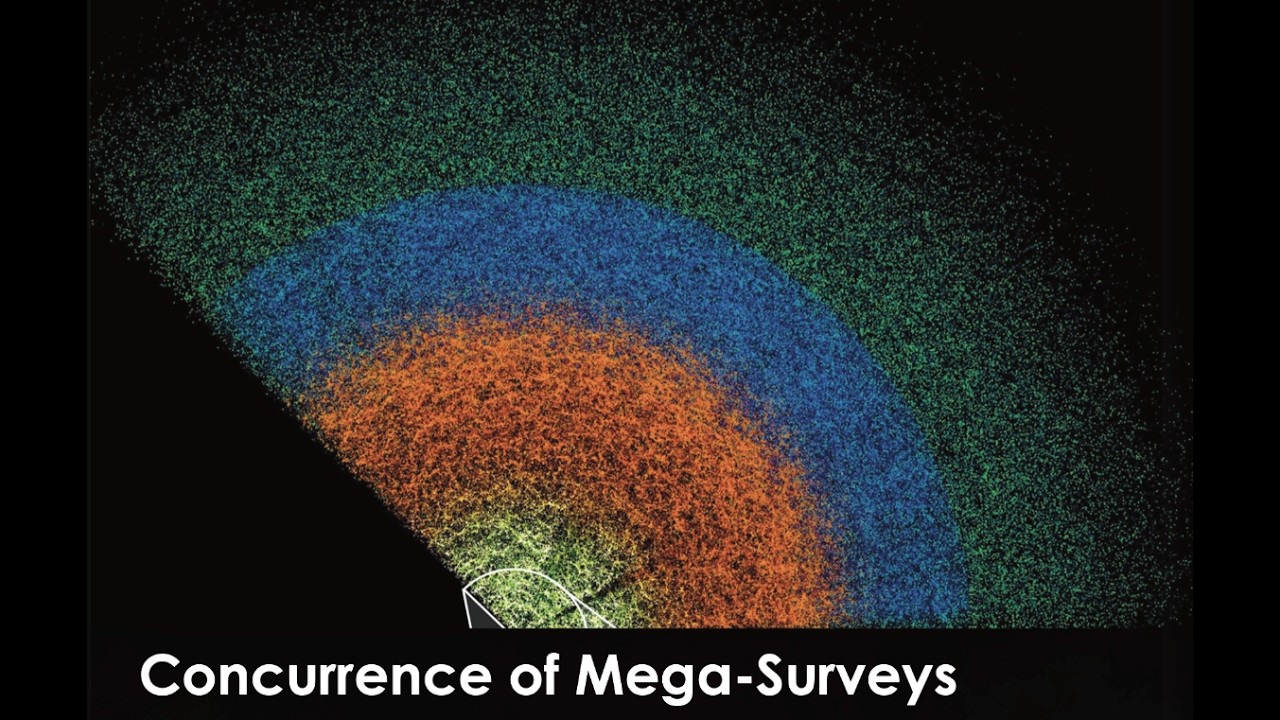
- The Concurrence of Mega-Surveys program — Workshop program that includes talks and resources; provides context for the research presented.
Contribution & Novelties
The main contributions are: (1) a fully redshift-space density split clustering model that avoids reconstruction and solves pair conservation by using halo centers; (2) a physical model for the density PDF and bias, validated with simulations; (3) a demonstration that combining density-split bins with standard clustering improves Fisher constraints on cosmological parameters due to rotated degeneracies; (4) an extension of the splitting principle to pairwise kSZ velocities, showing enhanced signal-to-noise despite larger variance. These advances promise to unlock more information from current and future surveys like DESI, Euclid, and Rubin.
Pour aller plus loin :
- Redshift-space distortions — Explains the physical effect that the model addresses.
- Kinetic Sunyaev–Zel’dovich effect — Background on the kSZ effect, including its tiny amplitude and use as a velocity probe.
- Fisher information — Foundational concept for the error forecasts used in the talk.
- Large-scale structure of the Universe — Provides context on how galaxy surveys map cosmic structure.
153 words
Radar Profile
The radar profile shows high scores across information quantity, quality, and technical level, reflecting a dense and advanced presentation. Fiabilité is slightly lower due to lack of explicit citations and preliminary results in the kSZ part, but still solid.