How Can We Use The Sunyaev-Zel'dovich Effect Robustly? by David Alonso
Keywords
Summary
175 words
Critical Evaluation
Value of the Information & Strength of the Argument
The value of this talk lies in its clear exposition of a nuanced analysis pipeline for the tSZ effect, particularly the advantages of forward modelling over traditional ILC. The argumentation is rigorous: the speaker always ties methodological choices to physical reasoning (e.g., why small-scale one-halo terms are problematic, why BPE is insensitive to feedback at low redshifts). Simulation-based tests (Flamingo) add credibility, and the comparison with existing measurements highlights the current discrepancies and the need for standardisation. The presentation avoids overclaiming and openly discusses limitations (e.g., dependence on galaxy bias models). This is a balanced and scientifically thoughtful lecture.
Scientific Rigor, Source Quality, Title Accuracy
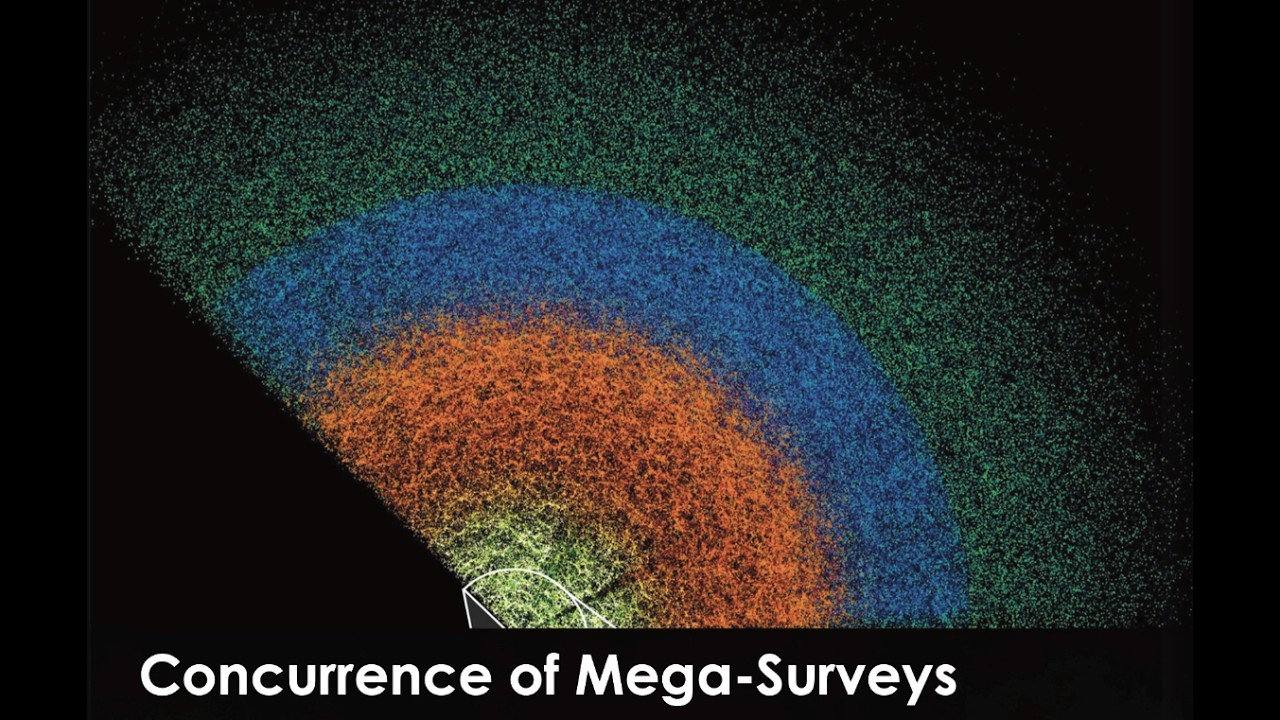
The talk is given within the ICTS program ‘The Concurrence of Mega-Surveys’, so the context is a scientific workshop. The speaker cites specific papers (e.g., by Henry Lee, Jaime Salcido, Sarah R., Adrian E.) and simulation suites (Flamingo), without providing URLs (which is typical of oral presentations). The description supplies the program link, which serves as the primary source. Methodological steps are well-motivated and follow standard cosmology practice. The title is perfectly adequate, as the lecture indeed focuses on robust approaches to using the tSZ effect, from component separation to cross-correlation analysis. No obvious contradictions with current literature are presented.
214 words
Title / Content Match
The title accurately reflects the content: a detailed discussion on robustly using the Sunyaev-Zel'dovich effect.
Quality & Reliability
9/10
Presentation by a recognised expert at a leading research institute, based on peer-reviewed methods and state-of-the-art simulations. The talk systematically addresses systematic errors and clearly distinguishes robust large-scale signals from more uncertain small-scale modelling.
Key Moments
Markers derived by PSI from the transcript: the creator did not define chapters.
- Introduction and acknowledgements of collaborators
- Review of thermal Sunyaev-Zel'dovich effect and Kompaneets equation
- Challenges of component separation, especially Cosmic Infrared Background contamination
- Presentation of Bayesian forward modelling approach for cross-correlations
- Introduction of bias-weighted pressure (BPE) and its cosmological relevance
- Simulation-based tests and comparison with current measurements
- Summary and future directions
Cited Sources
- The Concurrence of Mega-Surveys program — Official program page of the ICTS workshop where this talk was presented, providing context and additional resources.
Contribution & Novelties
The talk synthesizes recent advances in tSZ cross-correlation analysis, emphasising robust measurement of bias-weighted pressure (BPE) through a forward-modelling approach. It argues for the importance of using physically motivated CIB SED libraries and demonstrates (via simulations) that flexible bias models can remove scale-dependent and stochastic contributions. The claim that BPE is nearly feedback-independent at low redshifts offers a promising avenue for cosmological inference. The presentation contributes by proposing a standardised pipeline that can be compared across data sets.
Pour aller plus loin :
- Cosmic infrared background — Relevant to the main foreground discussed in the talk.
- Compton scattering — The underlying physical process for the tSZ effect.
- Matter power spectrum — Key to the large-scale cross-correlation modelling.
117 words
Radar Profile
The scores indicate a highly technical and information-dense presentation with strong scientific rigour. The high scores in 'niveau_technique' and 'fiabilite_globale' reflect the expert-level content and reliable methodologies, while 'quantite_information' is slightly lower due to the focused scope on a specialised topic.