Making sense of two billion stars - The GAIA view of the Milky Way Dark Matter H.. by Subha Majumdar
Keywords
Summary
179 words
Critical Evaluation
Value of the Information & Strength of the Argument
The talk provides substantial original results, combining multiple surveys to overcome Gaia’s limitations. The argumentation is methodical, showing historical context and systematically addressing systematic errors. The speaker demonstrates the necessity of including asymmetric drift and measuring anisotropy parameter beta rather than assuming zero. The comparison with existing studies and the recovery of known features like caustic rings strengthens the credibility. However, some results are preliminary and not yet peer-reviewed, and the dependence on LSR assumptions is significant.
Scientific Rigor, Source Quality, Title Accuracy
The speaker references multiple prior works (Eilers et al., Bhattacharjee et al., etc.) and shows consistency with gas rotation curves. The description links to the workshop program, providing context. The title accurately reflects the content. The talk is technically rigorous, with detailed equations and error bars, but the lack of published paper means the results should be taken as preliminary. The video has no comments provided, so no public feedback is available.
164 words
Title / Content Match
The title accurately reflects the content: the speaker discusses making sense of 1.8 billion stars from Gaia to study the Milky Way's dark matter halo.
Quality & Reliability
8/10
Talk presented at a scientific workshop, based on original analysis of Gaia DR3 data combined with other surveys. The methodology is described in detail, and systematic uncertainties are addressed, though the results are not yet peer-reviewed.
Key Moments
Markers derived by PSI from the transcript: the creator did not define chapters.
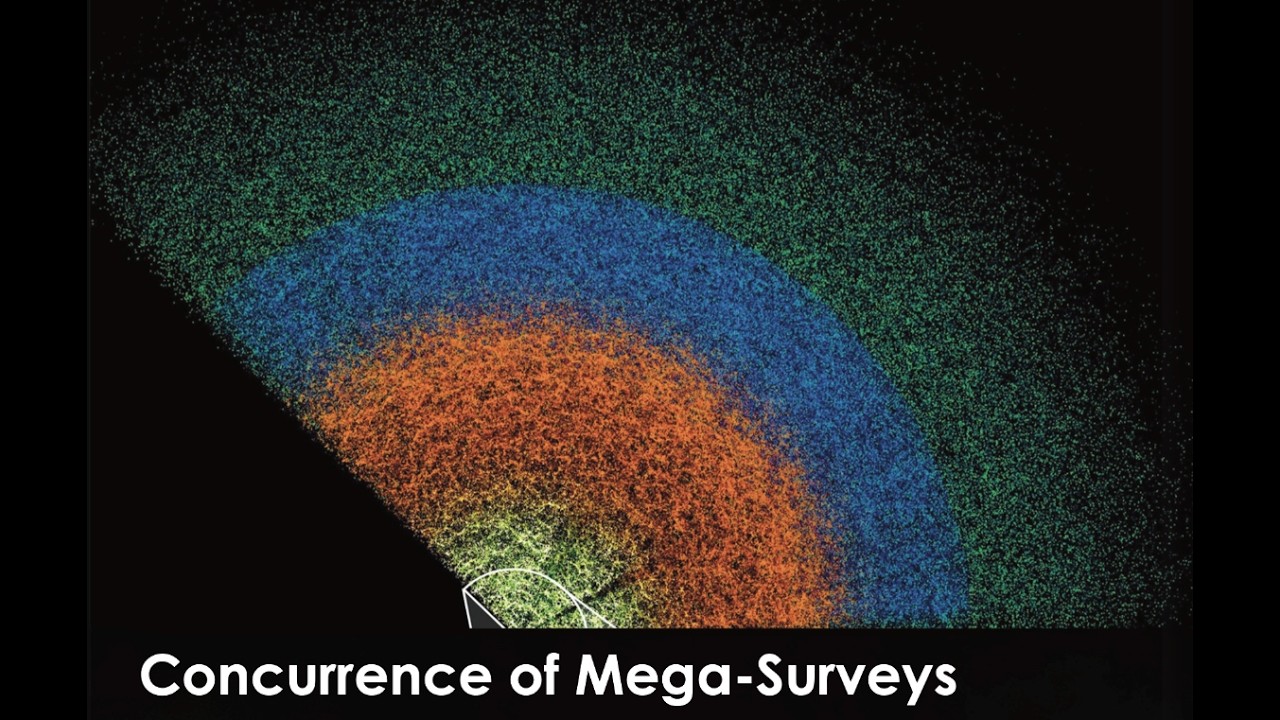
- Introduction to Gaia as a mega-survey and its complementarity with other surveys.
- Historical rotation curves pre-Gaia and early Gaia results, highlighting the Gaia barrier.
- Method to cross the Gaia barrier: combining Gaia with other surveys to improve distances and velocities.
- Construction of a continuous rotation curve from disk to halo out to 250 kpc, incorporating asymmetric drift and beta.
- Mass estimates of the Milky Way dark matter halo and local dark matter density, showing dependence on LSR and baryonic assumptions.
- Detection of two caustic rings in the rotation curve, consistent with spherical infall models.
- Implications for dark matter detection experiments and concluding remarks.
Cited Sources
- ICTS Program: The Concurrence of Mega-Surveys — Workshop program page where this talk was presented, providing context for the research and related materials.
Contribution & Novelties
This work significantly extends the Milky Way rotation curve to 250 kpc using a single consistent dataset, avoiding the systematic errors from patchwork surveys. It also computes the asymmetric drift and anisotropy parameter beta directly from data, improving mass estimates. The detection of caustic rings suggests new physics in dark matter distribution.
Pour aller plus loin :
- Gaia mission — The space observatory providing the data.
- Galaxy rotation curve — Overview of rotation curve studies.
- Jeans equations — The modeling framework used.
82 words
Radar Profile
The profile shows high scores across all dimensions, indicating a dense, technical, and reliable presentation with significant new findings.