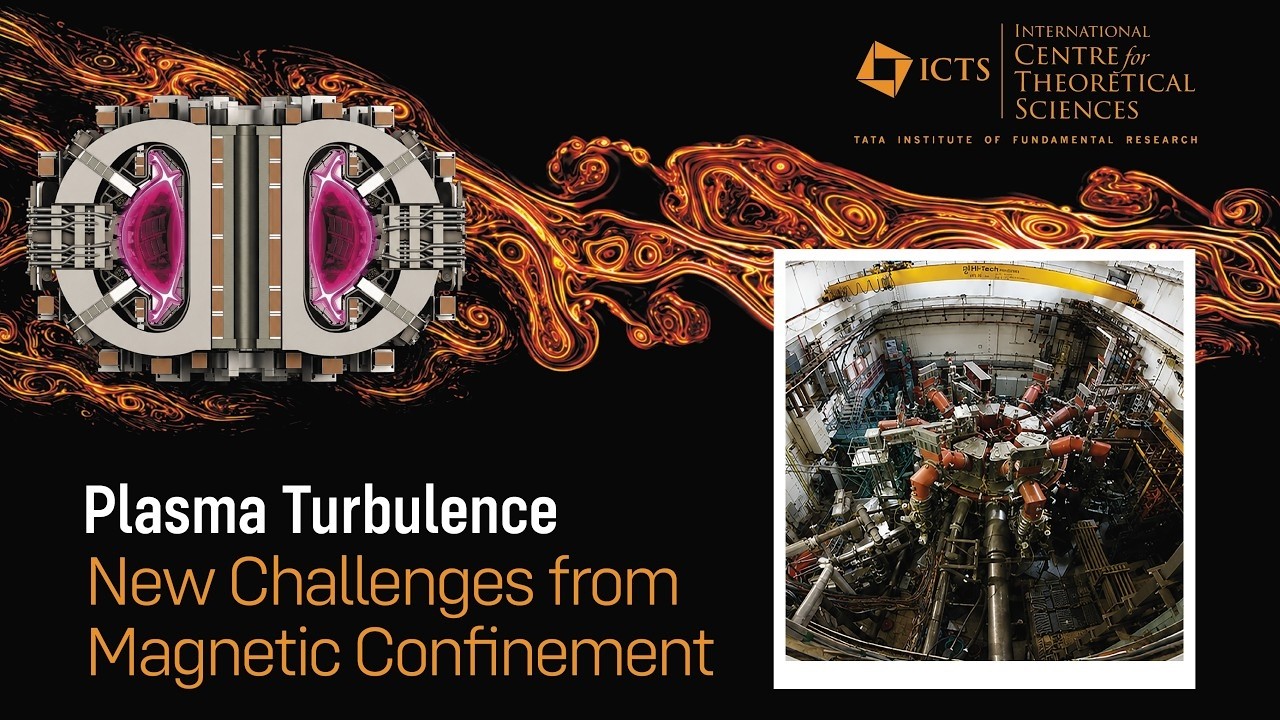
Bridging Inertial and Magnetic Confinement Fusion Paradigms by Amita Das
Keywords
Summary
146 words
Critical Evaluation
Value of the Information & Strength of the Argument
The information is valuable as it proposes a concrete pathway to enhance ICF efficiency and introduces new physics mechanisms. The argumentation is logical, starting from fundamentals and building to original simulation results, supported by theoretical predictions and experimental evidence where available. The speaker clearly explains how external magnetic fields alter electron dynamics, leading to direct ion heating and improved energy coupling, and demonstrates this with PIC simulations.
Scientific Rigor, Source Quality, Title Accuracy
The presentation is scientifically rigorous, referencing established fusion facts and citing specific experimental programs (ITER, MAST-U, SPARC) and prior work. The title matches the content closely, clearly indicating a comparative and integrative approach. The speaker acknowledges collaborations and further references, maintaining a high standard of source credibility.
129 words
Title / Content Match
The title accurately reflects the talk, which systematically compares inertial and magnetic confinement fusion and proposes a bridge using external magnetic fields in ICF.
Quality & Reliability
9/10
Expert presentation by a plasma physics researcher, backed by peer-reviewed simulations and experimental collaborations; some concepts simplified for a wide audience but overall rigorous.
Key Moments
Markers derived by PSI from the transcript: the creator did not define chapters.
- Introduction and outline of the talk.
- Tokamak physics basics (TOK 101): force balance, stability, and turbulence.
- Inertial confinement fusion overview and challenges.
- Bridging paradigms: applying external magnetic fields to ICF.
- PIC simulation results showing enhanced ion heating with magnetic field.
- Localized heating via resonance and mode conversion.
- Colliding wave mechanism in small droplets improves laser-plasma coupling.
- Electron Bernstein waves and magnetic field amplification in experiments.
- Plasma as an optical element; conclusions and acknowledgments.
Cited Sources
- ITER - the world's largest fusion experiment — Referenced as a prime example of magnetic confinement fusion.
- EUROfusion for ITER — Mentioned in relation to ITER collaboration.
- LLNL - Fusion ignition and the path to inertial fusion energy — Cited for laser-driven inertial confinement fusion.
- Commonwealth Fusion Systems - SPARC — Example of compact high-field tokamak.
- MIT Plasma Science and Fusion Center - SPARC — Details on SPARC derived from Alcator program.
- Helion Energy — Mentioned as a commercial fusion startup.
- United Kingdom Atomic Energy Authority - MAST-U — Spherical tokamak example.
- EAST - Experimental Advanced Superconducting Tokamak — Chinese tokamak, precursor to BEST.
- ICTS Program: Plasma Turbulence — Program link for the workshop.
Concurring Sources
Contribution & Novelties
The talk’s original contribution lies in proposing and simulating the use of strong external magnetic fields in inertial confinement fusion to enhance ion heating and energy coupling, bridging two traditionally separate paradigms. This opens new parameter regimes and suggests practical improvements to fusion targets. The speaker also presents novel observations such as colliding surface waves in small targets and the generation of energetic electrons via Bernstein modes.
Pour aller plus loin :
- Magnetic confinement fusion — Overview of MCF principles and devices.
- Inertial confinement fusion — Detailed description of ICF concepts and challenges.
- Fast ignition — Related ICF scheme that the talk builds upon.
- Bernstein waves — Explanation of electrostatic waves in magnetized plasmas relevant to the observed electron heating.
120 words
Radar Profile
The profile shows high scores in information quality and reliability, with a balanced technical depth. The moderate quantity score reflects the focused but not exhaustive coverage of topics, while the global note acknowledges the talk's strong scientific content despite limited audience engagement metrics.