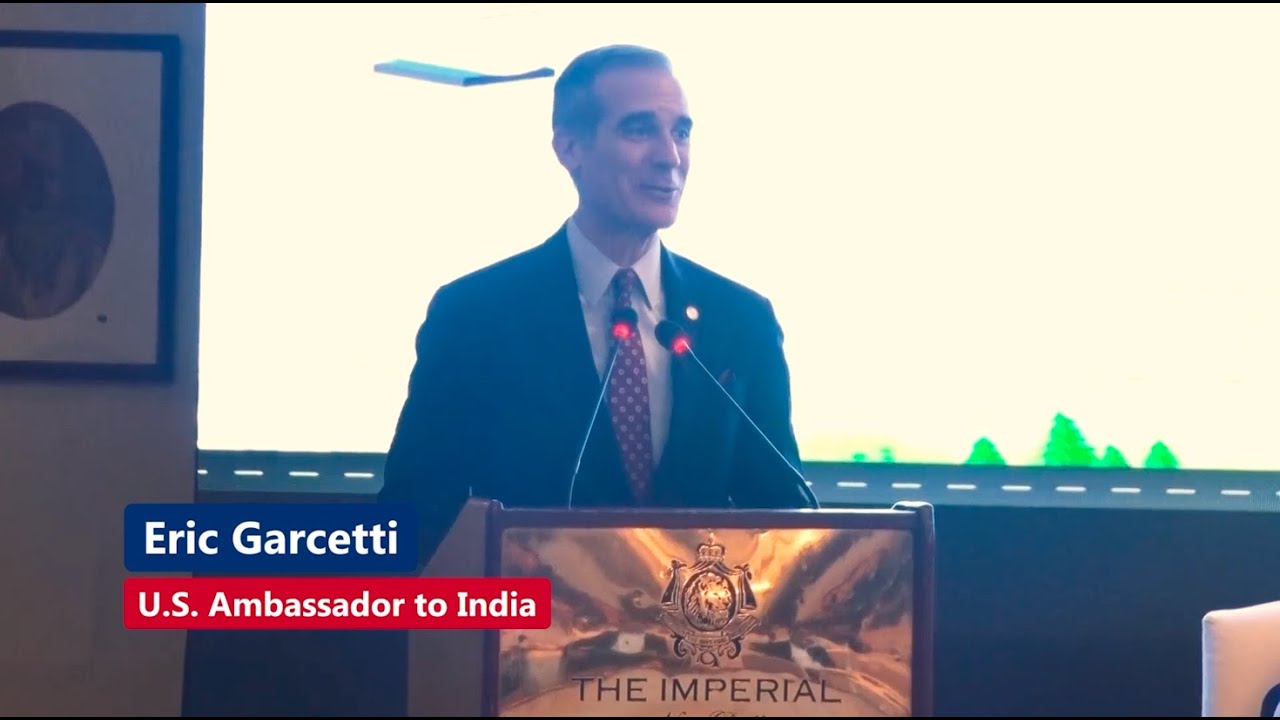
Eric Garcetti, U.S. Ambassador to India at 'Accelerating Deployment of eBuses in India' event
Keywords
Summary
165 words
Critical Evaluation
Value of the Information & Strength of the Argument
The value of this speech lies primarily in its authoritative voice and anecdotal evidence, rather than in rigorous analytics or new data. Garcetti draws on his personal history in Los Angeles to illustrate the health impacts of pollution and the challenges of policy transitions, which makes the argument accessible and emotionally compelling. He uses anecdotes like the crushed EV1 cars and the exponential growth of EV sales to argue for urgency and feasibility. However, the argumentation relies heavily on narrative and moral imperative rather than systematic evidence. Key claims about cost reductions and maintenance savings are asserted without referencing specific industry data or economic studies. The speech is effective as a motivational and diplomatic piece, but its scientific and technical content is minimal.
Scientific Rigor, Source Quality, Title Accuracy
The speech lacks formal citations or references to specific studies, data sources, or policy documents, aside from a brief mention of an IPCC report and the film ‘Who Killed the Electric Car?’. No sources are provided in the video description, nor are any external links offered. The title accurately describes the event, but the content is less about technical analysis and more about political will and partnership. The credibility relies on the speaker’s institutional authority (U.S. Ambassador) rather than on verifiable sources. Consequently, while the tone is confident and the context is relevant, the scientific rigor is low, and the quality of sources is not demonstrable. The title–content alignment is good, as the speech indeed focuses on accelerating e-bus deployment through collaboration.
260 words
Title / Content Match
The title accurately reflects the content: a keynote address by the U.S. Ambassador on accelerating e-bus deployment in India.
Quality & Reliability
5/10
The speech is a diplomatic address with personal anecdotes and advocacy for electric buses, lacking substantive empirical data or formal citations. It provides contextual perspective from Los Angeles but no novel scientific findings.
Key Moments
Markers derived by PSI from the transcript: the creator did not define chapters.
- Opening remarks and acknowledgment of officials
- Personal story of riding buses as a child in Los Angeles and air pollution health impacts
- Reference to IPCC report and urgency of climate action
- Los Angeles' goal for complete electric bus fleet by 2028 Olympics
- Anecdote about GM EV1 and the 'Who Killed the Electric Car' film
- Statistics on accelerating EV adoption and India's role
- Four Ps: Peace, Prosperity, Planet, and People; partnership theme
- Closing remarks on US-India friendship and forward momentum
Cited Sources
- IPCC (Intergovernmental Panel on Climate Change) — Mentioned in the context of the first climate change report and urgency.
- Who Killed the Electric Car? (film) — Referenced as documenting the demise of GM's EV1 program.
Contribution & Novelties
The original contribution is a high-level diplomatic endorsement of electric bus adoption, linking international partnership to climate action. It does not present new research but offers a persuasive narrative based on personal and political experience. The speech underscores the role of government leadership and cross-national collaboration.
Pour aller plus loin :
- Electric bus — Overview of electric bus technology and deployment statistics.
- US-India Clean Energy Partnership — Official U.S. Department of State page on bilateral ties and initiatives.
- Zero-emission vehicle — Covers broader categories of zero-emission vehicles and policies.
- Climate change in India — Context on climate impacts and mitigation efforts in India.
103 words
Radar Profile
The radar profile shows a moderate score in information quantity and credibility, but low technical depth and limited rigorous sourcing. The strength lies in the authority of the speaker and the practical perspective, while the weakness is the absence of empirical detail and formal references.