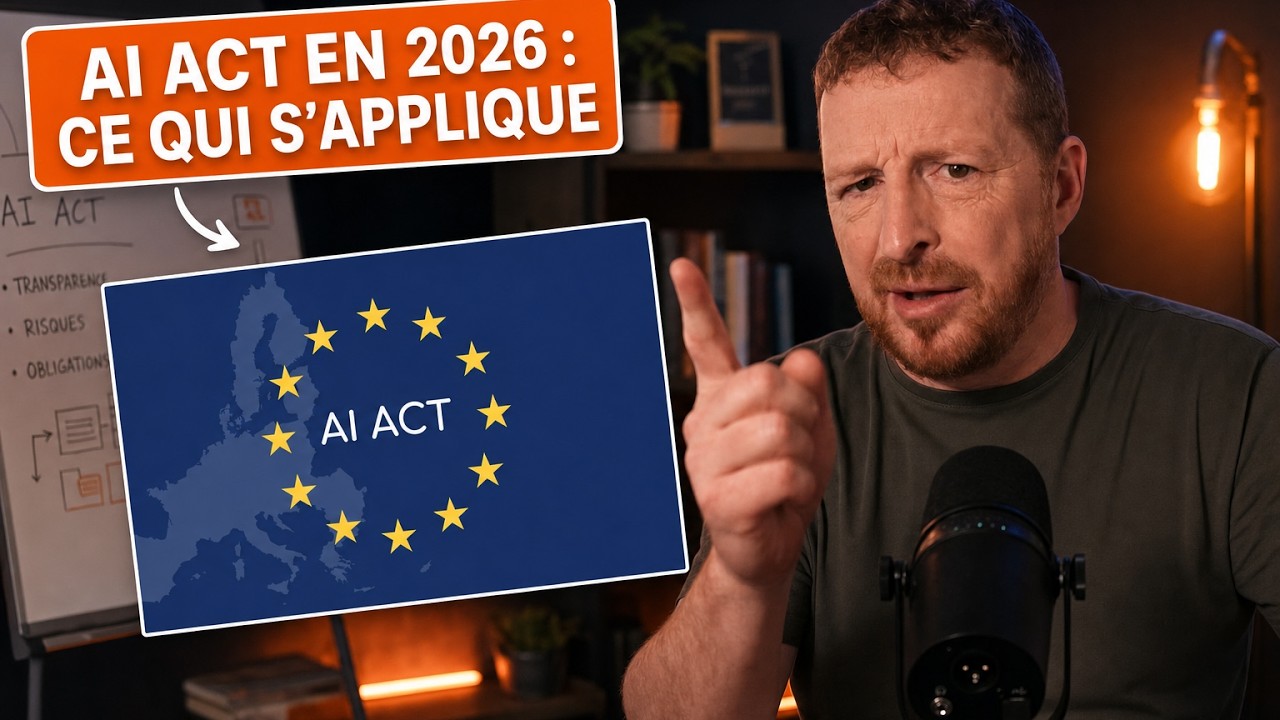
AI Act, ce qui s'applique vraiment depuis le 2 août 2026
AI Act: What’s actually been in effect since August 2, 2026
Keywords
Summary
152 words
Critical Evaluation
Value of the Information & Strength of the Argument
The video offers substantial value by clarifying a complex regulation and correcting common misconceptions, such as the confusion between the training obligation’s start date and its enforcement date. The argumentation is based on the legal text and its practical application, though it includes personal opinions on policy and lobbying. The presenter supports his claims with references to specific articles (e.g., Article 4) and real-world examples like Anthropic’s labeling. The reasoning is coherent and helps viewers understand the current state of the law, although it occasionally veers into hypothetical scenarios.
Scientific Rigor, Source Quality, Title Accuracy
The video demonstrates a good understanding of the AI Act’s timeline and provisions, but it does not cite external legal documents or official sources, relying on the presenter’s expertise. The title matches the content precisely, focusing on the actual obligations in force. The description provides links to the channel’s own website and club, which are not academic sources but offer additional context. No contradictions with widely known facts were noted, but the presentation mixes facts with opinion, which should be considered when assessing rigor.
188 words
Title / Content Match
The title accurately reflects the content, focusing on the actual obligations in force since August 2, 2026, and matches the video's scope.
Quality & Reliability
7/10
The video provides a detailed and accurate explanation of the AI Act's implementation timeline, but includes subjective opinions and promotional elements.
Key Moments
Markers derived by PSI from the transcript: the creator did not define chapters.
- Introduction and overview of what changed on August 2, 2026.
- History of the AI Act: 2021 proposal and 2023 amendments for generative AI.
- Article 4: Employee training obligation since February 2025, now enforceable.
- Transparency requirement: Chatbots must disclose their AI nature.
- Machine-readable labels for AI-generated content, including Anthropic's initiative.
- Definition and obligations for deepfakes, with examples.
- Delay of high-risk AI systems to 2027-2028 and reasons behind it.
- Enforcement in France: Lack of a dedicated authority and practical challenges.
- Conclusion and recommendations for businesses and viewers.
Cited Sources
- Website of Renaud Dékode — Channel's official website, providing additional resources and training.
- Klub Renaud Dékode subscription — Paid subscription offering e-learning and community access.
Contribution & Novelties
This video contributes by demystifying the August 2026 implementation of the AI Act, distinguishing between obligations that were already in force and those newly applicable. It provides practical guidance for businesses and employees, such as how to label AI-generated content and ensure chatbot transparency. The video also highlights enforcement gaps in France, which is a useful observation for compliance planning.
Pour aller plus loin :
- EU AI Act Regulation (EUR-Lex) — Primary legal text of the AI Act.
- Wikipedia: Artificial Intelligence Act — Overview of the regulation and its history.
- C2PA official site — Coalition for Content Provenance and Authenticity, relevant to machine-readable labeling.
- European Commission digital strategy on AI — Official EU page on AI regulation updates.
118 words
Radar Profile
The profile shows balanced scores across information quantity and quality, with a moderate technical level, indicating accessible content suitable for a broad audience. The reliability is decent but not exceptional, reflecting the mix of factual explanation and personal opinion.