Optimizing Workforce Structures for Holistic Care in Fetal Medicine- Mr W. Pfende
Keywords
Summary
170 words
Critical Evaluation
Value of the Information & Strength of the Argument
The presentation offers valuable practical insights into a frequently overlooked aspect of fetal medicine: the psychological well-being of parents following a diagnosis. The speaker’s argument is logically structured, moving from the problem (masked distress) to a systematic solution (task shifting and collaborative co-management). The use of a concrete case scenario effectively illustrates the phenomenon and grounds the proposal in clinical reality. The argumentation is persuasive, as it builds around a clear conceptual framework with defined roles for different personnel. However, the presentation is primarily opinion-based, lacking empirical data or references to support the efficacy of the proposed interventions. Nonetheless, the strategic alignment of non-mental health staff with mental health professionals appears practical and could be feasibly implemented in resource-limited settings.
Scientific Rigor, Source Quality, Title Accuracy
Scientific rigor is moderate: the talk is based on clinical experience and professional reasoning rather than on peer-reviewed evidence. No external sources or citations are provided, which limits reproducibility and generalizability. The quality of sources is therefore low, though the framework presented aligns with established principles of task-shifting in global health. The title accurately reflects the content, which is a proposal for optimizing workforce structures to achieve holistic care. The speaker mentions using the Maslach Burnout Inventory, but does not provide details on its application. Overall, the presentation is a sound rationale for integrating mental health services into fetal medicine, but would benefit from documented evidence and outcome data.
244 words
Title / Content Match
The title accurately reflects the content, which discusses workforce optimization and holistic care in fetal medicine.
Quality & Reliability
6/10
The presentation is a professional opinion and strategic proposal based on clinical experience, but lacks published evidence or cited references. It offers a reasonable framework for integrating mental health into fetal medicine, yet the evidence base is not articulated.
Key Moments
Markers derived by PSI from the transcript: the creator did not define chapters.
- Introduction: the speaker sets the stage, emphasizing mental health in fetal medicine.
- Problem: fetal diagnosis triggers severe psychological trauma; the smile as a mask.
- Case scenario: patient with skeletal dysplasia, internal distress hidden by a calm smile.
- Task-shifting model: training non-mental health staff for screening and referral.
- Key takeaways: never equate compliance with emotional stability; implement warm handoffs.
Contribution & Novelties
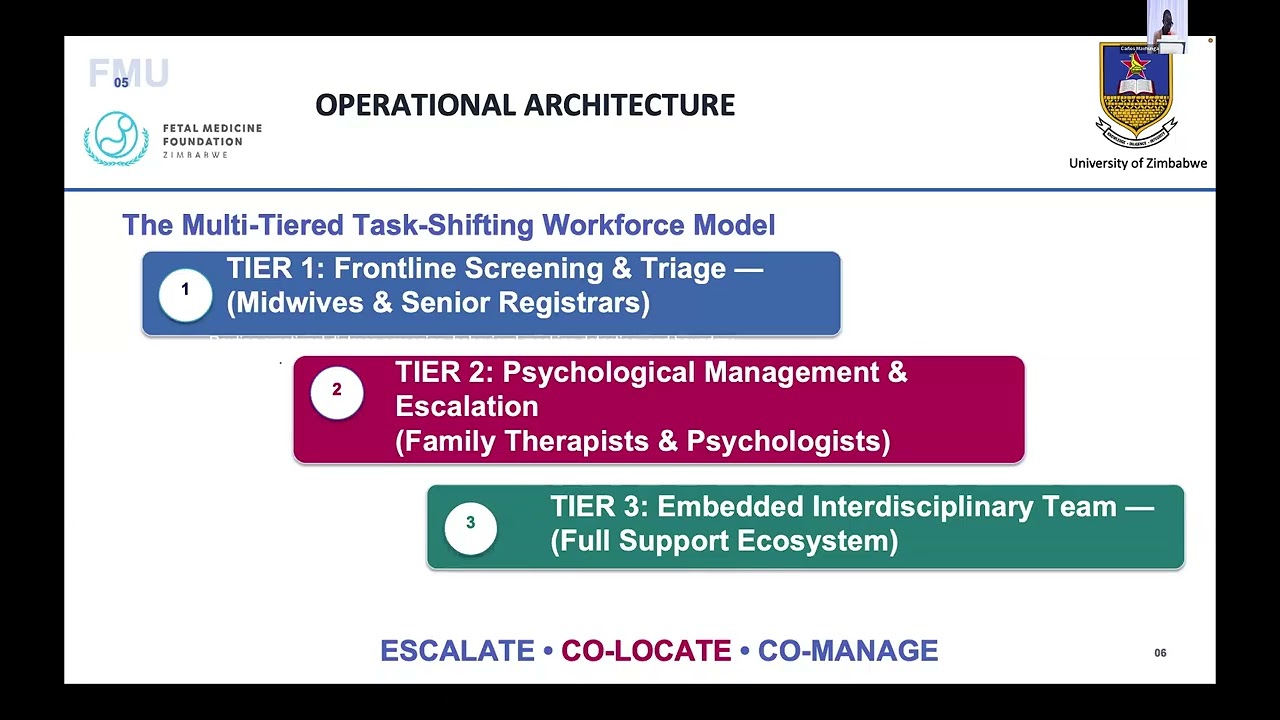
The presentation’s originality lies in its explicit adaptation of task-shifting principles to the fetal medicine context, proposing a three-tier operational model to integrate mental health care seamlessly. It highlights the often-ignored phenomenon of ‘masked affect’ in parents receiving a fetal anomaly diagnosis and provides a concrete referral pathway. The emphasis on co-managing both partners and addressing practitioner burnout adds a systemic perspective.
Pour aller plus loin :
- Task shifting (healthcare) — Relevant as the core strategy discussed.
- Fetal medicine — Provides background on the specialty mentioned.
- Maslach Burnout Inventory — The tool referenced for screening clinician burnout.
97 words
Radar Profile
The radar profile shows a balanced performance with moderately high scores on information quantity and quality (7/7), while technical level (6) and reliability (6) are slightly lower. This indicates a presentation that is dense and well-structured but lacks external validation or peer-reviewed support, making it a practical opinion piece rather than a rigorous scientific study.