Promoting Healthy Pregnancy Through Sustainable Fetal Medicine Scale-Up in Zimbabwe - Dr C. Verenga
Keywords
Summary
141 words
Critical Evaluation
Value of the Information & Strength of the Argument
The talk delivers valuable empirical data from a real-world implementation, showing measurable growth in scan volumes and workforce training over seven years. The argument is logically structured: from the problem of low ultrasound access to a multi-pronged solution involving infrastructure, training, governance, and digital integration. The emphasis on clinical governance as a necessary complement to task shifting is particularly insightful, addressing a common pitfall in scale-up initiatives. The speaker also contextualizes the work within a broader African perspective, arguing for replicability across the continent. However, the argumentation relies heavily on self-reported data without external validation or comparative analysis, which limits its strength.
Scientific Rigor, Source Quality, Title Accuracy
The scientific rigor is moderate: the presentation is an expert opinion backed by programmatic data, but no external literature is cited, and the data is not peer-reviewed. The title matches the content well, as the talk directly addresses promoting healthy pregnancy through a sustainable fetal medicine scale-up. The speaker is transparent about limitations, such as attrition and underestimation of training numbers, but the lack of methodological detail (e.g., data collection, statistical analysis) tempers the overall robustness. The audience appears to be fellow professionals, but the focus on a specific program without comparative benchmarks reduces generalizability.
212 words
Title / Content Match
The title accurately reflects the content: the talk describes the scale-up of fetal medicine in Zimbabwe, focusing on sustainable implementation and training.
Quality & Reliability
7/10
Presentation at a congress by a practicing doctor, providing detailed program data and implementation insights. Self-reported, no external peer review, but offers concrete statistics and a clear argumentative structure.
Key Moments
Markers derived by PSI from the transcript: the creator did not define chapters.
- Opening remarks: seven-year journey, goal to promote ultrasound use.
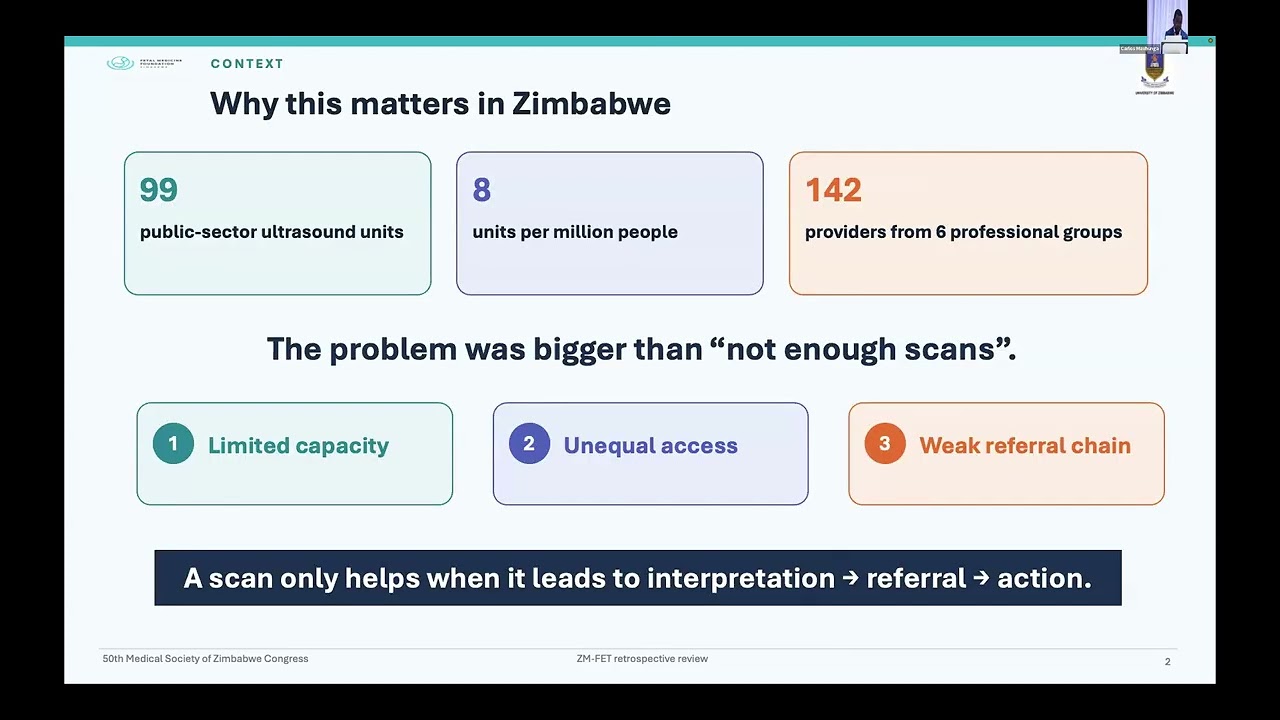
- Baseline data: only 16% of pregnant women receive ultrasound; 99 public-sector ultrasound units, 142 providers.
- Comparison of scan volumes: 2,678 in 2019-2020 vs 6,634 in 2025-2026.
- Reasons for referral: growth issues, well-being, hypertensive, and placenta disorders (60%).
- Training achievements: 350 providers, 20 trainers, 30+ O&G registrars.
- Clinical governance pathway: specialist oversight, triage, and supervised practice.
- Introduction of Mama Link digital platform with decision-making tool and image review.
- Conclusion: building an integrated referral system and multidisciplinary network.
Contribution & Novelties
This talk provides a rare in-depth look at a national-scale fetal medicine program in a low-resource setting, emphasizing governance and sustainable training. It demonstrates a replicable model for other African countries. The integration of digital platforms with clinical workflows is an innovative step.
Pour aller plus loin :
- Fetal medicine — Provides the scientific basis and techniques referenced in the talk.
- Task shifting — Discusses the WHO strategy of delegating tasks to non-physician providers, core to the training approach.
- Ultrasound in obstetrics — WHO guidance on ultrasound use in antenatal care, relevant to the scale-up context.
96 words
Radar Profile
The profile shows high scores in information quantity and technical level, with slightly lower scores in quality and reliability due to self-reported data. The talk is rich in specific numbers and detailed implementation, but its credibility is limited by a lack of external validation.