FMSZ 2026 Annual Congress Presentation by Dr Stephen Ganyani
Keywords
Summary
168 words
Critical Evaluation
Value of the Information & Strength of the Argument
The value of this presentation lies in its direct clinical relevance: it demonstrates that the choice of fetal growth standard can materially change the classification of growth restriction or macrosomia, which in turn influences antenatal management. The argumentation is supported by quantitative results showing distinct classification discrepancies among the three charts for the same measured pregnancies. The presenter clearly states the study’s primary objective as classification rather than superiority, which is a methodologically sound approach. However, the presentation could have been enhanced by a more detailed discussion of statistical methods, confidence intervals, and potential confounding factors (e.g., ethnicity, gestational age distribution). The argumentation is coherent but relies heavily on descriptive comparisons without formal inferential testing, limiting the strength of the claims.
Scientific Rigor, Source Quality, Title Accuracy
The scientific rigor is adequate for a congress presentation: the study uses a defined cohort, a held-out validation set, and explicitly addresses measurement convention differences (outer-to-outer vs. outer-to-inner). The sources cited are the WHO and INTERGROWTH-21st international standards, which are well-established. No external links were provided in the description, and the presentation did not cite specific publications, only the standards themselves. The title accurately describes the content as a congress presentation by Dr Ganyani, without overclaiming. The adequacy between title and content is high. No public comments were available for trend analysis.
228 words
Title / Content Match
The title accurately reflects the content: a congress presentation on comparing fetal growth charts.
Quality & Reliability
7/10
Presentation of a retrospective comparative study with a clear methodology and held-out validation, but limited peer-review and only one presenter.
Key Moments
Markers derived by PSI from the transcript: the creator did not define chapters.
- Introduction: Three-way comparison of candidate Zimbabwean, WHO, and INTERGROWTH-21st fetal growth charts.
- Key message: Choice of growth standard can alter diagnostic classification.
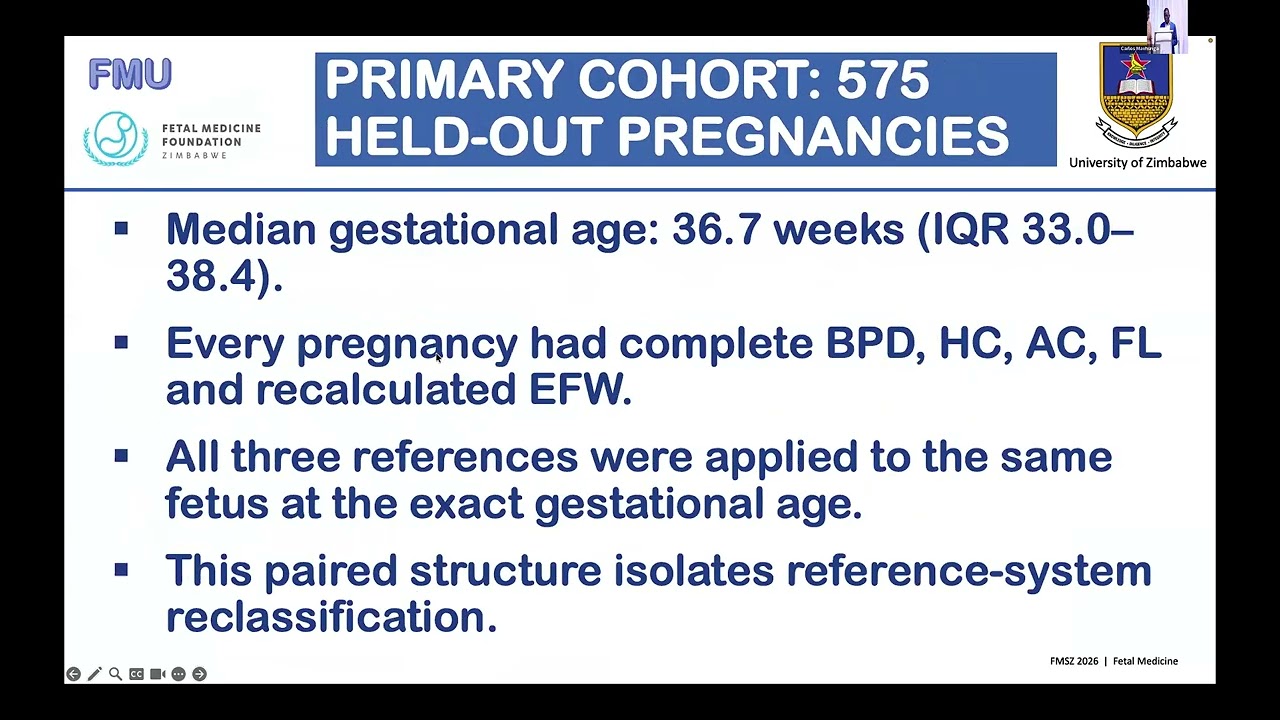
- Methodology: retrospective comparison on 575 held-out pregnancies, with inclusion criteria.
- Results: Classification rates differ (7.3% vs 4.7% vs 4.1% below 10th centile).
- Discussion: Three-chart agreement high for weight (89%) but lower for head circumference (62.6%).
- Conclusion: Charts are not interchangeable; protocol and chart must be used as a linked package.
Cited Sources
- WHO fetal growth charts — Mentioned as an international reference used for comparison in the study.
- INTERGROWTH-21st fetal growth standards — Mentioned as an international reference used for comparison in the study.
Contribution & Novelties
The original contribution is the first local validation of international fetal growth charts in a Zimbabwean population, showing that international standards may not be clinically interchangeable and that locally derived charts can significantly alter risk classification. This highlights the importance of context-specific chart selection. The presentation also underscores the need to report measurement protocols and chart choices in ultrasound reports.
Pour aller plus loin :
- INTERGROWTH-21st Project — Official site of the INTERGROWTH-21st initiative, providing details on the international fetal growth standards.
- Intrauterine growth restriction — Wikipedia article explaining clinical implications of fetal growth classification.
- Obstetric ultrasonography — Overview of ultrasound biometry and its role in fetal medicine.
108 words
Radar Profile
The radar profile shows a balanced distribution across information quantity, quality, and technical level, with a slightly lower reliability score reflecting the non-peer-reviewed nature and limited methodological detail presented. This is typical of a congress talk.