Prediction and Prevention of Pre-eclampsia by Dr Long Nguyen Hoang(Vietnam)
Keywords
Summary
168 words
Critical Evaluation
Value of the Information & Strength of the Argument
The value of this lecture lies in its concise, evidence-based synthesis of current strategies for PE prediction and prevention, with a particular focus on applicability to Asian populations—a common gap in global guidelines. The argumentation is solid, built on randomized controlled trials (ASPRE, Forecast) and meta-analyses (Roberge et al., role of dose and timing). The speaker logically progresses from screening performance data to preventive interventions, and addresses practical issues like adherence and chronic hypertension. He also introduces a novel mechanistic hypothesis (aspirin shift model) supported by metabolomic ageing data from the ASPRE trial, which adds original insight. The claims are well-nuanced, acknowledging uncertainties (optimal dose 75 vs 150 mg, ongoing studies). One minor weakness is that some statistics are cited without exact references (e.g., detection rates in Asia), but the overall reasoning is coherent and persuasive.
Scientific Rigor, Source Quality, Title Accuracy
The scientific rigour is high: the speaker references pivotal trials, meta-analyses, and international guidelines from FIGO, ISUOG, ACOG, and NICE. He clearly differentiates screening approaches and quantifies their performance. The quality of sources is strong, though specific citations (full author, journal) are not individually listed in the description, limiting immediate verifiability. The title accurately reflects the content—a focused presentation on PE prediction and prevention—without overclaiming. The content matches the title, and the speaker’s credentials (clinician) and context (congress) reinforce its credibility. The presentation does not include commercial sponsorship or product placement.
242 words
Title / Content Match
The title accurately reflects the content: a focused talk on prediction and prevention of pre-eclampsia, delivered by a named clinician from Vietnam, as part of a congress presentation.
Quality & Reliability
8/10
The presentation relies on major clinical trials (ASPRE, Forecast, meta-analyses) and international guidelines, demonstrating solid evidence synthesis. The speaker clearly distinguishes recommendations from supporting data, though some nuances (e.g., exact study dates, sample sizes) are not always precisely cited.
Key Moments
Markers derived by PSI from the transcript: the creator did not define chapters.
- Introduction and acknowledgements; speaker introduces topic: prediction and prevention of pre-eclampsia in Asia.
- Burden of pre-eclampsia: complications for mother and baby, 76,000 maternal deaths and 500,000 perinatal deaths annually.
- Classification of pre-eclampsia by gestational age at delivery (34/37 weeks) and link to severity.
- Checklist-based screening (ACOG/NICE) versus FMF combined test with biomarkers (PLGF, PAPP-A, uterine artery PI).
- FMF model performance: detects 90% early-onset, 80% preterm, 45% term PE at 10% false-positive rate; superiority over ACOG/NICE.
- Validation in Asia: prospective study of 11,000 women across 7 countries; detection rates of 65% preterm PE at 10% FPR, 76% at 20% FPR.
- Prevention: ASPRE trial (150mg aspirin <14 weeks) reduces preterm PE by 60% and early-onset by 80%; Forecast trial in Asia shows 40-55% reductions.
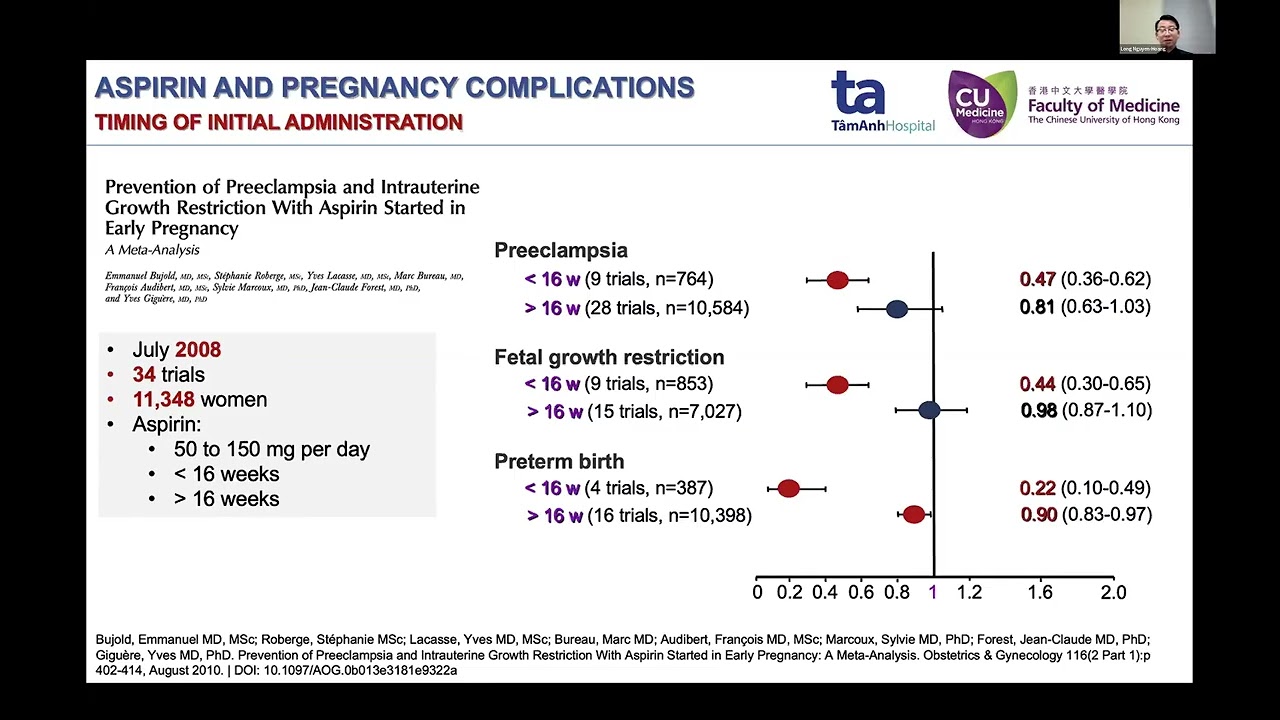
- Timing and dose of aspirin: meta-analyses show benefit only if initiated <16 weeks and dose ≥100 mg; low-dose (<100 mg) ineffective.
- Aspirin adherence and chronic hypertension: adherence <90% wipes protection; excluding chronic hypertension boosts prevention to 95%.
- Mechanism: aspirin shift model—delays PE onset; metabolomic gestational age shows 3-4 weeks delay in placental maturation.
- Aspirin reduces preterm birth and placenta-related complications before 32 weeks; global screening recommendations summary.
Cited Sources
- ASPRE trial (Aspirin for Evidence-Based Preeclampsia Prevention) — Cited as the landmark European RCT demonstrating 60% reduction in preterm PE and 80% reduction in early-onset PE with 150mg aspirin started before 14 weeks.
- Forecast trial (First Trimester Aspirin for Preeclampsia Prevention in Asia) — Large randomized/observational study across 18 hospitals in 10 Asian countries showing 40-55% reduction in preterm PE in real-world setting.
- Meta-analysis on aspirin dose and timing (Roberge et al., 2018) — Cited to support the need for ≥100 mg dose and initiation before 16 weeks; no effectiveness if started later.
- Meta-analysis of 34 trials (11,000 women) on aspirin timing — Cited to show aspirin before 16 weeks reduces PE, FGR, and preterm birth; no effect after 16 weeks.
Contribution & Novelties
This presentation adds value by presenting real-world Asian data (Forecast study) that validates the FMF combined screening test, and by highlighting the importance of aspirin dose and timing with actionable recommendations. The ‘aspirin shift model’—that aspirin delays PE onset rather than entirely preventing it—is a novel mechanistic interpretation supported by metabolomic data, which could refine future research and clinical counselling. It also emphasizes adherence and chronic hypertension as modulators of aspirin efficacy, and notes ongoing trials comparing 75 vs 150 mg doses.
Pour aller plus loin :
- Pre-eclampsia - Wikipedia — Background on disease mechanisms and clinical definition.
- WHO fact sheet on pre-eclampsia and eclampsia — Global burden and prevention guidelines.
- Fetal Medicine Foundation — Official source for the combined screening algorithm and research.</p></description>
124 words
Radar Profile
The profile shows high scores in technical level and information quantity/quality, reflecting a dense, evidence-rich presentation. The fiabilite is also high, though slightly lower than the technical depth due to reliance on summary citations. The overall shape is balanced, indicating a rigorous and informative talk with minor caveats in source verifiability.