FMSZ 2026 Annual Congress Presentation by Dr Cladious Verenga
Keywords
Summary
123 words
Critical Evaluation
Value of the Information & Strength of the Argument
The value lies in providing locally derived reference charts, which is critical because existing charts come from different populations. The argumentation is solid: clear methodology, appropriate statistical techniques, transparent limitations. The internal validation shows acceptable performance, but external validity remains uncertain. The presenter acknowledges that the study is retrospective and not yet validated against pregnancy outcomes.
Scientific Rigor, Source Quality, Title Accuracy
The study uses a large dataset and rigorous statistical methods (quantile regression with splines, weighting to avoid overrepresentation). However, since it’s retrospective, there is potential for selection bias, and measurements were not reviewed for quality. The presenter does not cite specific sources in the video, but relies on established methodology. The title is generic (‘FMSZ 2026 Annual Congress Presentation’) but the description specifies the study; the content matches the description, so the title is adequate enough, though not descriptive. This minor mismatch is considered in the global score.
159 words
Title / Content Match
The title is generic (congress presentation) but the description specifies the study; the content matches the description. Slight mismatch because the title itself is not descriptive.
Quality & Reliability
7/10
Retrospective study with robust statistical methods (quantile regression, splines), internal validation, but lacks external validation and outcome linkage. Clear transparency about limitations.
Key Moments
Markers derived by PSI from the transcript: the creator did not define chapters.
- Introduction: need for local fetal biometric charts in Zimbabwe
- Description of retrospective study design and data collection from 11,723 clients
- Explanation of statistical methods: quantile regression and cubic splines for centile construction
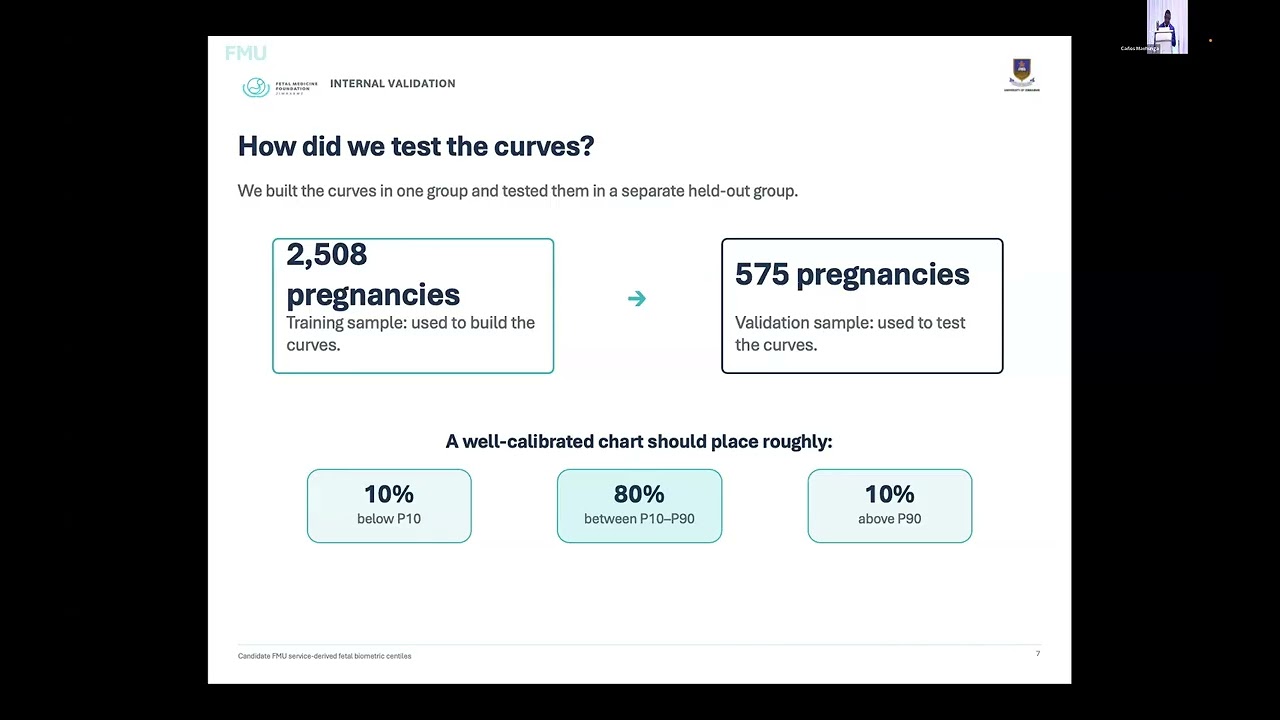
- Discussion of internal validation process and weighting to balance gestational age distribution
- Presentation of results and resulting Zimbabwean candidate charts
- Limitations acknowledged and future plans for prospective national validation
Contribution & Novelties
The novel contribution is the creation of Zimbabwe-specific fetal biometric centiles using a large local dataset, addressing the lack of population-specific reference charts. This is a step towards improving prenatal care in Zimbabwe. The study is original but preliminary.
Pour aller plus loin :
- Quantile regression — Explains the statistical method central to the study.
- INTERGROWTH-21st — International effort to create fetal growth standards.
- Fetal growth restriction — Clinical relevance of centile charts.
73 words
Radar Profile
The profile shows high scores in information quantity and technical level, but slightly lower in quality and reliability, reflecting the study's robust statistical methods but preliminary status.