Turning the pyramid of prenatal care by Prof Kypros Nicolaides(UK)
Keywords
Summary
163 words
Critical Evaluation
Value of the Information & Strength of the Argument
The talk presents a compelling argument backed by extensive clinical experience and numerous large-scale studies, including the speaker’s own research and landmark trials. The speaker systematically demonstrates how early screening can predict and prevent conditions like preeclampsia and preterm birth, offering concrete strategies such as aspirin prophylaxis at 12 weeks. He also addresses practical concerns, such as cost and feasibility in public health systems, proposing innovative solutions like ophthalmic artery Doppler AI and blind sweep ultrasound to reduce costs. The argumentation is coherent, evidence-driven, and persuasive, though it is delivered from a single expert’s viewpoint with limited critical discussion of potential limitations.
Scientific Rigor, Source Quality, Title Accuracy
The lecture maintains a high scientific standard, referencing numerous peer-reviewed studies and large-scale trials (e.g., a Lancet study on 36-week preeclampsia screening). The speaker cites historical milestones and recent advances accurately. However, the talk lacks formal citations during presentation, and some claims are presented without immediate reference to publications. The title accurately encapsulates the core message, and the content consistently adheres to the title’s promise.
182 words
Title / Content Match
The title accurately reflects the central thesis of the talk, which is to invert the traditional pyramid of prenatal care toward early prediction and prevention.
Quality & Reliability
8/10
The lecture is delivered by a leading expert in fetal medicine with decades of research experience. It synthesizes multiple evidence-based advancements and personal research findings, though it primarily reflects the speaker's perspective and does not provide extensive formal citations during the talk.
Key Moments
Markers derived by PSI from the transcript: the creator did not define chapters.
- Introduction and presentation of the traditional pyramid of prenatal care
- Discovery of nuchal translucency and its link to chromosomal abnormalities
- Proposal to invert the pyramid and rationale for early prediction/prevention
- Screening for chromosomal abnormalities: from maternal age to cell-free DNA
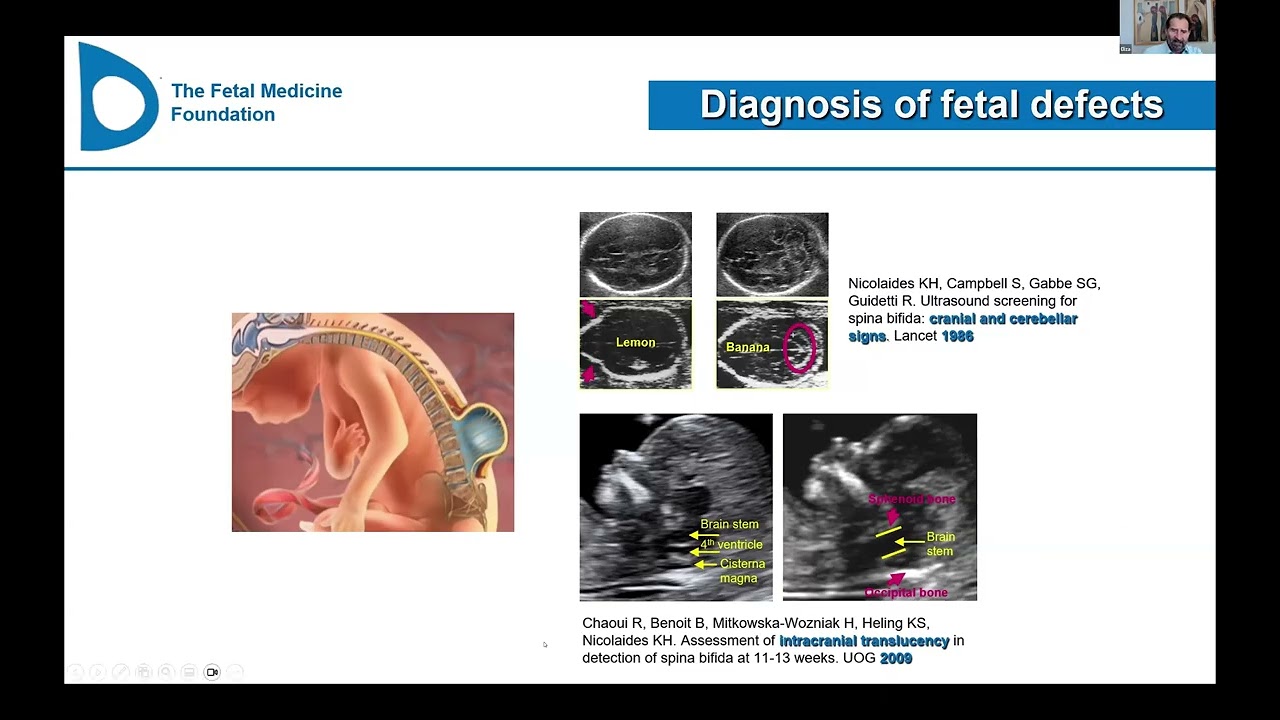
- Detection of structural defects, especially spina bifida, in first trimester
- Preeclampsia screening and prevention with aspirin; the Gates Foundation study
- The 36-week 'birth plan scan' and its role in delivery planning
- Gestational diabetes: moving screening to first trimester and continuous glucose monitoring
- Preterm birth prediction via cervical length measurement and management
- Postnatal follow-up at 6 months to address long-term maternal cardiovascular risks
Contribution & Novelties
The talk provides a visionary framework for restructuring prenatal care, emphasizing early prediction and prevention. It introduces specific innovations such as the ‘birth plan scan’ at 36 weeks, the use of ophthalmic artery Doppler AI to replace costly biomarkers, and the potential of blind sweep ultrasound for low-cost fetal weight estimation. The speaker also advocates for extending prenatal care to 6-month postnatal assessments, a novel approach to addressing long-term health.
Pour aller plus loin :
- Nuchal translucency – Wikipedia — Background on the marker central to first-trimester screening.
- ASPRE trial – NEJM — Key evidence for aspirin in preventing preterm preeclampsia.
- ISUOG Guidelines — Professional guidelines for prenatal ultrasound and screening.
111 words
Radar Profile
The profile shows a very high quantity and quality of information, with a strong technical depth (scores around 8-9). This reflects a dense, expert-level presentation of scientific content. The overall reliability is also high, though slightly lower than other metrics, consistent with a single-expert opinion without formal citations in the talk.