Trainer and Trainee Experiences From a Qualitative Phenomenological Study- Dr C. Verenga
Keywords
Summary
184 words
Critical Evaluation
Value of the Information & Strength of the Argument
The value of this presentation lies in its focus on a real-world, low-resource setting, addressing the shortage of trained providers in obstetric ultrasound. The qualitative approach provides rich insights into the training experience, which can inform similar programs. The argumentation is cohesive: the speaker clearly outlines the study design, methodology, and findings, and appropriately acknowledges limitations. The use of phenomenology to capture the essence of lived experiences adds depth. However, the presentation is brief, and some details, such as specific interview questions or data saturation criteria, are omitted. The speaker does not provide quantitative evidence of training effectiveness, but that is not the aim of this qualitative study. Overall, the argument is solid within its scope.
Scientific Rigor, Source Quality, Title Accuracy
The study appears methodologically sound, using a recognized qualitative framework (transcendental phenomenology). The description of the course and evaluation is clear. However, no external sources are cited in the video, and the presentation is not peer-reviewed in this form. The title accurately reflects the content, and the presentation is appropriately titled for a congress presentation. The speaker mentions that a paper is available via a QR code, but no direct citation is provided. Given the limited scope, the rigour is acceptable but could benefit from more detailed references.
219 words
Key Moments
Markers derived by PSI from the transcript: the creator did not define chapters.
- Introduction: background on shortage of providers in Zimbabwe and study purpose.
- Description of the six-week training course structure: theory, attachment, exit assessment.
- Focus of training: viability, dating, biometry, and care pathways.
- Study design: qualitative transcendental phenomenology, interviews with 8 trainers and 8 trainees.
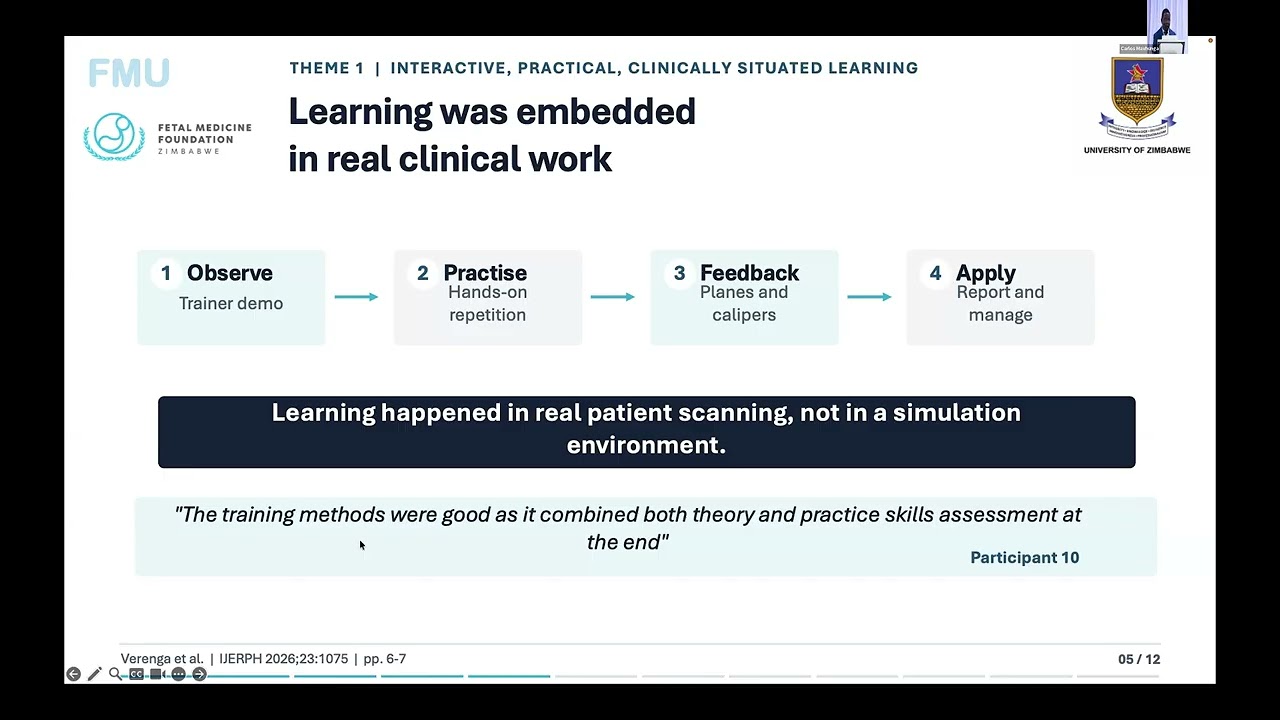
- Theme 1: Interactive, practical, clinically situated learning.
- Theme 2: Confidence and basic skill development through supervised practice.
- Theme 3: Interprofessional learning and reshaping of professional hierarchy.
- Theme 4: Sustainability, equipment access, mentorship, and refresher courses.
- Strengths, limitations, and future evaluations.
Cited Sources
- Husserl's transcendental phenomenology — Mentioned as the philosophical basis for the study design.
- Moustakas' phenomenological analysis method — Cited as the analytical framework used in the study.
Contribution & Novelties
This study contributes to knowledge by providing qualitative evidence on the experiences of both trainers and trainees in a low-resource setting, specifically in obstetric ultrasound training. It highlights the importance of interprofessional education and the need for ongoing support systems. The findings suggest that practical, clinically embedded training builds confidence and skills, but sustainability requires robust infrastructure.
Pour aller plus loin :
- Transcendental phenomenology — Concept of phenomenological philosophy that underpins the study.
- Task shifting — Policy approach to address workforce shortages by redistributing tasks to less specialized health workers.
- WHO Manual on Diagnostic Ultrasound (possible reference) — World Health Organization guidelines on training in diagnostic ultrasound, though not directly cited in the video.
114 words
Radar Profile
The radar shows a strong performance in quantity of information and overall reliability, with moderate technicality. The video provides substantial content on a specialized topic, but the lack of external citations slightly reduces confidence.