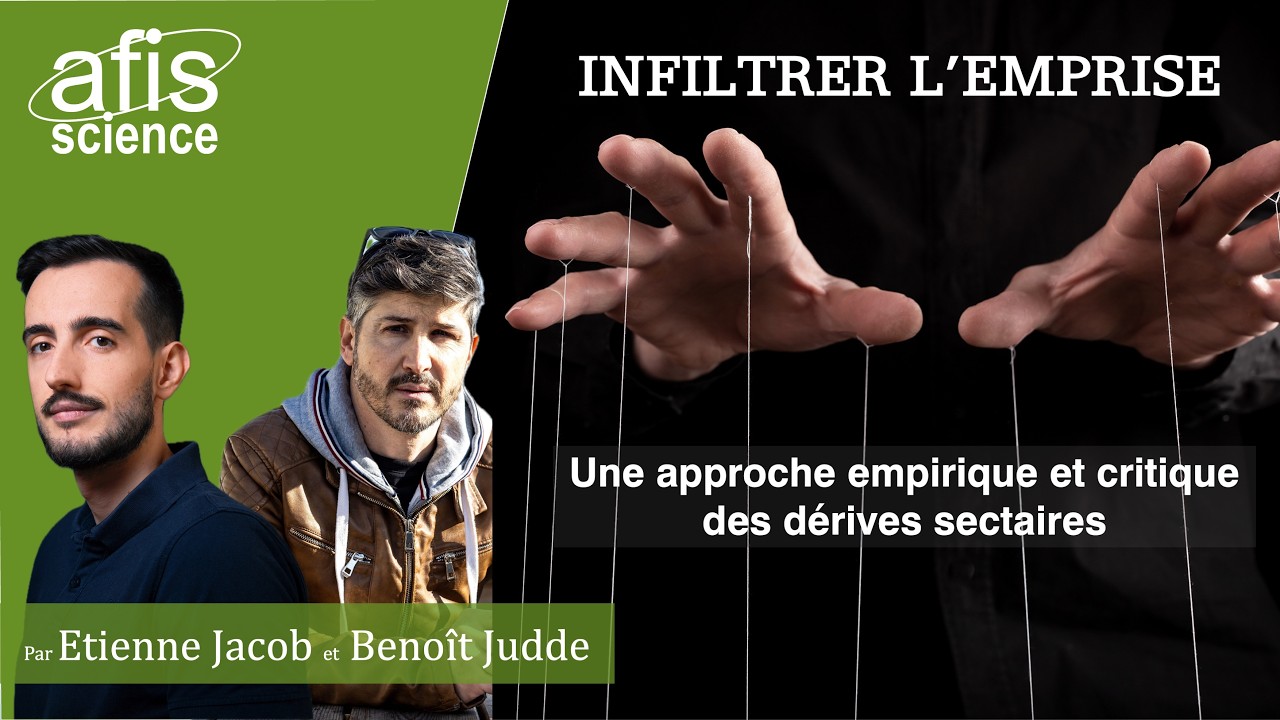
Infiltrer l’emprise : une approche empirique et critique des dérives sectaires
Infiltrating Influence: An Empirical and Critical Approach to Cult-Like Movements
Keywords
Summary
139 words
Critical Evaluation
Value of the Information & Strength of the Argument
The value of the information lies in the unique combination of journalistic and private-detective perspectives, offering concrete insights into the practice of infiltration and the psychological levers used by cults. The argumentation is solid: both speakers justify their methods by referring to ethical codes, legal texts (e.g., the 2024 reform on psychological suggestion), and observations from their field experiences. They carefully distinguish between objective facts and subjective interpretations, and they acknowledge the limitations of their approach, including potential biases and the risk of generalization. The discussion is well-structured, moving from legal definitions to real-world examples and then to critical reflection, which strengthens the credibility of their testimony.
Scientific Rigor, Source Quality, Title Accuracy
The scientific rigor is commendable: the speakers reference precise legal articles and codes, and they explicitly connect their observations to the literature in social and cognitive psychology. They do not overstate conclusions but instead propose a critical framework for understanding cultic phenomena. The title perfectly matches the content, as the presentation focuses on empirical infiltration as a method for studying and critiquing cultic deviations. The sources used are predominantly their own books and official AFIS resources; they do not cite external academic papers during the talk, but they do align their claims with established knowledge. No audience comments were provided, so no public reaction trends can be analyzed.
230 words
Title / Content Match
The title accurately reflects the content: speakers detail their empirical infiltration experiences and critically analyze cultic mechanisms, making the title fully appropriate.
Quality & Reliability
8/10
High reliability due to expert speakers, rigorous discussion of legal and psychological frameworks, and a critical approach to their own methods. However, content relies heavily on personal anecdotes and infiltration experiences, which limits generalizability.
Key Moments
Markers derived by PSI from the transcript: the creator did not define chapters.
- Introduction by the moderator describing the speakers and the topic.
- Étienne Jacob presents his journalism background and methods.
- Benoît Judde explains the legal and regulatory environment of private detectives in France.
- Discussion of the legal concept of 'suggestion psychologique' and its 2024 reform.
- First-hand account of infiltration into the Raëlian movement.
- Analysis of manipulation techniques and their psychological effects.
- Exploration of external factors that make individuals vulnerable to cult recruitment.
- Emphasis on the universality of susceptibility to manipulation.
- Why journalists choose to go undercover in cults.
- Examples of journalistic infiltrations and their challenges.
- Why private detectives infiltrate cults and the legal limits.
- Discussion of hidden camera investigations and evidence collection.
- Question-and-answer session with the audience.
Cited Sources
- Science et pseudo-sciences (revue) — The AFIS journal is mentioned as a resource for scientific information.
- Qu'est-ce que l'AFIS ? — The AFIS association's presentation page is referenced for further information.
Contribution & Novelties
The conference’s original contribution is the rare dual perspective of a journalist and a private detective on the empirical practice of infiltration into cultic environments. They provide concrete operational insights while maintaining a critical stance on the methodology, which is often absent in sensationalist accounts. The discussion of the legal evolution of ‘suggestion psychologique’ is particularly novel for a general audience.
Pour aller plus loin :
- Cult — Overview of cultic groups and their defining features.
- Brainwashing — Theoretical background on coercive persuasion techniques.
- Cognitive bias — Explanation of the cognitive shortcuts exploited by manipulative groups.
96 words
Radar Profile
The radar profile shows high scores in quantity and reliability, indicating a content-rich and trustworthy discussion. The lower technical level (7) reflects the fact that the talk is accessible to a non-specialist audience, avoiding overly academic jargon. The quality score (8) is consistent with the speakers' rigorous approach.