L6 Unitary Matrix and Complete Basis
Keywords
Summary
140 words
Critical Evaluation
Value of the Information & Strength of the Argument
The value of this lecture lies in its clear pedagogical approach. The instructor builds intuition step by step, starting from basic linear algebra and progressing to the definition and properties of unitary matrices. The argumentation is solid: the proof that unitary matrices preserve inner products is rigorous and well-explained. The use of a concrete example (sigma x) helps solidify the abstract concept of outer product reconstruction. The discussion of column/row orthonormality provides a practical criterion for checking unitarity. The instructor also clarifies common misconceptions, such as the difference between inner and outer products, and the action of the adjoint on bra vectors.
Scientific Rigor, Source Quality, Title Accuracy
The scientific rigor is high for a lecture: definitions are precise, proofs are complete, and examples are worked out in detail. The sources are limited to the course playlist provided in the description, which serves as the reference for the entire series. The title accurately represents the content, which centers on unitary matrices and their connection to complete bases. The lecture does not claim to present original research but rather a tutorial on fundamental concepts. The instructor’s willingness to correct mistakes during the lecture actually enhances credibility, as it shows a live, unscripted teaching environment.
212 words
Title / Content Match
The title accurately reflects the lecture's focus on unitary matrices and their connection to complete bases in quantum computing.
Quality & Reliability
8/10
Lecture delivers a clear, step-by-step explanation of unitary matrices, including proofs and examples, with minor self-corrected errors that actually reinforce understanding.
Key Moments
Markers derived by PSI from the transcript: the creator did not define chapters.
- Administrative announcements and reminder about homework.
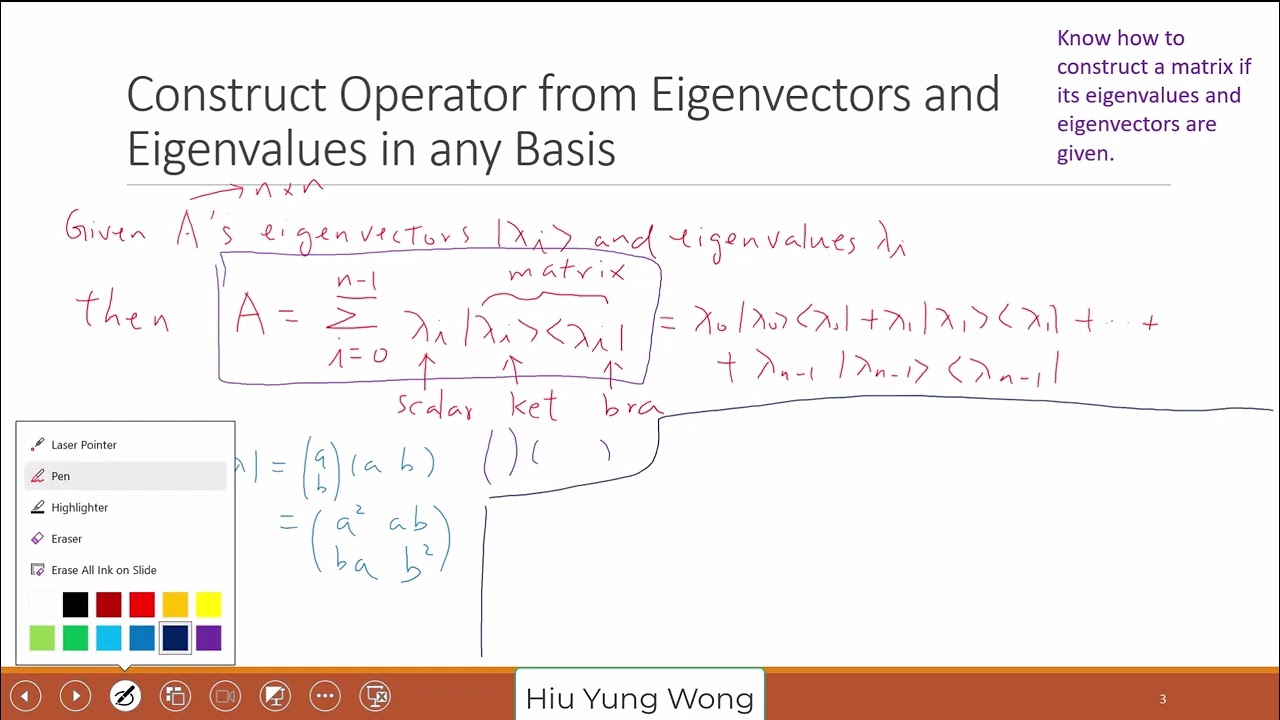
- Recap of eigenvalues/eigenvectors and formula to reconstruct a matrix from eigenpairs.
- Example: constructing sigma x from its eigenvectors using outer products.
- Definition of unitary matrix (U†U = I) and its importance in quantum computing.
- Proof that unitary matrices preserve inner products, with step-by-step derivation.
- Interpretation of unitary matrix columns and rows as orthonormal basis vectors.
Cited Sources
- Course Playlist: Quantum Computing, TCAD, Semicond — Playlist containing the full lecture series, likely including supplementary materials.
Contribution & Novelties
The lecture provides a clear, intuitive treatment of unitary matrices, emphasizing their physical significance in quantum mechanics and quantum computing. It bridges the gap between abstract linear algebra and practical applications, such as quantum gates. The ‘pour aller plus loin’ suggestions below offer avenues for deeper exploration.
Pour aller plus loin :
- Unitary matrix — Covers definition, properties, and examples.
- Quantum gate — Explains how unitary matrices represent quantum operations.
- Inner product space — Provides background on inner products and their preservation.
82 words
Radar Profile
The radar profile shows high scores in qualitative information and reliability, indicating a well-structured and trustworthy lecture. The technical level is moderately high, suited for an intermediate audience. Quantitatively, the score reflects a thorough but not overly dense coverage of the topic.