L12 Matrix Trace and Hadamard Gate
Keywords
Summary
145 words
Critical Evaluation
Value of the Information & Strength of the Argument
The value of this lecture lies in its clear, step-by-step derivation of fundamental concepts in quantum computing. The instructor builds logical arguments from basic definitions to more complex results, such as showing the trace invariance via unitary transformation and demonstrating the self-inverse property of the Hadamard gate through explicit matrix calculations. The argumentation is solid, though it occasionally relies on stated properties without proof (e.g., trace of AB = BA) and contains minor notational ambiguities. Overall, the reasoning is coherent and pedagogically effective.
Scientific Rigor, Source Quality, Title Accuracy
The content aligns with standard quantum computing curricula and no external sources are cited beyond a playlist link. The title accurately reflects the content, which is fully dedicated to the matrix trace and the Hadamard gate. The instructor’s explanations are rigorous and mathematically sound, with only trivial typos (e.g., date 2026) that do not affect the scientific integrity. There is no evidence of misinformation, and the teaching method encourages understanding over memorization.
170 words
Title / Content Match
Excellent: title directly reflects the topics covered (matrix trace and Hadamard gate).
Quality & Reliability
8/10
Lecture by university instructor, covers standard concepts clearly with examples; some minor typos and informal language, but overall reliable and well-structured.
Key Moments
Markers derived by PSI from the transcript: the creator did not define chapters.
- Administrative announcements: assignments, midterm, IBMQ access.
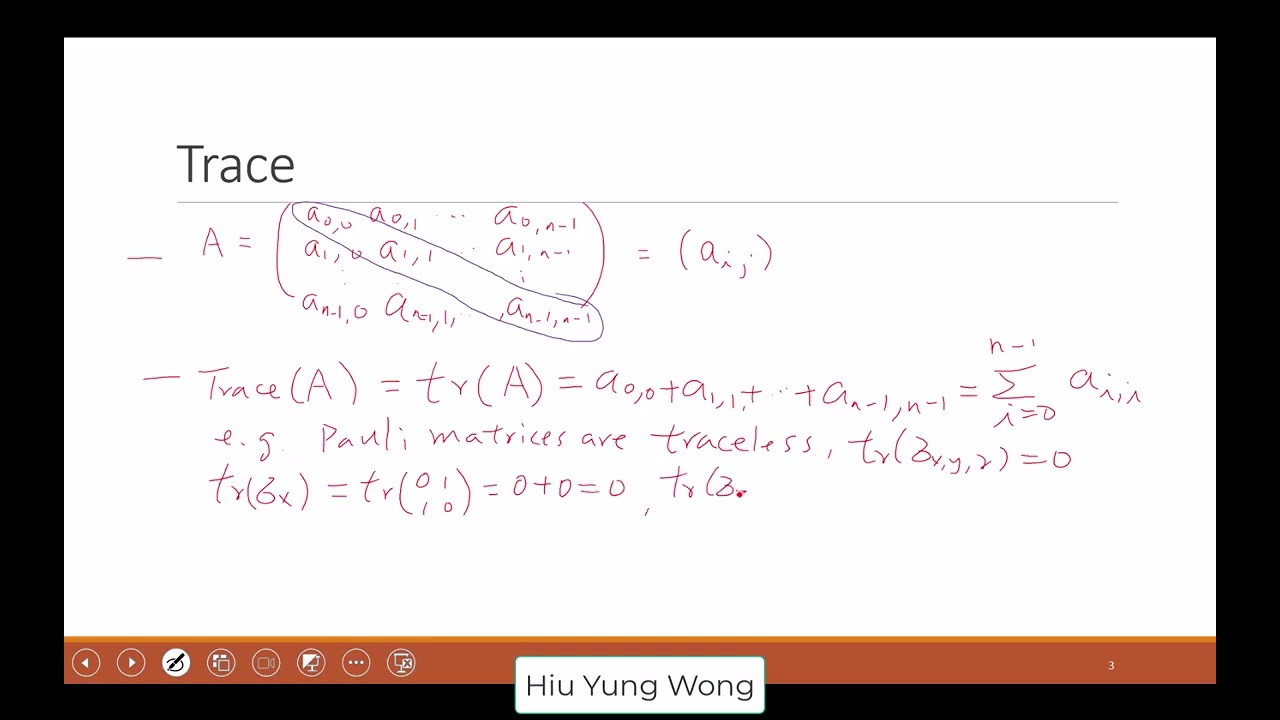
- Definition of trace of a matrix as sum of diagonal elements.
- Example: Pauli matrices are traceless.
- Trace invariance under unitary transformation and relation to eigenvalues.
- Introduction to the Hadamard gate and its effect on basis states.
- Matrix representation of Hadamard gate and verification.
- Detailed computation of Hadamard inverse using minors and determinant.
- Conclusion that Hadamard gate is its own inverse.
- N-qubit Hadamard gate applied to |0...0> gives equal superposition of all basis states.
Cited Sources
- Lecture Playlist — General playlist for the lecture series, likely containing related materials and references.
Contribution & Novelties
This lecture serves as a foundational educational resource, systematically explaining matrix trace and the Hadamard gate—cornerstones of quantum computing. It bridges linear algebra concepts with quantum gate operations, providing derivations that reinforce understanding. The discussion of the n-qubit Hadamard transformation highlights the generation of uniform superpositions, crucial for quantum algorithms. The lecture does not present new research but offers a clear pedagogical contribution.
Pour aller plus loin :
- Hadamard gate (Wikipedia) — Overview of the Hadamard gate’s properties and role in quantum computing.
- Trace (linear algebra) (Wikipedia) — Detailed definitions and properties of matrix trace.
- Pauli matrices (Wikipedia) — Fundamental matrices used in quantum mechanics, including tracelessness.
107 words
Radar Profile
The radar profile shows a balanced lecture with high reliability and quantity of information, moderate technical depth, and good quality. The scores are consistent with an educational tutorial that thoroughly covers foundational topics without extreme specialization.