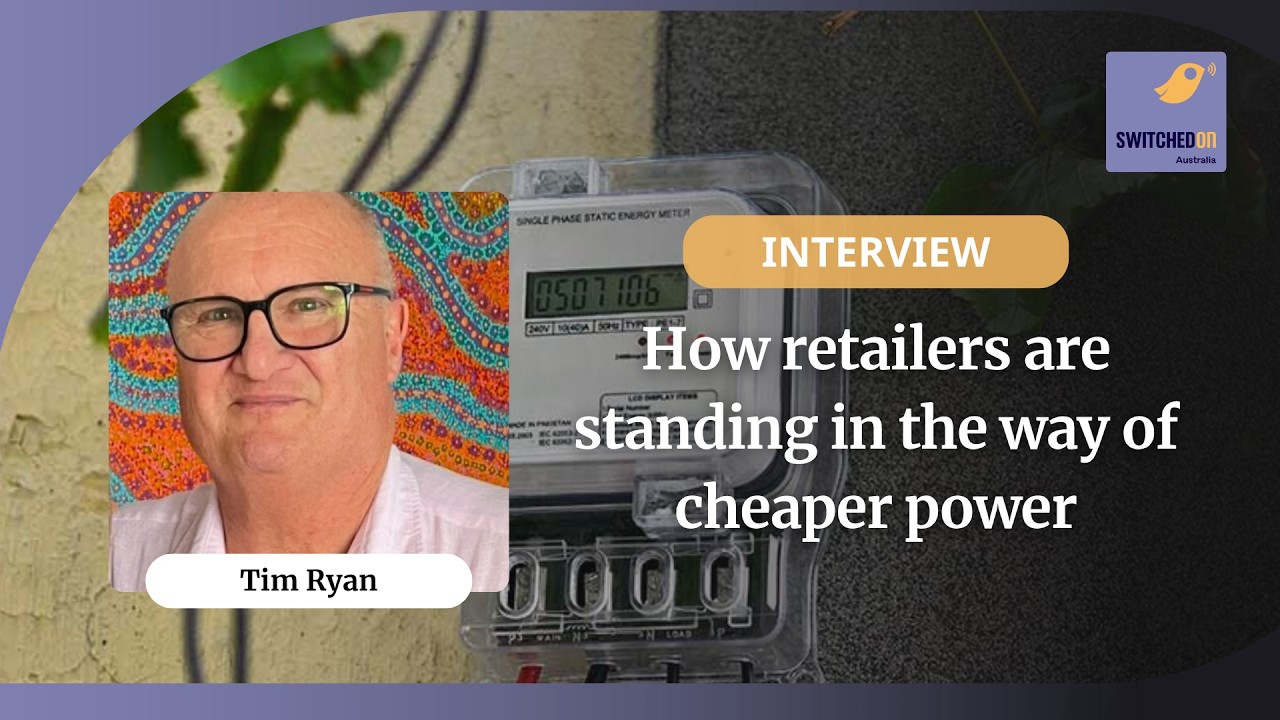
How retailers are standing in the way of cheaper power | SwitchedOn Australia
Keywords
Summary
201 words
Critical Evaluation
Value of the Information & Strength of the Argument
The video offers a compelling and detailed critique of the current electricity market from a consumer perspective. Tim Ryan provides concrete examples such as the Solar Sharer program and Project Edith tariff to illustrate how retailers and network operators often serve their own interests rather than those of households. His argumentation is logically structured, building from the premise that retailers are profit-driven corporations to the conclusion that a direct network-consumer relationship would be more efficient. He introduces innovative concepts like the ‘Consumers’ Grid’ and ‘magic pudding effect’ to explain how dynamic grid management can benefit all parties. The discussion is rich with practical insights about tariffs, batteries, and the regulatory environment, making it valuable for anyone interested in energy transition policy. However, the viewpoint is explicitly one-sided, presenting the case against retailers without substantial counterarguments, which limits its neutrality as a source.
Scientific Rigor, Source Quality, Title Accuracy
The scientific rigor of the video is moderate. While Tim Ryan draws on his experience as a consumer representative and references specific regulatory processes and programs, he does not provide peer-reviewed studies or empirical data to support his claims. The sources cited are limited to the channel’s social media and newsletter links, which are not substantive references. The title accurately captures the core thesis of the video: that retailers are blocking cheaper power for consumers. Although the content is opinionated, it clearly aligns with the title. The lack of external citations and balanced perspectives reduces its reliability as a scientific source, but it serves as a well-articulated expert opinion on a pressing policy issue.
271 words
Title / Content Match
The title accurately reflects the central argument that retailers hinder cheaper power for households.
Quality & Reliability
6/10
The video presents an expert's opinion on electricity market design, drawing on specific examples but without peer-reviewed evidence or counterarguments.
Key Moments
Markers derived by PSI from the transcript: the creator did not define chapters.
- Introduction of Tim Ryan and the topic of retailers as obstacles.
- Discussion on the fundamental conflict of interest of retailers.
- Critique of the Solar Sharer program and the 'blunt disaster' description.
- Introduction of the 'Consumers' Grid' concept and community batteries.
- Discussion on network tariffs, the Project Edith tariff, and the role of regulators.
Cited Sources
- Renew Economy LinkedIn page — Channel's official LinkedIn page mentioned in the video description.
- Renew Economy Bluesky profile — Channel's official Bluesky profile mentioned in the video description.
- Renew Economy Newsletter sign-up — Newsletter subscription link mentioned in the video description.
Contribution & Novelties
The primary novelty is the proposal of a ‘Consumers’ Grid’ that would allow households to interact directly with distribution networks, bypassing retailers. This concept highlights the potential for dynamic tariffs and community energy storage to empower consumers and improve grid efficiency. The video also challenges conventional assumptions about the necessity of retailers in a digital energy system.
Pour aller plus loin :
- Virtual power plant — A concept discussed implicitly as a way to aggregate distributed energy resources.
- Demand response — The mechanism of shifting electricity usage in response to supply conditions, relevant to dynamic pricing.
- Dynamic pricing — The tariff structure that Tim Ryan advocates as a means for consumers to benefit from low-cost periods.
116 words
Radar Profile
The radar profile shows a high quantity of information (8) and moderate technical level (7), but lower reliability (6) and quality (6). This indicates a content-rich but opinion-driven discussion that provides detailed insights yet lacks rigorous verification.