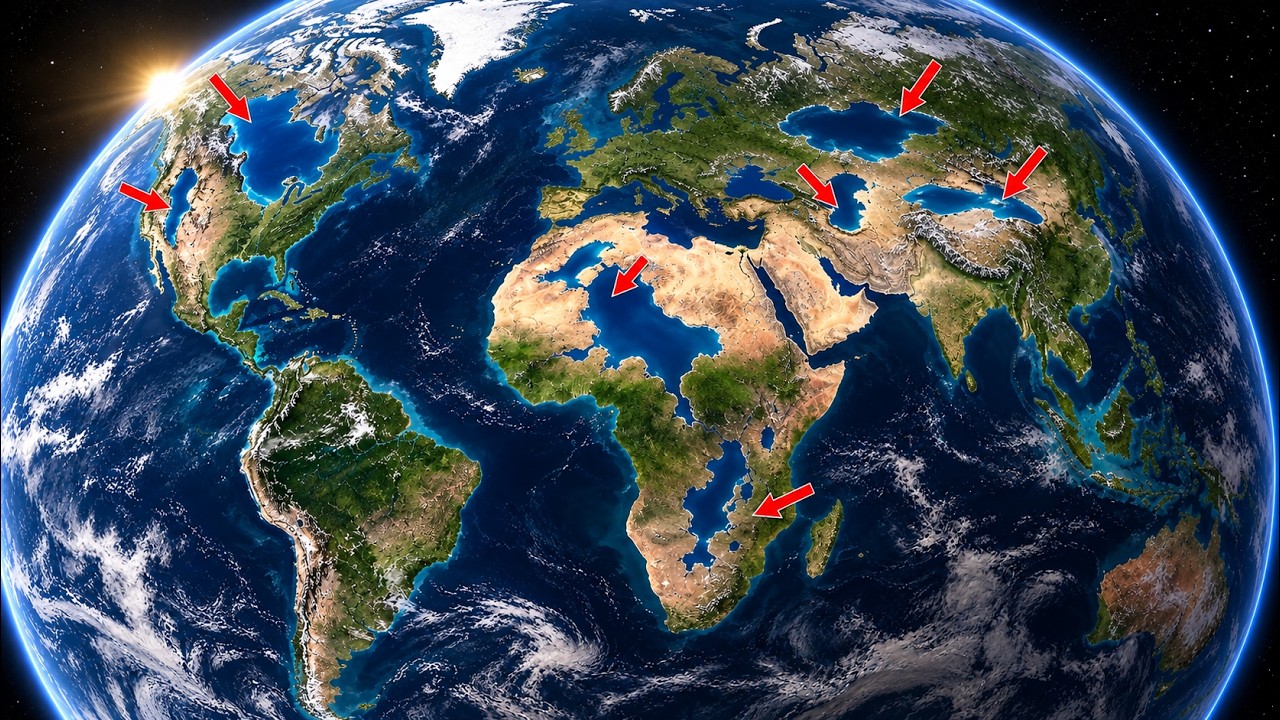
L’étrange carte des lacs géants disparus
The Strange Map of Lost Giant Lakes
Keywords
Summary
173 words
Critical Evaluation
Value of the Information & Strength of the Argument
The video provides tremendous educational value by connecting disparate regions and geological epochs into a coherent narrative. It excels at visualizing abstract volumes and temporal scales, explaining how, for example, the drainage of Lake Agassiz impacted global thermohaline circulation. The argumentation is solid, logically progressing from genesis to catastrophe to decline, supported by numerical data (areas, volumes, ages). Hypotheses are presented clearly, and the environmental causality is convincingly articulated, making modern landscapes intelligible through their ancient watery past.
Scientific Rigor, Source Quality, Title Accuracy
The scientific rigor is high, drawing on classic paleolimnology literature (Cohen’s ‘Paleolimnology’, Vincent’s ‘Les lacs’) and several peer-reviewed articles available via ScienceDirect. The creator explicitly credits sources, which bolsters trust. The title accurately reflects the subject, though it emphasizes mystery over the systematic scientific review that follows. The analysis of the 30 comments reveals an overwhelmingly positive public reception, praising the blend of poetry and science, with recurring requests for clearer labeling of AI-generated imagery to distinguish them from real archival footage.
175 words
Title / Content Match
The title accurately reflects the core subject—the vanished giant lakes—though it slightly overemphasizes 'strangeness' rather than the rigorous geological and climatic narrative that follows.
Quality & Reliability
8/10
The video synthesizes well-established paleolimnological and paleoclimatological research, explicitly citing academic books (Cohen, Vincent) and peer-reviewed articles linked in the description. The narrative is scientifically accurate, although it blends AI-generated and archival visuals without always explicit labeling.
Chapters
Cited Sources
- Paleolimnology: The History and Evolution of Lake Systems (Andrew S. Cohen) — Book cited as a foundational source for paleolimnological methods and lake history.
- Les lacs : une brève introduction (Warwick F. Vincent) — Book cited as a general reference for limnology and lake science.
- ScienceDirect Article (PII 0033589478900352) — Peer-reviewed article linked in the description, likely addressing a specific quaternary lake system.
- ScienceDirect Article (PII S0277379103003433) — Peer-reviewed article on Quaternary paleoclimate or glaciation, linked in the description.
- ScienceDirect Article (PII S0277379109000584) — Peer-reviewed article linked in the description, related to glacial lakes or paleohydrology.
- ScienceDirect Article (PII S1040618201000635) — Peer-reviewed article linked in the description, potentially on Lake Megachad or the African humid period.
Concurring Sources
- Paleolimnology: The History and Evolution of Lake Systems (Andrew S. Cohen) — Concordant academic reference providing the theoretical framework for paleolake studies.
- ScienceDirect Article (PII S0277379103003433) — Concordant peer-reviewed study on quaternary paleoclimate supporting the video's climate interpretations.
- ScienceDirect Article (PII S1040618201000635) — Concordant source on lacustrine sediments or paleohydrology, aligned with the discussed megachad system.
Contribution & Novelties
The video’s added value lies in its synthetic, globe-spanning narrative of vanished giant lakes, clearly linking geological events to planetary-scale climatic consequences (e.g., Agassiz’s impact on the 8.2 ka event). It popularizes complex paleoclimatic concepts through striking visual analogies and a coherent chronological flow across continents. By juxtaposing examples from North America, Africa, and Siberia, it highlights common physical mechanisms of lake formation and demise, offering an engaging mental map for audiences.
Pour aller plus loin :
- Lake Agassiz — Central to the video, this page details its history and catastrophic drainage events.
- Missoula floods — Explains the repeated glacial lake outburst floods that sculpted the Channeled Scablands.
- African humid period — Contextualizes the Green Sahara and the rise of Lake Megachad, a key example in the video.
- Ancylus Lake — Directly corresponds to the Baltic Sea precursor covered in the latter part of the video.
146 words
Radar Profile
The radar displays a strong, balanced profile across all four axes, with 'Quantité d'information' and 'Qualité d'information' peaking highest. 'Niveau technique' is slightly lower, reflecting the accessible popularization tone, while 'Fiabilité globale' remains high, grounded in the cited academic literature and methodology.
💬 Très positif. Sur les 30 commentaires analysés, le public exprime un enthousiasme unanime pour la narration poétique et la rigueur scientifique, avec des demandes récurrentes pour identifier explicitement les images générées par IA.