6 Graph Problems (English)
Keywords
Summary
147 words
Critical Evaluation
Value of the Information & Strength of the Argument
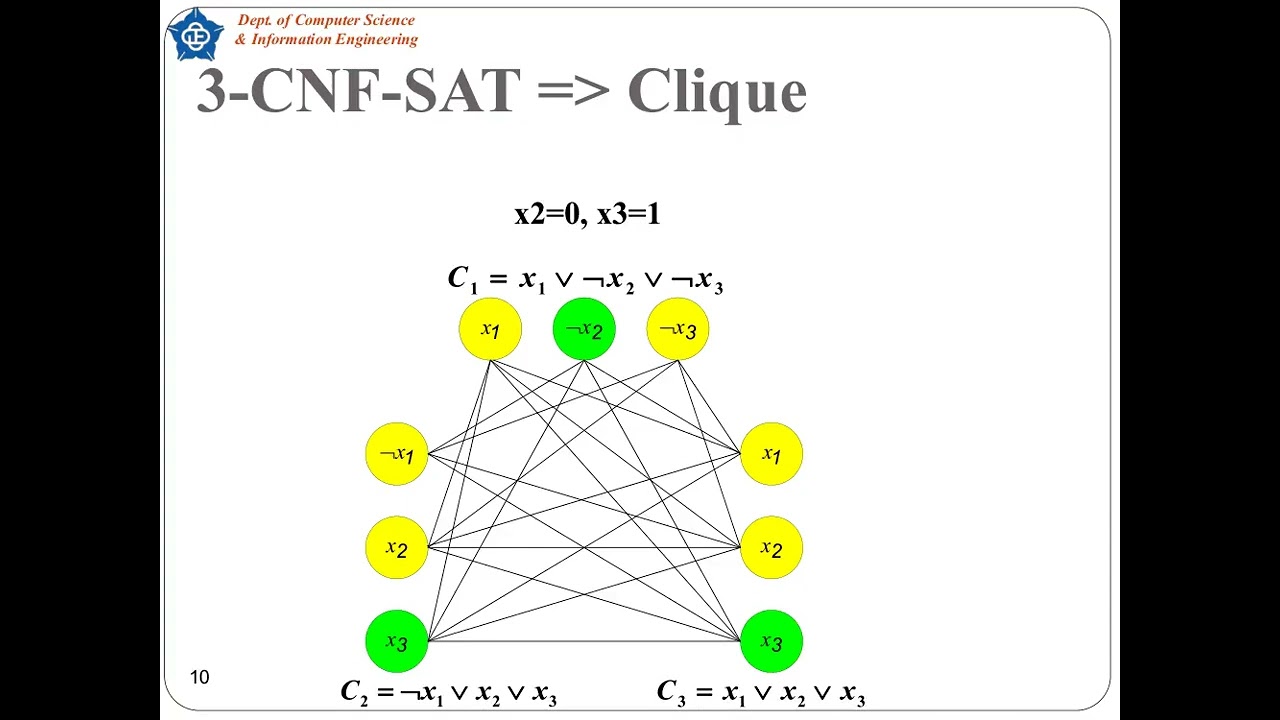
The video delivers substantial value by systematically demonstrating how classic NP-complete problems are interconnected through reductions. The argumentation is rigorous, starting from a high-level proof template and then providing explicit constructions for each reduction, often with concrete examples. For instance, the 3SAT-to-Clique reduction is explained step-by-step, showing how a k-clique corresponds to a satisfying assignment. The explanation of independent set and vertex cover, along with the complement graph relationship, is particularly insightful, making it clear that these problems are equivalent under polynomial-time transformation. The logical flow is sound, and the instructor takes care to prove both directions of each equivalence. Overall, the lecture effectively convinces the viewer of the inherent hardness of these problems under standard complexity assumptions.
Scientific Rigor, Source Quality, Title Accuracy
The lecture demonstrates strong scientific rigor in its logical reasoning and mathematical proofs. However, it does not cite any external sources or references, which is typical for a course lecture but limits verifiability. The content is accurate and up-to-date with standard complexity theory results. The title ‘6 Graph Problems’ is somewhat general, as the video actually covers more than six problems (including 3SAT and the general reduction framework), but it accurately highlights the graph problems at the core. The absence of external references is compensated by the clarity and correctness of the presentation, which stands on its own as a self-contained lesson.
235 words
Title / Content Match
The title '6 Graph Problems' accurately reflects the content, which covers six classic graph problems (Clique, Independent Set, Vertex Cover, Hamiltonian Cycle, TSP, Subgraph Isomorphism) and their NP-completeness.
Quality & Reliability
8/10
The lecture provides a rigorous and coherent explanation of NP-completeness reductions for six classic graph problems, with correct proofs and clear constructions. However, it does not cite external sources or references.
Key Moments
Markers derived by PSI from the transcript: the creator did not define chapters.
- Introduction to graph problems and their applications in GPS, social networks, and bioinformatics.
- Outline of the NP-completeness proof method and the reduction chain diagram starting from CIRCUIT-SAT.
- Definition of 3-SAT and demonstration of its NP-hardness with an example formula.
- Clique problem definition and proof of NP-completeness via reduction from 3-SAT, with a concrete example.
- Independent Set problem and its reduction from 3-SAT using clause triangles.
- Vertex Cover problem and the reduction from Clique to Vertex Cover via complement graph.
- Graph Isomorphism and Subgraph Isomorphism discussion, highlighting the complexity gap and NP-hardness proof.
Contribution & Novelties
This video provides a clear and accessible walkthrough of the classic NP-completeness reductions among graph problems, integrating them into a single narrative. The pedagogical approach of showing the entire reduction chain from CIRCUIT-SAT to TSP helps viewers see the big picture. The use of concrete examples, such as the 3SAT-to-Clique construction, makes abstract concepts tangible. While the material is not new, the synthesis and presentation add value for learners.
Pour aller plus loin :
- NP-completeness — Foundational concept for understanding why these problems are hard.
- Clique problem — Detailed treatment of the clique decision and optimization problems.
- Reduction (complexity) — The technique used to prove NP-hardness in this lecture.
109 words
Radar Profile
The radar profile shows high scores in technical level (9) and quantity/quality of information (8 each), indicating a dense, well-presented theoretical lesson. The fiabilité score is also high (8), reflecting the correctness of the proofs. The overall balance suggests a thoroughly rigorous and informative video.