8 Approximation Algorithm (English)
Keywords
Summary
107 words
Critical Evaluation
Value of the Information & Strength of the Argument
The video provides a clear and structured introduction to approximation algorithms, emphasizing worst-case guarantees. The argumentation is solid: it defines concepts precisely, proves key inequalities (such as |A| ≤ C* and C ≤ 2C* for vertex cover), and systematically builds up to the 2-approximation for TSP. The use of concrete examples (4-city TSP, 7-vertex graph) helps illustrate abstract ideas. The lecture references authoritative textbooks, adding credibility. However, it is a lecture, not a critical evaluation of literature, so it does not engage with competing approaches or open research questions.
Scientific Rigor, Source Quality, Title Accuracy
The video cites two classic textbooks: Vazirani (2001) and Hochbaum (1996), both authoritative in the field. The content aligns with these sources. The title is perfectly adequate, as the video indeed covers approximation algorithms. No comments were provided for analysis. The scientific rigor is high: definitions are mathematically precise, and proofs are concise and correct. The presentation lacks production polish but the technical content is accurate.
170 words
Title / Content Match
The title clearly indicates a lecture on approximation algorithms, and the content matches exactly, covering definitions, examples, and algorithms.
Quality & Reliability
8/10
The video is a university-level lecture on approximation algorithms, covering foundational concepts and known results. The content is consistent with standard textbooks (Vazirani, Hochbaum) and presents clear definitions and proofs. No peer review but produced by an academic course, hence high reliability.
Key Moments
Markers derived by PSI from the transcript: the creator did not define chapters.
- Introduction to approximation algorithms and course overview.
- Explanation of NP-hardness and P vs NP.
- Definition of approximation algorithm and its three criteria (feasibility, tractability, quality).
- Introduction of approximation ratio ρ(n).
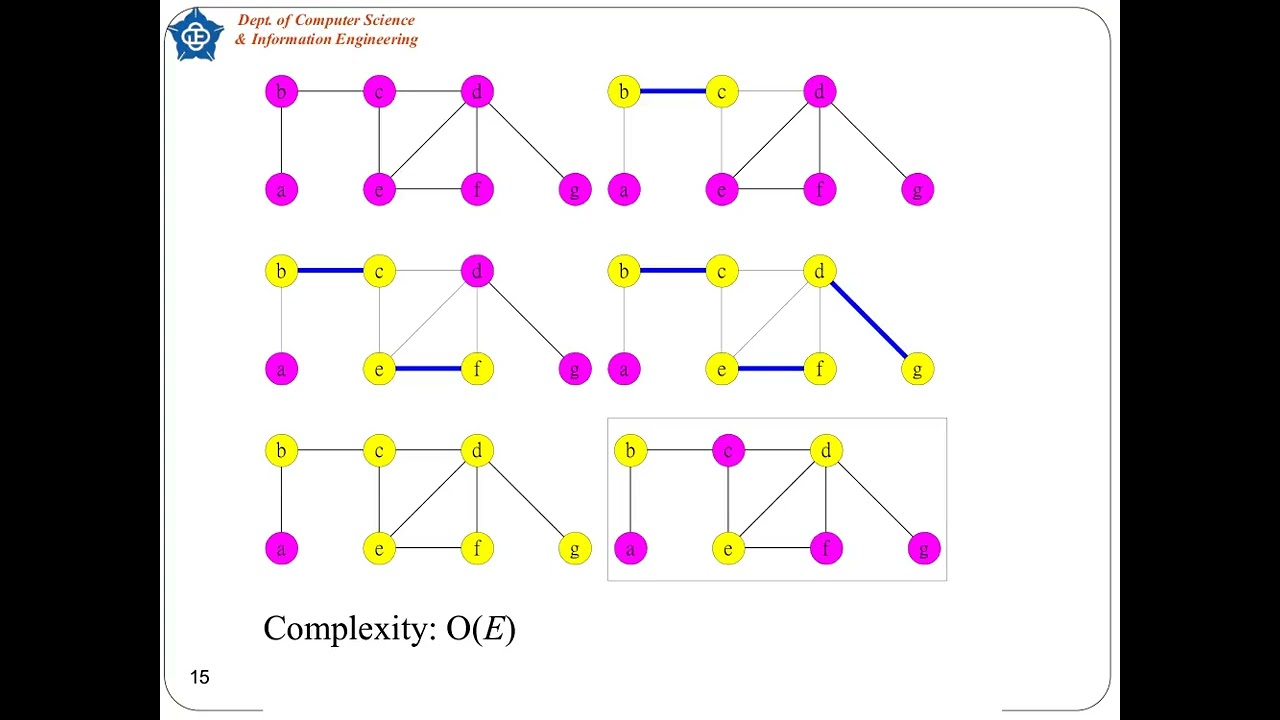
- Vertex cover problem and greedy 2-approximation algorithm.
- Proof of the 2-approximation ratio for vertex cover using matching lower bound.
- TSP with triangle inequality, metric TSP, and MST introduction.
- Kruskal's and Prim's algorithms for minimum spanning trees.
- Doubling and shortcutting method for 2-approximate TSP tour.
- Mention of minimum weight perfect matching and Edmonds' algorithm.
Cited Sources
- Approximation Algorithms — Primary reference, written by Vijay V. Vazirani, Springer-Verlag 2001.
- Approximation Algorithms for NP-Hard Problems — Edited by Dorit S. Hochbaum, 1996, serves as cornerstone for the course.
Contribution & Novelties
The video offers a self-contained lecture on approximation algorithms, effectively explaining core concepts and proving classic results. Its novelty lies in its pedagogical clarity and the way it integrates multiple topics (vertex cover, TSP, MST, matching) into a coherent narrative. It serves as a solid educational resource.
Pour aller plus loin :
- Approximation algorithm — Overview and formal definitions.
- Polynomial-time approximation scheme — Related concept of tunable approximation.
- Vertex cover — Problem discussed in detail.
- Traveling salesman problem — Core NP-hard problem addressed.
83 words
Radar Profile
The profile shows high scores in quantitative information and technical depth, with a strong fit for formal computational theory. The reliability is high but not maximal due to lack of original research. The approach is typical of a graduate lecture, emphasizing proofs and algorithms.