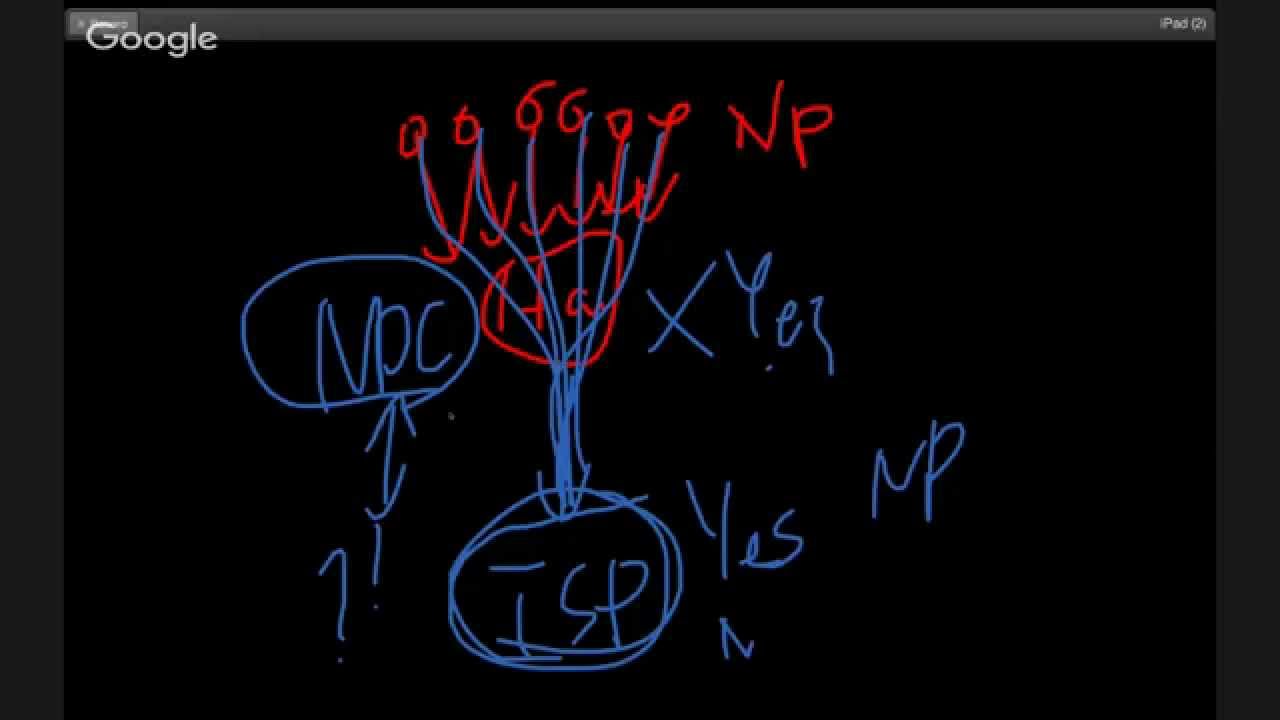
CCU Graduate Algorithm 2015 NP-completeness II
Title history
- CCU Graduate Algorithm 2015 NP-completeness II — observed on 20261026-0309 UTC (YouTube)
Keywords
Summary
242 words
Critical Evaluation
Value of the Information & Strength of the Argument
The lecture provides a solid and rigorous explanation of the reduction technique, which is the core of NP-completeness proofs. The two examples are carefully chosen: the first illustrates a simple reduction with a clean cost threshold trick, while the second demonstrates a more subtle construction using auxiliary vertices to encode directedness in an undirected graph. The arguments are step-by-step and include checks for both directions of equivalence, as well as counterexamples for invalid reductions. The delivery is clear despite some informal speech and minor interruptions (e.g., slides issues), but the mathematical logic remains coherent and well-structured.
Scientific Rigor, Source Quality, Title Accuracy
The lecture is scientifically sound, relying on foundational results (Cook’s theorem) and well-known problems. The instructor mentions specific researchers (Cook, Karp) and examples of unsettled problems, but does not provide explicit citations or references within the video. The title accurately describes the content and is consistent with the level of a graduate algorithm course. The overall rigor is high; the logic of reductions is correctly presented, and the instructor also notes the importance of verifying the NP membership (verifiability) alongside the hardness. The discussion of open problems is accurate and appropriately hedged (e.g., pancake sorting).
206 words
Title / Content Match
Title accurately reflects the content: a graduate-level algorithm lecture dedicated to NP-completeness proofs, continuing a previous session.
Quality & Reliability
8/10
The lecture is a rigorous academic exposition of NP-completeness proofs, based on established concepts (Cook-Levin theorem, Karp reductions). The reasoning is detailed and correct, with two worked examples. Minor informalities in speech do not affect the mathematical rigor.
Key Moments
Markers derived by PSI from the transcript: the creator did not define chapters.
- Review of NP and NP-complete definitions; role of reductions.
- General strategy for proving NP-completeness: pick a known NPC problem and construct a reduction.
- Example 1: Reduce Hamiltonian cycle to TSP with weight threshold.
- Example 2: Reduce directed Hamiltonian cycle to undirected graph using auxiliary triples.
- Conclusion: landscape of P vs NP-complete, and open problems.
Contribution & Novelties
This lecture offers a clear pedagogical exposition of NP-completeness proofs through concrete reductions. Its originality lies in the detailed step-by-step construction of the reduction from Hamiltonian cycle to TSP and the directed-to-undirected conversion, which are typical exam and research topics. It also provides an up-to-date (as of 2015) perspective on open problems, including graph isomorphism and pancake sorting, with the latter being claimed NP-complete in 2011.
Pour aller plus loin :
- NP-completeness — Overview of definition, history, and examples.
- Cook–Levin theorem — Foundational result showing that SAT is NP-complete.
- Reduction (complexity) — Formal definition of polynomial-time reductions.
- Traveling Salesman Problem — Problem and its decision variant.
- Hamiltonian path problem — Related decision problem.
113 words
Radar Profile
The radar profile shows high technical depth (9) and good information quantity/quality (8 each), with overall reliability at 8. The strength is the rigorous technical content, while presentation style might be less polished but does not detract from the academic value.