9 Sorting by Reversal (English)
Title history
- 9 Sorting by Reversal (English) (PSI archive)
- 9 Sorting by Reversal (English) — observed on 20261016-0132 UTC (PSI archive)
Keywords
Summary
199 words
Critical Evaluation
Value of the Information & Strength of the Argument
The video provides a clear and well-structured explanation of a classical computational biology problem. Its value lies in connecting a formal algorithmic problem to a real-world application (genome rearrangements) and in breaking down the theoretical concepts (breakpoints, strips, lower bounds) into digestible steps. The argumentation is logical and progressive: it starts with definitions, builds intuition through examples, introduces a greedy approach, critiques its shortcomings, and then develops a more refined algorithm with a proven bound. The lecturer consistently links each step to the previous one, making the reasoning easy to follow. The use of concrete numeric examples (e.g., the permutation 1 2 3 6 4 5) helps solidify the concepts. However, the video does not discuss alternative approaches or provide references, which limits its scope as a standalone resource.
Scientific Rigor, Source Quality, Title Accuracy
The presentation is scientifically sound: definitions are precise, algorithms are correctly described, and the lower-bound argument is rigorous. The instructor does not cite any external sources, which is typical for a lecture but weakens verifiability. The title ‘Sorting by Reversal’ is perfectly matched to the content, as the entire lecture is dedicated to this specific problem. No comments were analysed, and the video description contains no links or references, so source quality cannot be assessed from metadata. The internal logical consistency is high, and the mathematical statements are accurate. The adéquation titre/contenu is excellent, and this does not affect the global score negatively.
247 words
Title / Content Match
The title accurately reflects the content, which is entirely devoted to the sorting by reversal problem.
Quality & Reliability
8/10
The lecture presents the topic clearly and rigorously, with correct definitions, examples, and proofs of bounds. However, it lacks external citations or references, relying solely on the instructor's presentation.
Key Moments
Markers derived by PSI from the transcript: the creator did not define chapters.
- Introduction to sorting by reversal with the book analogy and problem statement.
- Definition of three criteria for approximation algorithms: feasibility, tractability, quality.
- Biological motivation: gene order reversals between cabbage and turnip.
- Formal modelling of gene order reversals with signed permutations.
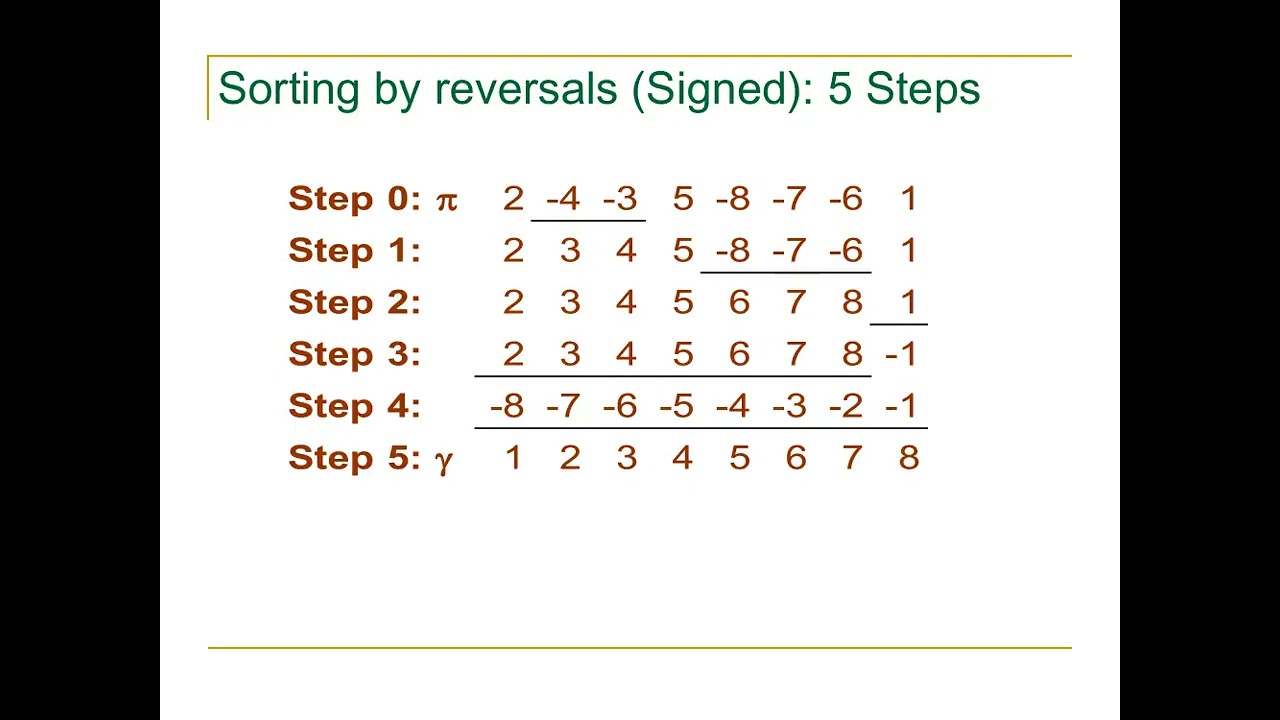
- Example of sorting a signed permutation step by step.
- Introduction of the unsigned case and its NP-hardness.
- Greedy strategy that increases the sorted prefix.
- Definition of breakpoints and their use in lower bounds.
- Definition of strips (increasing and decreasing) for analysis.
- Description of improved breakpoint reversal sort algorithm.
- Analysis of the algorithm's approximation guarantee via lower bound.
Contribution & Novelties
The video’s contribution is pedagogical: it explains a classic algorithm for sorting by reversals, focusing on the breakpoint-based approximation algorithm that achieves a factor-2 guarantee. While the content is not new (the algorithm dates back to the 1990s), the step-by-step presentation with detailed examples makes the topic accessible to graduate students. The lecturer’s use of the cabbage/turnip example effectively motivates the problem.
Pour aller plus loin :
- Approximation algorithm — Pertinent background on approximation guarantee concepts.
- Genome rearrangement — Directly related to reversal distance and its biological significance.
- Reversal distance — Specifically about the problem, though the page may be short.
101 words
Radar Profile
The profile shows high quality and technical level (8/10) with slightly lower quantity (7/10) due to the narrow focus on one algorithm. The reliability is solid (8/10) as the content is mathematically correct. The bias toward 'niveau technique' and 'fiabilite' indicates a rigorous but specialised resource.