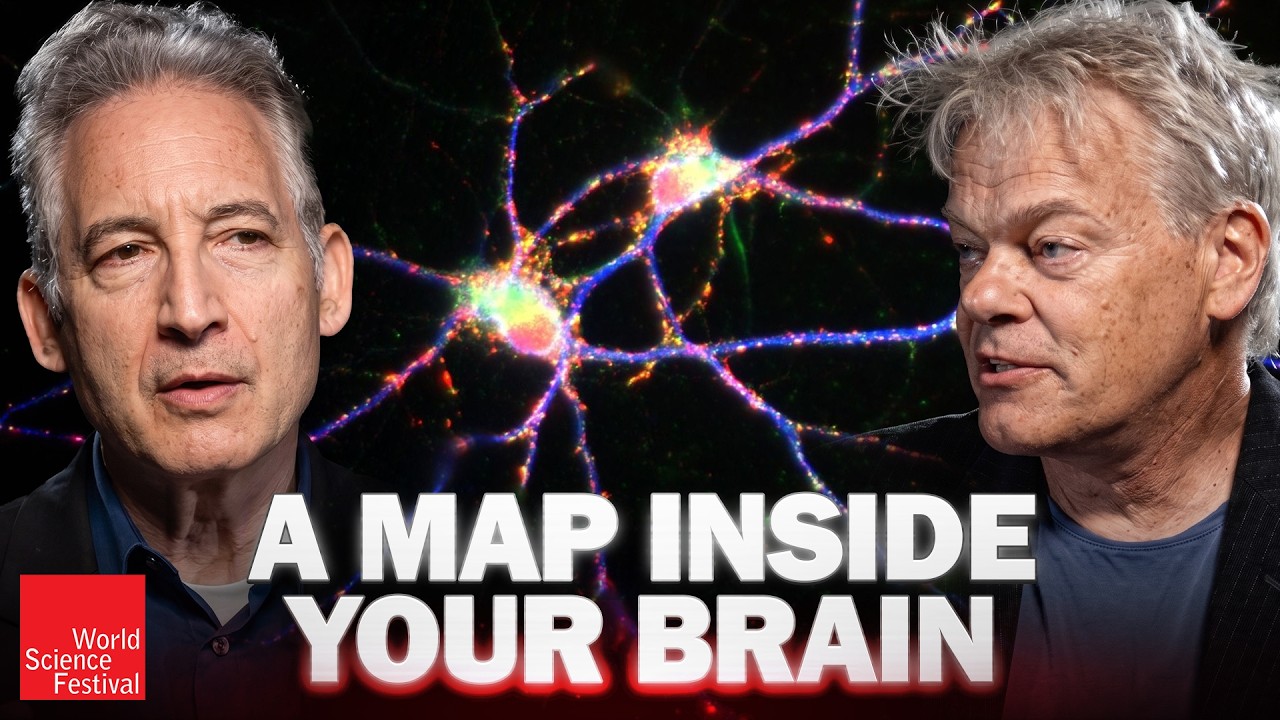
How Does Your Brain Know Where You Are? | World Science Festival
Keywords
Summary
191 words
Critical Evaluation
Value of the Information & Strength of the Argument
The interview provides high-value information by presenting firsthand accounts of groundbreaking discoveries from the scientist who made them. Moser clearly explains the progression from place cells to grid cells, the concept of modular organization, and the mathematical representation as a torus. The argumentation is solid: he describes the experimental methods (electrode recordings in rats, large arenas), the initial skepticism, and the converging evidence from multiple species and human studies. He also acknowledges open questions, such as the exact mechanism by which grid cell modules combine and the nature of 3D mapping. The discussion is nuanced, avoiding oversimplification while remaining accessible. The moderator’s questions help clarify key points without disrupting the flow. The value is further enhanced by the inclusion of evolutionary and clinical perspectives (Alzheimer’s). Overall, the argumentation is rigorous, evidence-based, and transparent about uncertainties.
Scientific Rigor, Source Quality, Title Accuracy
Scientific rigor is exemplary: the speaker is the original researcher, and the content aligns with the published literature. Sources are not explicitly cited in the video, but the description links to the World Science Festival website and social media, which are not academic sources. The title accurately reflects the content, as the entire conversation revolves around the brain’s spatial navigation system. The moderator’s questions are well-informed, and the guest’s answers are precise. No misleading claims or sensationalism were detected. The only minor issue is the lack of direct references to specific papers, but given the format (public interview), this is acceptable. The promotional segment is brief and does not affect the scientific quality.
263 words
Title / Content Match
The title 'How Does Your Brain Know Where You Are?' accurately reflects the core topic of the conversation: the brain's internal navigation system, including place cells, grid cells, and the toroidal map. The content fully delivers on this promise.
Quality & Reliability
9/10
The content is a direct interview with Edvard Moser, Nobel laureate and director of the Kavli Institute for Systems Neuroscience, who describes his own primary research on grid cells. The discussion accurately reflects established neuroscience (place cells, head direction cells, grid cells, entorhinal cortex, toroidal topology) and is moderated by a physicist who asks informed questions. No factual errors or unsupported claims were detected. The only limitation is the absence of explicit citations in the video itself, but the speaker is the original discoverer, ensuring high reliability.
Chapters
- Welcome, Edvard Moser
- Place Cells: The Discovery That Started It All
- Can a Rat Navigate in Complete Darkness?
- An Internal Map the Brain Is Born With
- Head Direction Cells: The Brain's Built-In Compass
- Grid Cells: What They Are and How Moser Found Them
- The Accidental Discovery in a Large Arena
- The Grid Cell Hierarchy
- Three-Dimensional Navigation
- Have Grid Cells Been Studied in Humans?
- Is This the Most Efficient Solution to the Navigation Problem?
- The Torus: How the Brain's Map Becomes a Mathematical Object
- Using Topology to Prove the Shape Is a Torus
- Is Space a Human Construct?
- Grid Cells Beyond Navigation
- Would AI Independently Discover the Same Map?
- Does Spending Your Life Studying the Brain Change How You See It?
- What Alzheimer's Disease Reveals About Grid Cells and Memory
- Does Knowing the Science Change the Experience of Navigation?
Cited Sources
- World Science Festival — Official website of the organization hosting the event, providing background on the festival and its mission.
- World Science Festival YouTube channel — Channel subscription link, not a scientific source but the platform for the video.
- World Science Festival LinkedIn — Professional networking page, not a scientific source.
- Video URL — Direct link to the video itself.
Concurring Sources
- The Nobel Prize in Physiology or Medicine 2014 — Official Nobel Prize announcement for the discovery of cells that constitute a positioning system in the brain, awarded to John O'Keefe, May-Britt Moser, and Edvard Moser.
- Grid cells and cortical representation — Review article by Moser et al. in Nature Reviews Neuroscience, summarizing grid cell research and supporting the content discussed.
- Place cells, grid cells, and the brain's spatial representation system — Annual Review of Neuroscience article by Moser, Kropff, and Moser, providing a comprehensive overview of the spatial representation system.
Contribution & Novelties
This interview offers a unique synthesis of Edvard Moser’s personal journey and the scientific milestones in spatial navigation research. It brings together the discovery of place cells, grid cells, and head direction cells into a coherent narrative, emphasizing the toroidal topology of the grid cell map. The discussion extends beyond typical popular science by including evolutionary comparisons (flies, bats, birds), the challenge of 3D navigation, and the potential implications for artificial intelligence. Moser’s reflections on whether space is a human construct and how Alzheimer’s disease affects the navigation system add depth. The conversation also highlights the role of mathematics (topology, modular arithmetic) in understanding brain function, bridging disciplines.
Pour aller plus loin :
- Grid cell — Wikipedia article providing an overview of grid cells, their discovery, and properties.
- Place cell — Wikipedia article on place cells, their role in spatial memory, and the hippocampus.
- Edvard Moser — Wikipedia biography of Edvard Moser, including his Nobel Prize and research contributions.
- Torus — Mathematical concept of the torus, relevant to the topological representation of grid cell firing patterns.
- Head direction cell — Wikipedia article on head direction cells, part of the brain’s navigation system.
192 words
Radar Profile
The radar profile shows very high scores in information quality and global reliability, reflecting the authoritative source and accurate content. The quantity of information is also high, covering a broad range of topics from discovery to implications. The technical level is moderately high, suitable for an informed audience but not overly specialized. Overall, the profile indicates a highly reliable and informative piece of science communication.
💬 Sur les 30 commentaires analysés, le climat est très positif, avec des remerciements, des éloges pour la clarté de la discussion et un vif intérêt pour les implications mathématiques et évolutives. Plusieurs commentaires partagent des anecdotes personnelles ou des réflexions approfondies, témoignant d'un engagement intellectuel élevé.