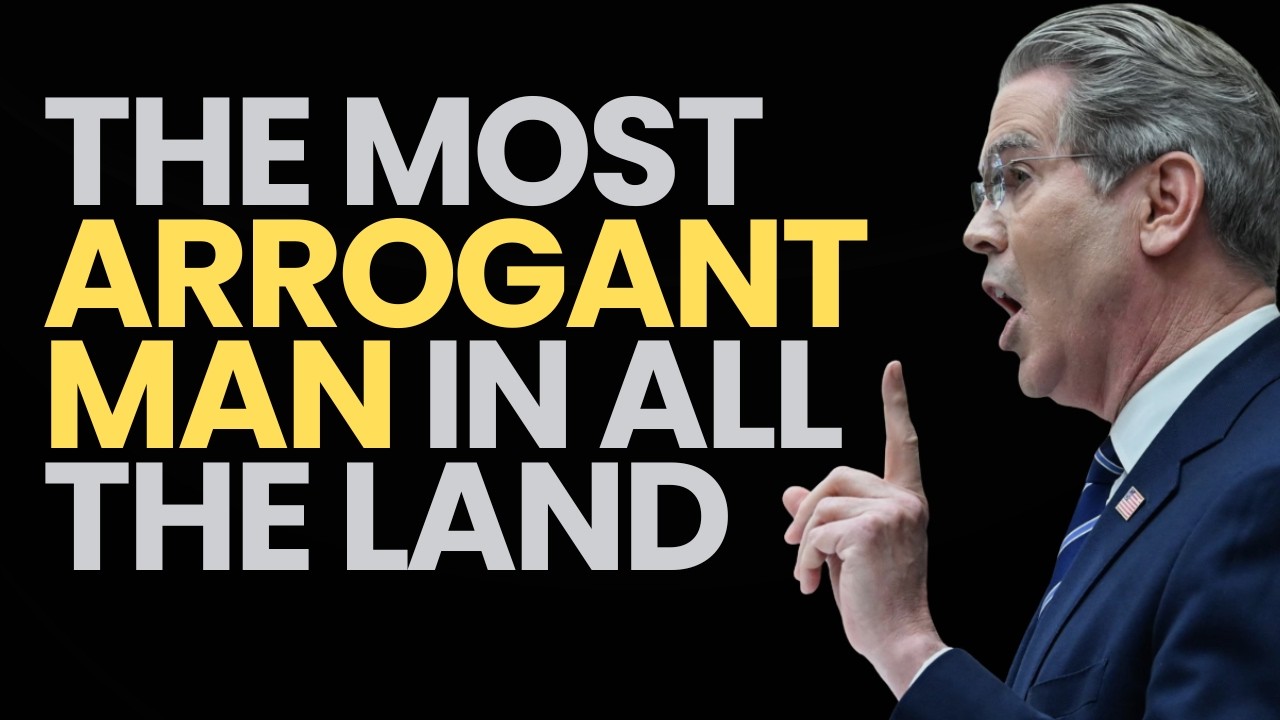
The Treasury Secretary Who Can't Get It Right
Keywords
Summary
161 words
Critical Evaluation
Value of the Information & Strength of the Argument
The video’s value lies in its critical perspective on a high-ranking official’s actions, potentially informing viewers of specific policy decisions and their market reactions. It touches on real issues such as the yen carry trade, yield curve control, and the role of Treasury in market stability. However, the argumentation is heavily biased and relies on emotional rhetoric, name-calling, and unverified claims. The host offers no balanced counterpoints and dismisses any potential justifications for Bessent’s actions. The argument is built on a sequence of failures but does not consider broader economic constraints. While the host mentions some sources, many claims are presented as absolute truths without evidence. The overall value is diminished by the lack of nuance and the vitriolic tone, making it more of a partisan rant than a rigorous economic analysis.
Scientific Rigor, Source Quality, Title Accuracy
The video provides a few sources in the description, including an NPR article on IRS job cuts, a Yahoo Finance piece on the yen, and historical references to Morgenthau from the US Holocaust Museum and Treasury. These are used primarily to support the critique but not systematically. The host does not cite sources within the video for many factual assertions, such as the effectiveness of sanctions or the 90% loss in Bessent’s hedge fund. The title ‘The Treasury Secretary Who Can’t Get It Right’ is catchy and aligns with the content, but it is hyperbolic. The video clearly is an opinion piece, not a journalistic investigation, so rigorous sourcing is not expected, but the credibility is weakened by the aggressive tone and lack of balanced evidence.
273 words
Title / Content Match
The title accurately reflects the content, which is a scathing review of Treasury Secretary Bessent's performance.
Quality & Reliability
4/10
The video is a strongly opinionated critique with limited balanced analysis. It makes several factual claims about market interventions and policy decisions, but lacks rigorous sourcing for many assertions, relying on rhetorical language and speculation. Some sources are provided in the description, but the analysis is one-sided and emotionally charged.
Key Moments
Markers derived by PSI from the transcript: the creator did not define chapters.
- Introduction: Host announces rant on Treasury Secretary Scott Bessent.
- Discussion of yen intervention and Bessent's 'I am the house' comment.
- Iran sanctions and oil price surge, critiques of Bessent's sabre-rattling.
- Bond buyback announcement and market reaction, criticism of insignificance.
- Comparison with Henry Morgenthau Jr., critique of Bessent's track record and integrity.
Cited Sources
- IRS tax collection job reductions — Reference to IRS cuts attributed to Bessent's tenure.
- Latest rebound in Japanese yen real — Reference to yen market movements and possible BOJ intervention.
- Henry Morgenthau Jr. personal story — Used to praise Morgenthau's actions during the Holocaust.
- Henry Morgenthau Jr. biography at Treasury — Historical context for comparing Bessent to Morgenthau.
- Bessent clip on asymmetric information — Video clip showing Bessent's 'I am the house' statement.
- Bessent clip on bond buyback — Video clip of Bessent announcing bond purchase plan.
- Bessent clip on Iran sanctions — Video clip related to Bessent's Iran policy.
- Bessent clip on yen intervention — Video clip about yen intervention failure.
Dissenting Sources
- Treasury Department official website — No specific source, but official statements could provide counterarguments to the critiques, though none are cited in the video.
External References
Contribution & Novelties
The video’s original contribution is its scathing, unapologetic critique of a sitting Treasury Secretary, compiling multiple recent controversies into a single narrative. It attempts to link Bessent’s actions to broader market instability and loss of global confidence. However, the analysis lacks depth and relies on emotional appeal rather than rigorous data. The video does not offer new information but repackages known events with heavy opinion.
Pour aller plus loin :
- Yield curve control — A monetary policy tool mentioned in the video, relevant to Bessent’s bond buyback plan.
- Carry trade — Essential concept for understanding the yen intervention and market dynamics discussed.
- Plaza Accord — Historical agreement referenced in the video, relevant to US-Japan economic relations.
- Treasury International Capital System — Reports mentioned to support claims about foreign liquidation of US debt.
132 words
Radar Profile
The radar shows moderate quantity of information and technical level, but low quality and reliability. This indicates a passionate but ultimately superficial analysis that might inform but not rigorously educate the viewer.