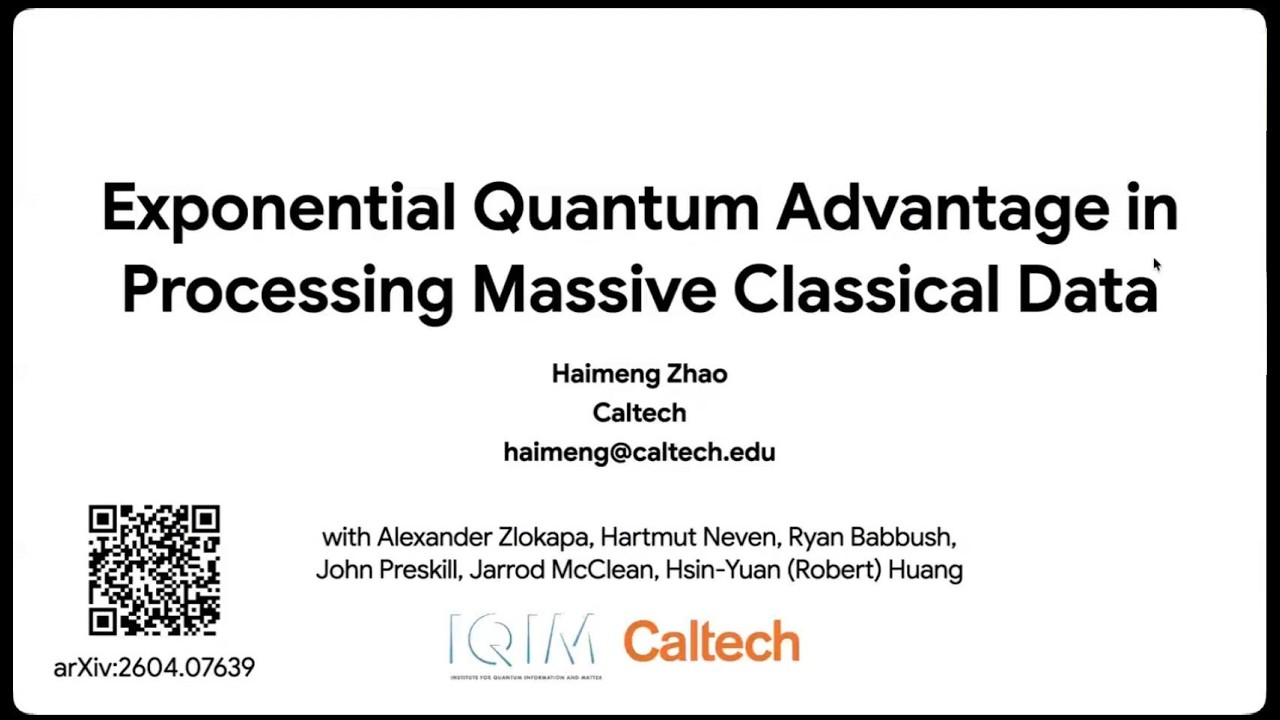
Exponential quantum advantage in processing massive classical data
Keywords
Summary
163 words
Critical Evaluation
Value of the Information & Strength of the Argument
The talk provides a high-value contribution by presenting a novel, rigorous result that addresses a fundamental open problem in quantum computing. The argumentation is clear and structured: it starts with the motivation, defines the problem formally, states the main theorems, and then explains the algorithmic approach. The speaker is careful to state all assumptions explicitly, which strengthens the credibility. The numerical experiments add practical relevance, showing that the theoretical advantage is not just asymptotic but also achievable with a modest number of qubits. The argument that the advantage is unconditional (independent of complexity assumptions) is particularly compelling, as it distinguishes this work from many other quantum advantage results that rely on unproven conjectures.
Scientific Rigor, Source Quality, Title Accuracy
The talk is scientifically rigorous, with a clear presentation of the theoretical framework and assumptions. The speaker mentions that the work is joint with collaborators and references the underlying techniques (e.g., classical shadows, quantum oracle sketching). However, no specific external sources are cited in the talk or description, so the reliability relies on the speaker’s expertise and the internal consistency of the presentation. The title accurately reflects the content, focusing on exponential quantum advantage in processing classical data. The talk does not include a public Q&A, but the speaker invites questions, indicating openness to scrutiny. The description provides a concise summary of the results, consistent with the talk.
236 words
Title / Content Match
The title accurately reflects the content: the talk presents a proof of exponential quantum advantage in processing classical data, with a focus on classification and dimension reduction.
Quality & Reliability
9/10
The talk presents a rigorous theoretical result with formal proofs (as stated), supported by numerical experiments on real datasets. The speaker is a PhD student at Caltech under John Preskill, a leading quantum computing researcher. The work is presented as a preprint, and the claims are clearly delineated with explicit assumptions. The presentation is technical and detailed, indicating high reliability.
Key Moments
Markers derived by PSI from the transcript: the creator did not define chapters.
- Introduction and motivation: the question of quantum advantage in everyday tasks.
- Formal definition of the classification task with assumptions.
- Main results for static classification: quantum machine of polylog size vs classical exponential size.
- Dynamic classification: super-polynomial sample separation.
- Dimension reduction task and its results.
- Numerical experiments on real datasets, showing 4-6 orders of magnitude reduction in size.
- Discussion of unconditional advantage, independent of complexity assumptions.
- Introduction to quantum oracle sketching algorithm.
- Comparison with classical streaming algorithms and memory requirements.
- Conclusion and invitation for questions.
Cited Sources
- Paper (not explicitly cited, but the work is presented as a preprint) — The talk presents the results of a research paper, but no specific URL is given in the description.
Concurring Sources
- Quantum machine learning (Wikipedia) — Provides background on the field and existing quantum advantage results.
Dissenting Sources
- Dequantization results in quantum machine learning — The talk mentions previous dequantization results that suggested quantum advantage in machine learning might be limited, but this work overcomes those limitations.
Contribution & Novelties
The talk presents a significant original contribution: a proof of exponential quantum advantage in processing classical data for machine learning tasks, which was previously an open problem. The key novelty is the ‘quantum oracle sketching’ algorithm that enables efficient access to classical data in quantum superposition without requiring a full quantum RAM. This work extends quantum advantage to a broad and natural domain, with practical implications for large-scale data processing.
Pour aller plus loin :
- Quantum machine learning — Overview of the field and its challenges.
- Classical shadows — A technique used in the algorithm for constructing succinct classical models.
- Quantum RAM (QRAM) — A concept for accessing classical data in superposition, which the work circumvents.
- Support vector machine — The classical algorithm used as a baseline in the experiments.
- Principal component analysis — The dimension reduction technique addressed in the talk.
142 words
Radar Profile
The radar profile shows high scores across all dimensions, with particularly strong performance in information quality and technical level. The talk is dense with rigorous content and provides a solid contribution to the field. The lower score in quantity of information reflects the focused scope of the presentation, but it is still substantial.