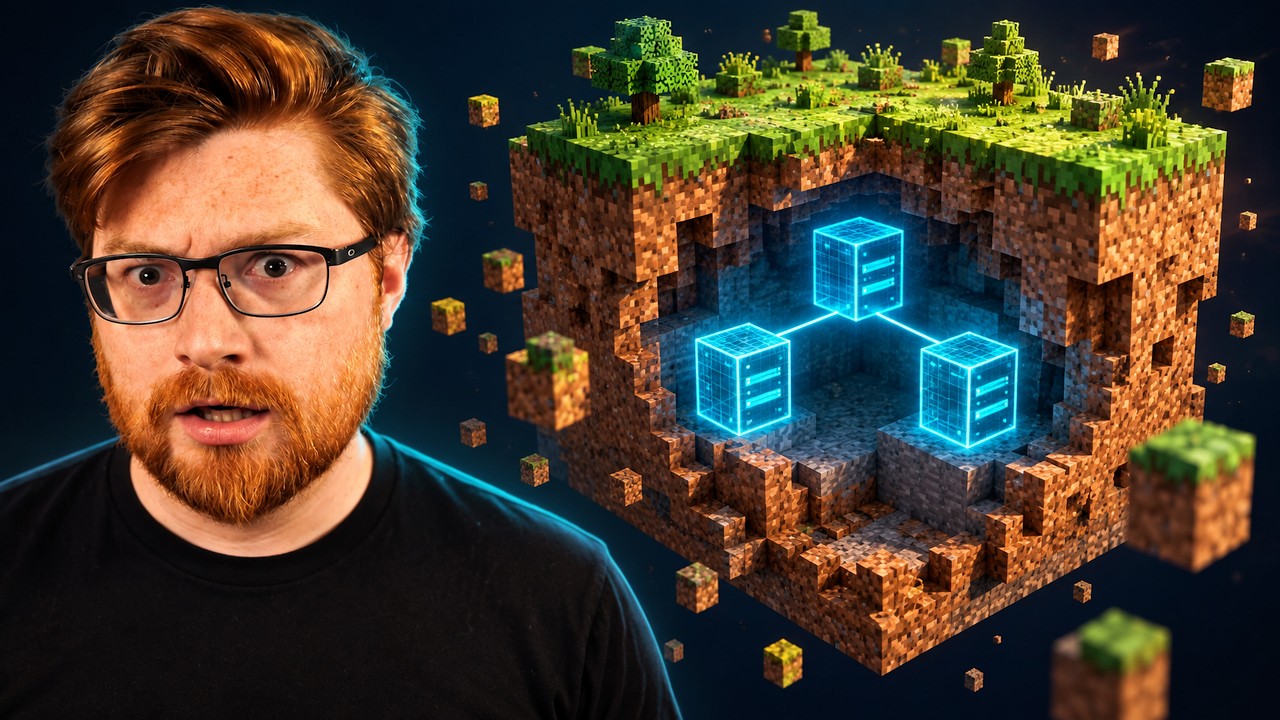
I Turned the Open Internet Into a Minecraft World
Keywords
Summary
227 words
Critical Evaluation
Value of the Information & Strength of the Argument
The video provides a hands-on demonstration of how AI can assist in building a functional mod that bridges cybersecurity OSINT (open directory enumeration) with gamified exploration. The value lies in the practical integration of a live API into a game environment, showing the process of iterative development with AI feedback. The argumentation is informal, based on trial-and-error, with Hammond and chat deciding on design choices. The solidity is limited because there is no rigorous scientific validation; however, the demonstration proves the concept’s feasibility. The discussion about API data normalization (camelCase vs snake_case) reflects genuine technical depth.
Scientific Rigor, Source Quality, Title Accuracy
The video is a live coding session, not a formal study. Sources cited are the sponsor links (training, tools) and the Hunt.io API used implicitly. The title is apt, as the content directly shows turning the internet into a Minecraft world. The scientific rigor is low: no citations, no methodology, and conclusions are based on a single prototype. Nonetheless, the demonstration is transparently presented, with a clear explanation of code changes and bugs. The public is likely following along for entertainment and inspiration rather than rigorous education.
198 words
Title / Content Match
The title is accurate: the video shows transforming open internet directories into explorable Minecraft worlds, with a clear demonstration of portals, mobs, and data representation.
Quality & Reliability
6/10
The video is an authentic live coding demonstration where an AI assistant (OpenAI Codex) builds a Minecraft mod that integrates real-time data from Hunt.io's open directories. It shows real API calls and functional results, but lacks formal methodology, reproducibility details, or peer review. The information is practical and demonstrable, yet not rigorous in a scientific sense.
Key Moments
Markers derived by PSI from the transcript: the creator did not define chapters.
- Introduction of the problem: how to represent computers and fix bugs.
- Discussion on using portals and dimensions; decision to start with portals in the same world.
- Codex builds the portal system; first successful portal to a live host chamber.
- Demonstration of file mobs (horses, chickens) with nameplates; issues with portal dimensions and mob AI.
- Testing multiple portals and encountering rate limiting and rendering problems.
- Wrap-up: listing remaining tasks and future enhancements for the mod.
Cited Sources
- Just Hacking Training — Advertisement for cybersecurity training provided by the channel.
- John Hammond's Newsletter — Link to sign up for the channel's newsletter.
- InfoSec Map — Resource for cybersecurity events mentioned in the video.
- CodeCrafters — Sponsor link for a coding education platform.
- OpenVPN — Sponsor link for VPN hosting.
- CyberDefenders — Sponsor link for blue team training and certifications.
Concurring Sources
- Hunt.io — The video implicitly uses Hunt.io to fetch open directory listings. The site is a commercial platform for OSINT on exposed directories.
Contribution & Novelties
This video contributes a novel proof-of-concept: using an AI coding assistant to build a Minecraft mod that visualizes live OSINT data (open directories) as explorable environments. The innovation lies in the real-time API integration and gamification of cyber reconnaissance, making data interaction tangible and playful. It also demonstrates iterative AI-driven development, where the human guides the AI to fix bugs and add features.
Pour aller plus loin :
- Minecraft modding — Overview of Minecraft modification development, relevant to understanding the technical context.
- Open Directory (computing) — Explains the concept of open directories on the internet, which are the core data source.
- OSINT — Open-source intelligence, the broader field that Hunt.io serves.
- AI pair programming — Concept where AI assists a human programmer, akin to the workflow shown in the video.
130 words
Radar Profile
The radar profile shows balanced scores across the dimensions, with a slightly higher technical level and moderate information quality. This indicates a hands-on demonstration that is more about practical implementation than deep theoretical knowledge. The reliability is medium, reflecting the prototype nature of the project.