Maximizing Results-Based Financing Results: lessons from the Beyond the Grid Fund for Africa (BGFA)
Keywords
Summary
214 words
Critical Evaluation
Value of the Information & Strength of the Argument
The webinar provides valuable insights into the practical design and implementation of results-based financing in the off-grid energy sector. The argumentation is grounded in empirical data from the BGFA mid-term evaluation, with clear metrics on connections, costs per connection, and customer satisfaction benchmarks. The discussion of trade-offs—mature versus nascent markets and reverse auction design—is nuanced, acknowledging that RBF works differently across contexts and that smaller companies face distinct challenges. The panelists, including program managers and evaluators, offer candid reflections on what has worked and what has not, such as the limited evidence of catalytic market effects and the cash flow pressures on smaller companies due to upfront payments offset against future deliveries. The argument for separating RBF components to better support working capital and resilience is well-reasoned. However, the transcript is truncated, and some points are left underdeveloped, such as the exact mechanisms for improving reverse auction design. Overall, the value lies in its honest assessment of a large-scale RBF program and its actionable recommendations for future subsidy design.
Scientific Rigor, Source Quality, Title Accuracy
The webinar demonstrates high scientific rigor, as it is based on a mid-term evaluation conducted by independent firms (Oxford Policy Management and GreenCraft Economics) and commissioned by Nefco on behalf of donors. The evaluation uses mixed methods, including quantitative data on connections and costs, and qualitative insights from companies and stakeholders. Sources are clearly attributed to the evaluation team and program implementers. The title accurately reflects the content, focusing on lessons from BGFA for maximizing RBF results. The discussion is transparent about limitations, such as the inability to prove catalytic effects and the challenges of attributing policy changes to the program. No comments were provided for analysis.
291 words
Title / Content Match
The title accurately reflects the content: the webinar focuses on lessons from the BGFA program regarding results-based financing design and implementation. The discussion covers efficiency, effectiveness, and impact findings, aligning well with the title.
Quality & Reliability
8/10
The webinar is hosted by ESMAP (World Bank) and features the evaluation team from Oxford Policy Management and GreenCraft Economics, along with program managers from Nefco and REEEP. The findings are based on a mid-term evaluation of a €110 million program, with clear methodology and data on connections, costs, and customer satisfaction benchmarks. However, the transcript is truncated and lacks detailed methodological transparency, and some claims are based on preliminary or partial data.
Key Moments
Markers derived by PSI from the transcript: the creator did not define chapters.
- Introduction by Lara Fores, managing the access to finance program at GOGLA, presenting the Subsidy Lab platform.
- Petra Mikolan from Nefco introduces the BGFA program and the evaluation team.
- Simon provides an overview of BGFA: €110 million program, 1.7 million connections target, six countries, two funding lots.
- Findings on efficiency: BGFA on track to meet targets, light-touch in-country presence, reverse auction results in low subsidies.
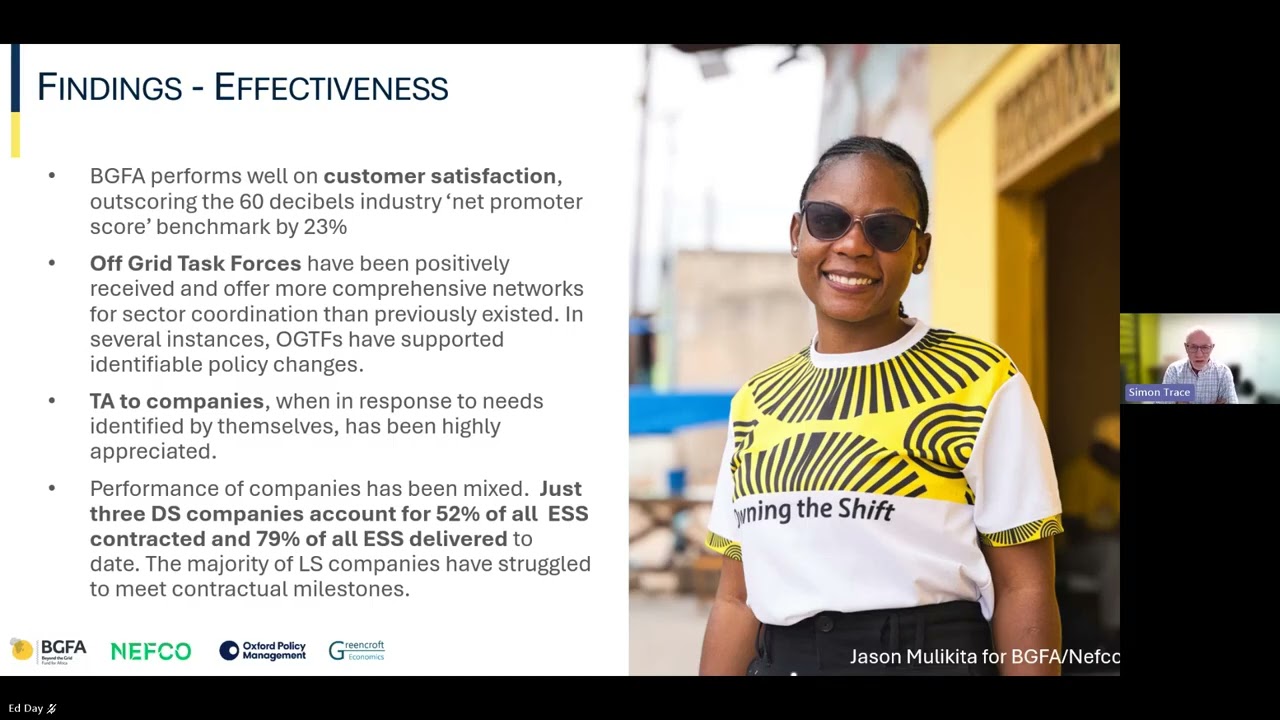
- Findings on effectiveness: high customer satisfaction, mixed company performance, three companies account for 80% of connections.
- Findings on impact: strong poverty reach and quality of life, but 48% of customers fell behind on payments.
- Ed presents the first trade-off: mature vs. nascent markets, with Zambia and Uganda accounting for 91% of connections.
- Discussion of external shocks: drought in Zambia, macroeconomic downturn in Liberia, conflict in Burkina Faso.
- Panel discussion with Peter from REEEP on the need for differentiated RBF design and support for smaller companies.
- Peter suggests separating RBF for working capital from other funding for infrastructure and resilience.
Contribution & Novelties
The webinar offers original insights from the mid-term evaluation of BGFA, a large-scale RBF program in the off-grid energy sector. It provides empirical evidence on the performance of RBF in different market contexts, highlighting the trade-offs between maximizing reach in mature markets and building nascent markets. The discussion on reverse auction design and the challenges faced by smaller companies is particularly novel, as is the recommendation to separate RBF components for working capital versus infrastructure. The findings on limited catalytic effects and the impact of external shocks add nuance to the understanding of RBF effectiveness.
Pour aller plus loin :
- Results-Based Financing — Wikipedia article explaining the concept and its applications.
- Beyond the Grid Fund for Africa — Official website of the BGFA program, providing details on its design and portfolio.
- ESMAP — Energy Sector Management Assistance Program, which co-hosted the webinar and publishes research on energy access.
- GOGLA — Global Off-Grid Lighting Association, co-host and source of industry benchmarks.
- Nefco — Nordic Environment Finance Corporation, manager of BGFA.
169 words
Radar Profile
The radar profile shows high scores in information quality and reliability, reflecting the evidence-based nature of the evaluation. The technical level is moderate, as the content is accessible to a policy and practitioner audience. The quantity of information is solid but limited by the truncated transcript. Overall, the webinar balances rigor with practical relevance.