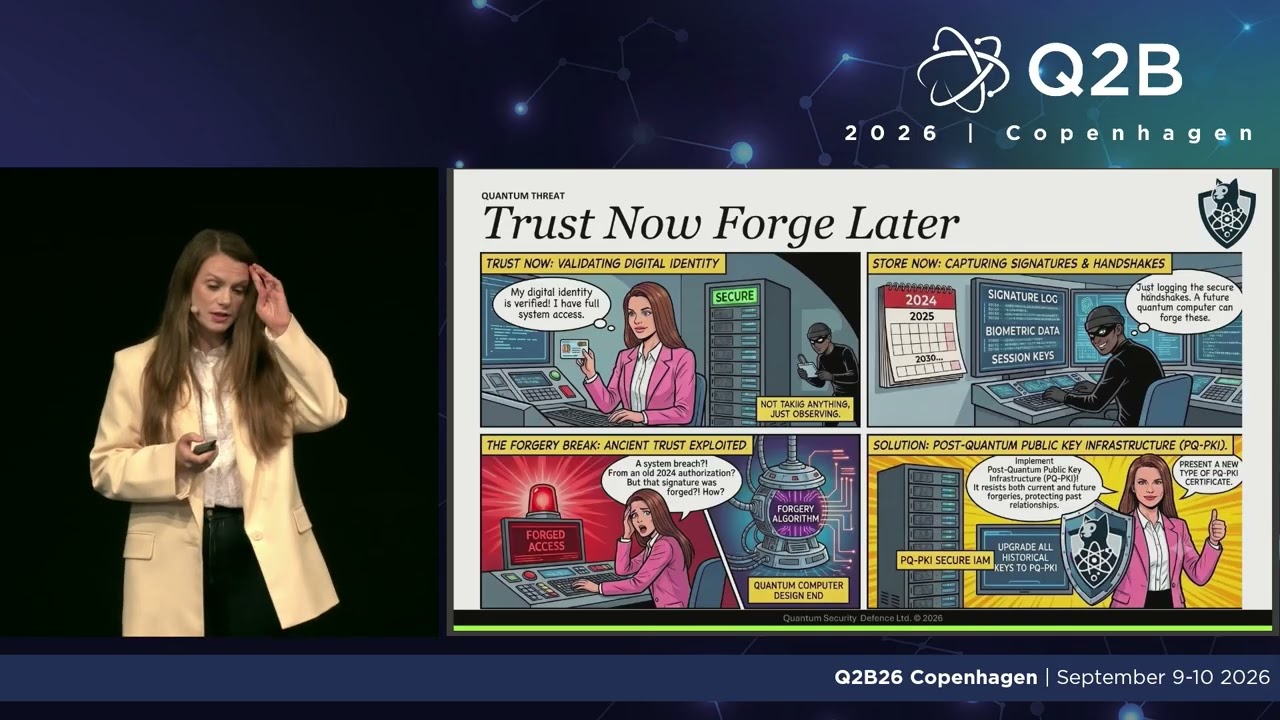
Q2B26 Copenhagen | Anna Beata Kalisz Hedegaard, CEO, Quantum Security Defense Ltd.
Keywords
Summary
179 words
Critical Evaluation
Value of the Information & Strength of the Argument
The talk provides valuable real-world data and trends from the cybersecurity industry, including specific metrics on AI-driven attacks and the ‘harvest now, decrypt later’ threat model. The argumentation is logically structured: it first establishes the imminent and amplified risks from AI and quantum, then explains the necessary defensive tools (PQC and QKD), and finally examines adoption barriers. The speaker incorporates references to authoritative institutions (MIT, University of Queensland, G7 statements) to underscore severity, and personal industry experience to illustrate practical obstacles. However, the argumentation is largely based on secondary data and does not provide primary evidence or detailed methodology for the cited statistics, which somewhat limits its scientific rigor.
Scientific Rigor, Source Quality, Title Accuracy
The talk demonstrates moderate scientific rigor: it cites well-known institutions and industry surveys, but does not give precise citations for many statistics, relying instead on general references like ‘MIT future tag’ and ‘University of Queensland risk assessments’. The speaker’s own company’s surveys are mentioned, but without full transparency. The title is purely informative about the event and speaker; it does not foreshadow the content’s focus on quantum security threats and mitigation, which could be seen as slightly vague but not misleading.
205 words
Title / Content Match
The title accurately identifies the event and the speaker, but does not hint at the content; it is purely descriptive of the talk's setting.
Quality & Reliability
7/10
The speaker is an expert in quantum security, presenting data and trends from industry surveys and authoritative institutions (MIT, University of Queensland, national agencies), but the talk relies on selective statistics and lacks detailed citations for each claim.
Key Moments
Markers derived by PSI from the transcript: the creator did not define chapters.
- Introduction to the talk: the impact of AI and quantum on cybersecurity, and the speaker's background.
- Discussion of AI-enhanced attacks: statistics on exploited software, chatbots, and breakout time.
- Explanation of 'harvest now, decrypt later' and the need for post-quantum cryptography and QKD.
- Review of industry adoption: surveys showing planning vs. implementation, and barriers like legacy systems and budgets.
- Conclusion: call to action for organizations to move from planning to actual migration to PQC.
Cited Sources
- Q2B Conference Official Website — The talk was presented at the Q2B26 Copenhagen event; the link provides general conference information.
Contribution & Novelties
The talk synthesizes current threats and mitigation strategies, offering a comprehensive overview of the quantum security landscape. It highlights the urgency of adopting post-quantum cryptography now, particularly for data confidentiality against ‘harvest now, decrypt later’ attacks, and emphasizes the often-overlooked challenge of legacy systems and budget constraints. The unique value lies in the speaker’s firsthand industry perspective and the integration of recent statistics and policy developments.
Pour aller plus loin :
- Post-quantum cryptography — Overview of cryptographic algorithms resistant to quantum attacks.
- Quantum key distribution — A method for secure communication using quantum mechanics.
- Harvest now decrypt later — Explanation of the threat model where encrypted data is stored for future quantum decryption.
113 words
Radar Profile
The radar profile shows uniform scores around 7, indicating a well-rounded talk with good balance across information quantity, quality, technical depth, and overall reliability. The 'quantite_information' and 'qualite_information' scores are equal, suggesting that the dense content maintains quality. The 'niveau_technique' score of 7 indicates it is accessible to a general technical audience but still requires some background. The overall note_globale of 4 reflects the strong content but a lack of full citations.