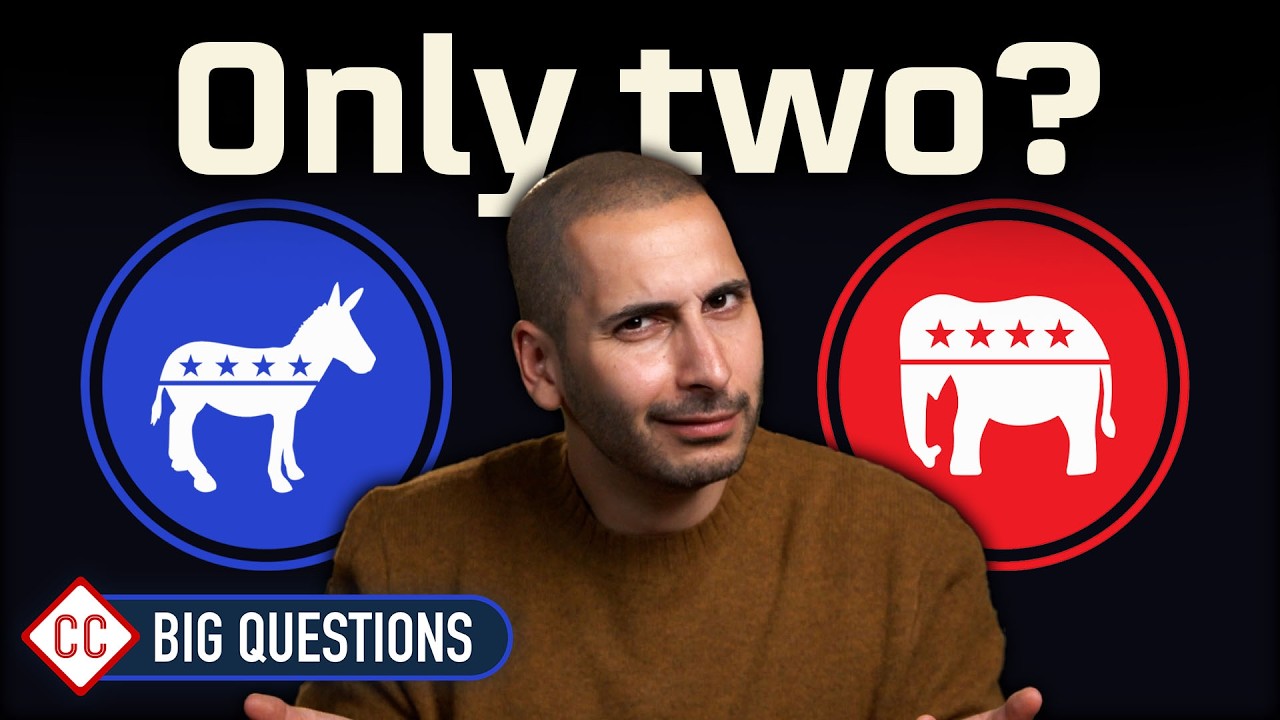
Why Does the US Only Have Two Major Parties?: Crash Course US Government #2
Keywords
Summary
178 words
Critical Evaluation
Value of the Information & Strength of the Argument
The video provides a rigorous yet accessible explanation of a complex political phenomenon. It effectively separates institutional and behavioral factors, grounding each in established political science concepts such as Duverger’s law and the spoiler effect. The argumentation is logical and supported by concrete examples, including comparisons with multiparty democracies like Sweden and Kenya. The use of hypothetical scenarios (e.g., the Pirate Party and Copyright Party) clarifies the mechanics of strategic voting. The presentation is balanced, acknowledging both systemic constraints and voter psychology without bias. The information is delivered with clarity and reinforcing humor, making it valuable for educational purposes.
Scientific Rigor, Source Quality, Title Accuracy
The video maintains a high standard of scientific rigor. It references a detailed supplementary document (Google Doc) presumably containing academic sources, and partners with USAFacts, a non-partisan civic tech project, to ensure data accuracy. The title accurately reflects the content, which directly addresses the question of why the U.S. has only two major parties. The structure is coherent, with clear chapters and a logical progression from describing the phenomenon to explaining its causes. The video does not oversimplify; it acknowledges nuances, such as the diversity among independents. Overall, the sources are credible, the reasoning is transparent, and the title-context match is excellent.
216 words
Title / Content Match
The title accurately reflects the content, which explores the reasons behind the U.S. two-party system through institutional and voter behavior perspectives.
Quality & Reliability
9/10
The video is well-researched, clearly structured, and cites credible sources including a supplementary document and USAFacts. The explanations are accurate and align with established political science concepts like Duverger's law and first-past-the-post.
Key Moments
Markers derived by PSI from the transcript: the creator did not define chapters.
- Introduction: the paradox of high support for a third party but low willingness to vote for one.
- Explanation of political parties and their ideological spectrum, with chart positions for Democrats and Republicans.
- Institutional explanation: first-past-the-post, single-member districts, and Duverger's law.
- Voter explanation: independents are not a cohesive group, many lean to one major party or hold outside views.
- Review and conclusion, mentioning potential reforms like ranked-choice voting.
Cited Sources
- Supplementary sources document — Referenced as the source list for the episode, likely containing academic references.
- USAFacts Crash Course resources — Provided as supplemental resources for the topics covered, including data and explanations.
Concurring Sources
- USAFacts — Non-partisan data source that aligns with the video's factual claims about voter demographics and electoral systems.
Dissenting Sources
- No specific discordant sources found — The video's explanations are widely accepted in political science, and no major contradictions were identified in the provided context.
External References
Contribution & Novelties
The video synthesizes existing political science knowledge into an engaging, accessible format, effectively bridging the gap between academic concepts and public understanding. It highlights the tension between public desire for a third party and the structural barriers that impede it, offering a clear framework for analysis. The integration of recent data (e.g., 2025 voter identification stats) adds contemporary relevance.
Pour aller plus loin :
- Duverger’s law — Core concept explaining how plurality voting systems favor two-party dominance.
- First-past-the-post voting — The specific electoral system in the U.S. and its effects.
- Ranked-choice voting — A proposed reform that could allow more third-party competition.
102 words
Radar Profile
The profile shows high scores in information quantity, quality, and fiabilité, with a slightly lower but still strong technical level, indicating an accessible yet rigorous educational video.
💬 Sur les 30 commentaires analysés, le climat est positif et équilibré, avec des retours majoritairement favorables à la qualité de l'explication et du contenu éducatif, plusieurs commentaires soulignant la clarté et la pertinence de l'épisode.