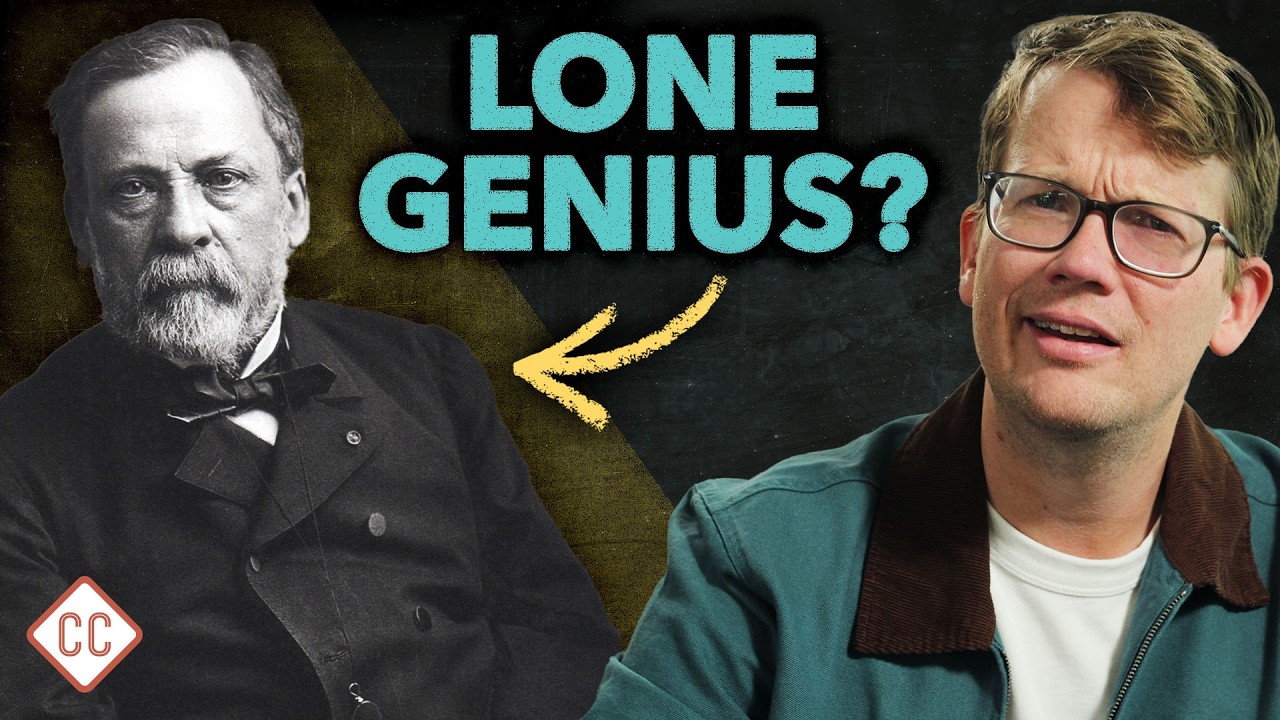
How Does Science Really Work? The Myth of the Great Experiment: Crash Course Scientific Thinking #3
Keywords
Summary
116 words
Critical Evaluation
Value of the Information & Strength of the Argument
The video provides high informational value by accurately representing the history of germ theory and the logic of scientific inquiry. The argumentation is solid: it uses a concrete case study (Pasteur) to demonstrate abstract concepts like variables and confounding factors. The transition from experimental to observational science is well-structured, and the ethical discussion adds depth. The claim that science is not about isolated great experiments is convincingly supported by examples and historical context.
Scientific Rigor, Source Quality, Title Accuracy
The video maintains scientific rigor by referencing a comprehensive source document (linked in the description). It correctly attributes contributions to Pasteur and acknowledges the work of predecessors like Robert Koch. The title accurately captures the main thesis, and the content stays on-topic. No commercial bias is present; the only mention of Patreon is a standard support request.
145 words
Title / Content Match
The title accurately reflects the content: it debunks the myth of the lone genius and explains the collaborative, multi-method nature of science.
Quality & Reliability
8/10
The video is part of the Crash Course series, known for educational reliability. It cites a detailed source document, and the content aligns with established historical and scientific consensus. However, it is a simplified overview, not an original study.
Key Moments
Markers derived by PSI from the transcript: the creator did not define chapters.
- Introduction: The myth of the lone genius and the role of the scientific community.
- The scientific community and Newton's 'shoulders of giants' analogy.
- Louis Pasteur and germ theory: historical context and the question of spontaneous generation.
- Pasteur's swan-neck flask experiments demonstrating microbial origin from air.
- Observational science: how climate change is studied through real-world measurements.
- Ethical considerations in experimentation: comparing standard and new treatments.
- Review and credits: science as a collaborative, evolving process.
Cited Sources
- Crash Course Scientific Thinking #3 Sources — List of references supporting claims in the episode.
Concurring Sources
- Germ theory of disease — Supports the historical account of Pasteur's contribution to germ theory.
- Observational study — Aligns with the video's discussion of observational science and its role.
External References
Contribution & Novelties
The video contributes by clearly separating the myth of the lone experiment from the reality of scientific practice, using Pasteur’s case to illustrate the interplay between experimental design, community critique, and observational approaches. It also stresses the importance of ethical constraints and confounding variables, making it a valuable pedagogical tool.
Pour aller plus loin :
- Germ theory of disease — Background on the development of germ theory and Pasteur’s role.
- Observational study — Explanation of observational research and its limitations.
- Confounding — Definition and examples of confounding variables in epidemiology.
90 words
Radar Profile
The scores show a balanced profile with high quality and quantity of information, moderate technical depth, and strong reliability. The video excels in substance and clarity, though not extremely technical.