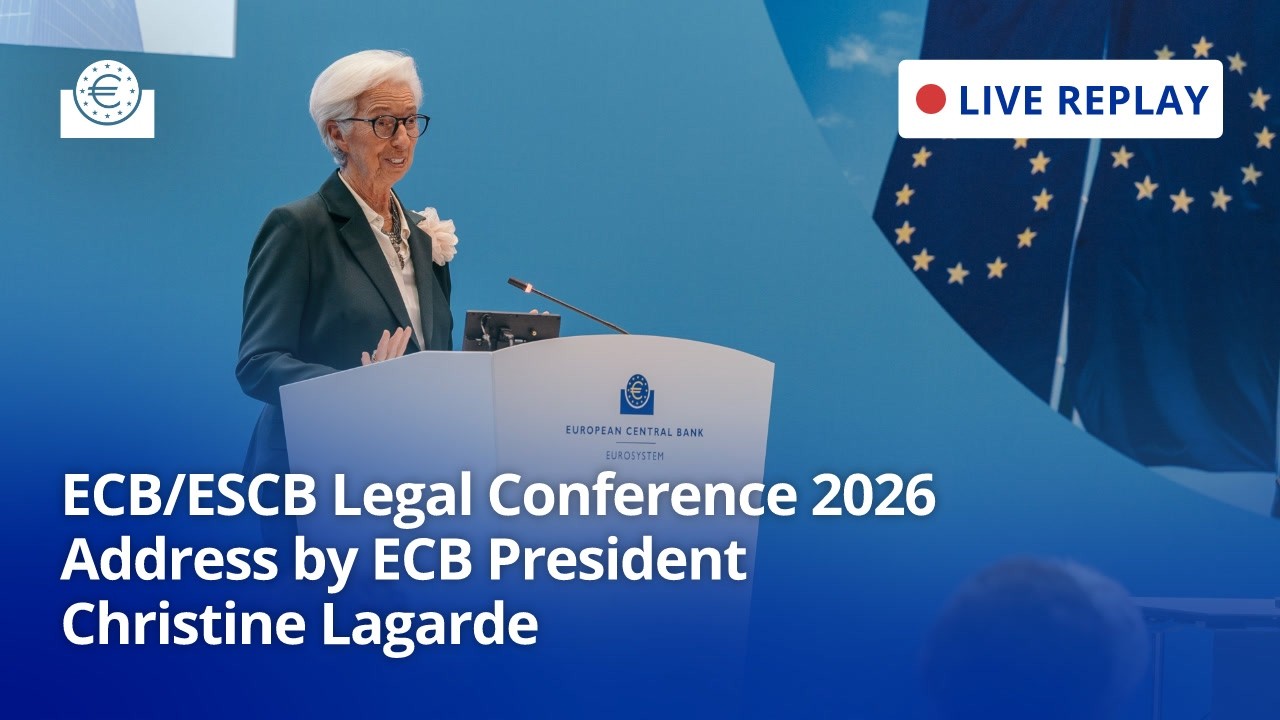
20261001 ECB Legal Conference Address Christine Lagarde
Keywords
Summary
197 words
Critical Evaluation
Value of the Information & Strength of the Argument
The speech provides valuable insight into the ECB’s perspective on institutional design and cooperation. Lagarde’s argumentation is logical and structured, countering potential criticisms by addressing both European and global challenges. She uses concrete examples such as the resolution framework and stablecoins to illustrate her points. However, the arguments are primarily based on her authority and experience rather than on cited data or studies, limiting the evidential basis. The reasoning is nevertheless coherent, and she effectively frames the discussion around accountability.
Scientific Rigor, Source Quality, Title Accuracy
The speech does not cite specific external sources or data, relying instead on the speaker’s authority as ECB President. This limits the verifiability of claims, though references to treaties and institutions are made without detail. The title accurately reflects the content: a formal address by Christine Lagarde at the ECB Legal Conference. No sources or links are provided in the video description, so the rigor of fact-checking is constrained. Despite this, the institutional context lends credibility.
171 words
Title / Content Match
The title accurately reflects the content: a formal address by Christine Lagarde at the ECB Legal Conference.
Quality & Reliability
8/10
The speaker is the ECB President, providing high institutional credibility. However, the speech lacks explicit citations or data, relying primarily on authority and experience.
Key Moments
Markers derived by PSI from the transcript: the creator did not define chapters.
- Introduction with quote from Jean Monnet on institutions and cooperation.
- Discussion of European cooperation and the expansion of ECB tasks since the Maastricht Treaty.
- Example of resolution framework and need for collective action.
- Transition to global challenges, mentioning stablecoins and cross-border banking.
- Identification of two temptations: informal cooperation in Europe and stepping back globally.
- Emphasis on codifying responsibilities and the role of international law.
- Example of NGFS as a coalition of the willing, noting growth despite departures.
- Conclusion: reassertion of Monet's point and the role of lawyers in ensuring accountability.
Contribution & Novelties
The speech offers a nuanced view on the balance between cooperation and accountability in central banking, particularly in the context of changing global dynamics. While it does not present new data, it articulates a clear institutional philosophy and addresses contemporary issues such as stablecoins.
Pour aller plus loin :
- Maastricht Treaty — The treaty that established the ECB and its primary objective.
- Network for Greening the Financial System — Example of a coalition of central banks on climate risk.
- Stablecoin — Digital assets that pose monetary policy challenges as discussed.
- Principle of sincere cooperation — A legal principle in EU law relevant to the discussion.
105 words
Radar Profile
The scores indicate a moderately high level of information quantity and quality, with strong reliability due to the authoritative source, but a moderate technical depth reflecting the policy-oriented nature of the speech.