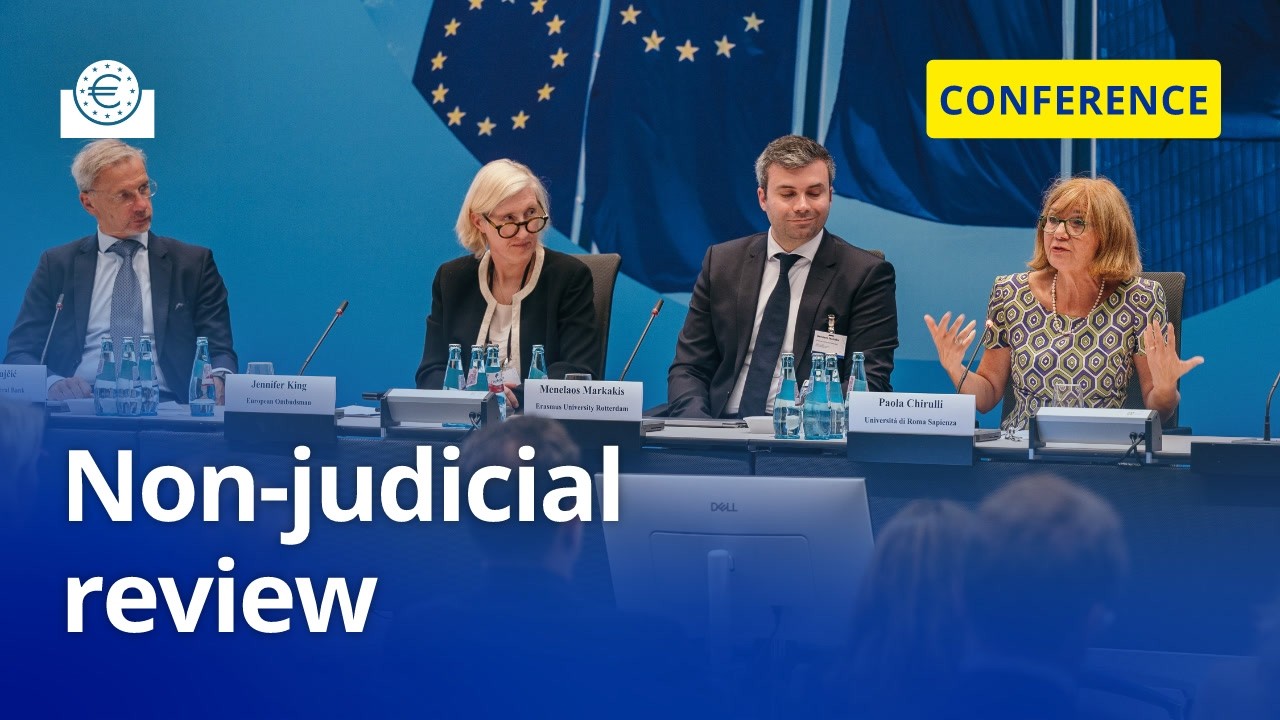
20261001 ECB Legal Conference Panel 6: Non judicial review: Central Banks, auditors and ombudsman
Keywords
Summary
173 words
Critical Evaluation
Value of the Information & Strength of the Argument
The video provides substantive insights into legal and institutional frameworks for reviewing central bank actions. Markakis argues convincingly for viewing accountability as a cooperative ecosystem, supported by examples and treaty provisions. His argument that accountability mechanisms should not operate in isolation is well-developed and normatively compelling. Jennifer King offers practical perspectives on how the Ombudsman operates, clarifying the scope of maladministration and the balance between independence and oversight. The reasoning is rigorous, with careful attention to legal constraints and institutional realities. The panelists engage with each other’s points, though the transcript does not include a full Q&A. Overall, the argumentation is sound and adds depth to the discussion of central bank accountability.
Scientific Rigor, Source Quality, Title Accuracy
The panel demonstrates scientific rigour by grounding claims in primary legal sources (TFEU, ECB Statute, SSM Regulation) and institutional reports. References to specific ECA special reports and the 2019 MOU are precise. The presenters cite academic work (Bovens, Papadopoulos) and institutional practice. The title accurately reflects the content, and the panel stays on topic. The video does not include external links, but the oral citations are verifiable. The inclusion of the European Ombudsman’s practical perspective adds credibility. There is no evidence of bias or unsupported claims; the discussion is balanced and acknowledges limitations.
220 words
Title / Content Match
The title accurately reflects the panel's focus on non-judicial review mechanisms (auditors, ombudsman) for central banks, with a clear match between title and content.
Quality & Reliability
8/10
Panelists are established legal scholars and practitioners; the content is grounded in EU law and institutional practice, with references to specific treaties, reports, and cases. While some arguments are normative, the factual claims appear reliable.
Key Moments
Markers derived by PSI from the transcript: the creator did not define chapters.
- Chair Boris Vujčić introduces the panel and poses the central question of whether non-judicial review can be seen as cooperation.
- Menelaos Markakis begins his presentation, defining administrative accountability and referencing Mark Bovens.
- Markakis discusses the European Court of Auditors' limited mandate over the ECB, citing article 27 of the ECB Statute.
- Markakis explains the 2019 memorandum of understanding between the ECA and ECB, improving cooperation.
- Markakis concludes with the concept of an 'ecosystem of accountability' and the need for synergies.
- Jennifer King begins her presentation on the European Ombudsman's role and its relation to the ECB.
- King explains the concept of maladministration and how it goes beyond legality to include broader principles.
- King discusses transparency cases, including the 1998 own-initiative inquiry and the Ireland letter case.
Cited Sources
- Mark Bovens' definition of accountability (as cited in EU law scholarship) — Foundation for discussing administrative accountability in the EU context.
- European Court of Auditors Special Reports on the Single Supervisory Mechanism (SSM) — Markakis references four special reports highlighting access limitations and later cooperation.
- Memorandum of Understanding between the European Court of Auditors and the ECB (2019) — Agreement improving information flow and interpreting audit scope.
- European Ombudsman inquiry into ECB President's membership in the Group of Thirty (G30) — Example of diagonal accountability; Ombudsman found maladministration and reported to Parliament.
- European Ombudsman own-initiative inquiry on public access to documents (1998) — Urged the newly established ECB to adopt transparency rules.
Contribution & Novelties
The video offers a fresh perspective on non-judicial review by framing it as a cooperative enterprise aimed at improving central bank accountability, rather than as a threat to independence. It highlights the concept of an ’ecosystem of accountability’ where different mechanisms (auditors, ombudsmen, parliaments) complement each other and enhance overall governance. The detailed analysis of legal constraints on the European Court of Auditors’ mandate over the ECB, and the practical insights from the European Ombudsman, provide nuanced understanding of how oversight can be exercised without encroaching on central bank independence.
Pour aller plus loin :
- European Ombudsman — Official EU institution responsible for investigating maladministration; central to the discussion.
- European Court of Auditors — The EU’s external auditor; its mandate and limitations over the ECB are key topics.
- Central bank independence — Underlying principle that shapes the balance between oversight and autonomy.
- Accountability — Conceptual framework used by the panelists to analyse oversight mechanisms.
- Administrative law — Legal domain governing the review of administrative actions, relevant to ombudsman and audit functions.
171 words
Radar Profile
The radar profile shows balanced scores across information quantity, quality, technical level, and reliability, all at 8/10. This indicates a uniformly high-quality presentation with substantial depth and credibility. The slightly lower overall rating (4/5) reflects the specialized nature and lack of broad accessibility.