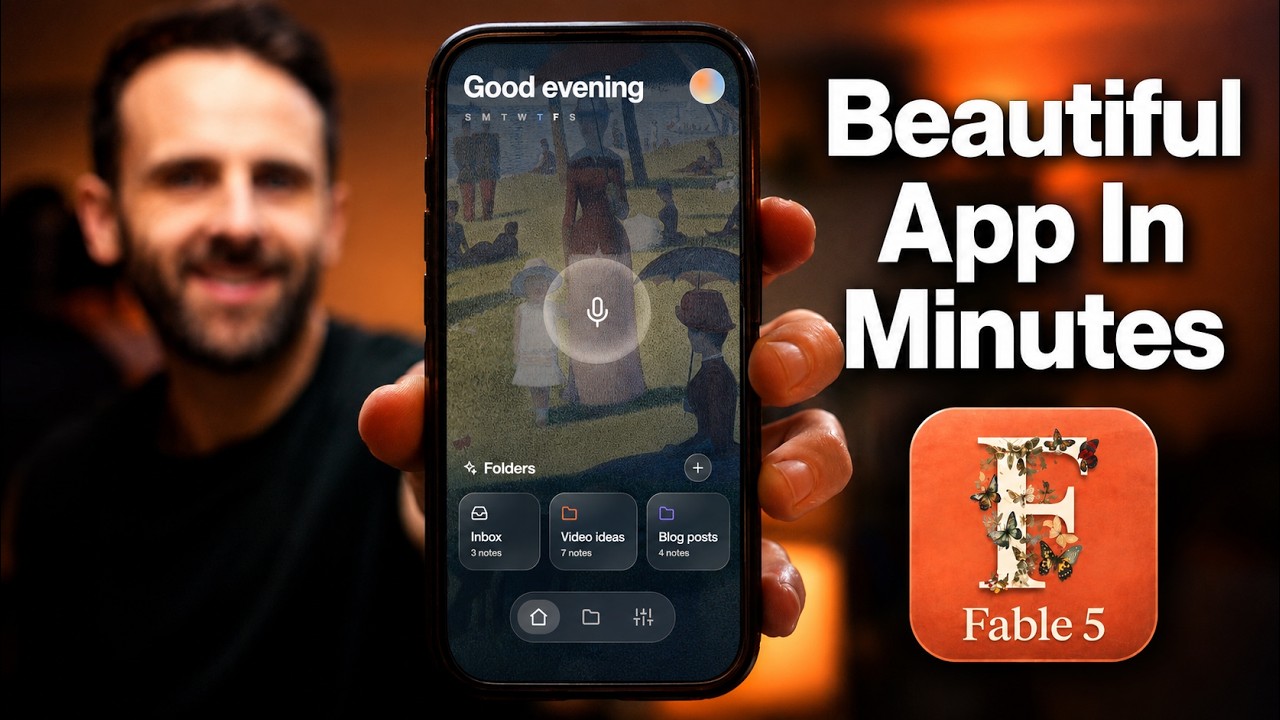
Fable 5 Is BACK. And It Just Built This Mobile App
Keywords
Summary
146 words
Critical Evaluation
Value of the Information & Strength of the Argument
The video provides a comprehensive walkthrough of using a leading AI model to build a functional mobile app. The value lies in its practical, step-by-step approach, showcasing real-world application of AI in software development. The argument is that AI models like Fable 5 can significantly speed up prototyping and design with minimal revisions. The creator supports this with direct experimentation, side-by-side comparison with Opus, and live demos. However, the argumentation is anecdotal and lacks quantitative measurements or external validation. The value is more in the methodology than in rigorous testing.
Scientific Rigor, Source Quality, Title Accuracy
The video’s scientific rigor is moderate; it’s a tutorial rather than a peer-reviewed study. The creator doesn’t cite external sources, except for an inspirational design by Anne Wen (mentioned, but no URL) and uses trade tools. The title is highly accurate and engaging, and the content matches the title exactly. The quality of sources is also limited to the creator’s own experience and tools. The only sources are the links in the description to the bootcamp and newsletter, which are self-promotional, but not directly cited as references for the content.
195 words
Title / Content Match
The title accurately reflects the content: the creator demonstrates how Claude Fable 5 builds a mobile app from scratch.
Quality & Reliability
7/10
The video is a practical demonstration with limited external sources. The creator shows actual results and provides insights into using Claude Fable 5, but does not cite scientific sources. The method is reproducible and the demonstration is transparent, but it remains an anecdotal tutorial.
Chapters
- Intro
- The app: a voice-note app for your creative brain
- The design that inspired it (glassmorphism)
- The prompt: a PRD, design-first, Fable as orchestrator
- First design — Fable nails the glassmorphism
- Fable vs. Opus 4.8
- New backgrounds + why we port to React Native
- The React Native build in iOS Simulator
- The killer features: AI analysis, add-to-note & chat
- Deploying: Expo + the Apple Developer Program
- Installing it onto my phone
- Testing the app on my phone
- Final thoughts
Cited Sources
- AI Bootcamp by Persimmon Studio — Linked in the description as an offer for an AI bootcamp.
- AI for Mortals Newsletter — Linked in the description as a newsletter subscription.
Contribution & Novelties
This video contributes a hands-on example of using Claude Fable 5, an advanced AI model, to build a complete mobile app, demonstrating its strengths in UI design and iterative development. It introduces a workflow that combines a design-first approach with delegated sub-agents to optimize token usage. The originality lies in the practical application and the clear demonstration of Fable’s capabilities over previous models. The video also highlights the potential of AI in personal software development.
Pour aller plus loin :
- React Native — Official framework for building native mobile apps with JavaScript/TypeScript, used in this project.
- Expo — Toolchain and services that simplify iOS/Android development and deployment, used for building and installing the app.
- Claude AI — Anthropic’s AI model family, including Fable 5, relevant to the AI-powered development discussed.
130 words
Radar Profile
The radar chart shows a strong profile in information quantity and technical level, with moderate quality and reliability. This indicates a content that is rich in practical details and advanced concepts, but lacks rigorous scientific sourcing.
💬 très positif. Sur les 30 commentaires analysés, la plupart sont positifs, avec des demandes de détails sur le processus et les coûts.