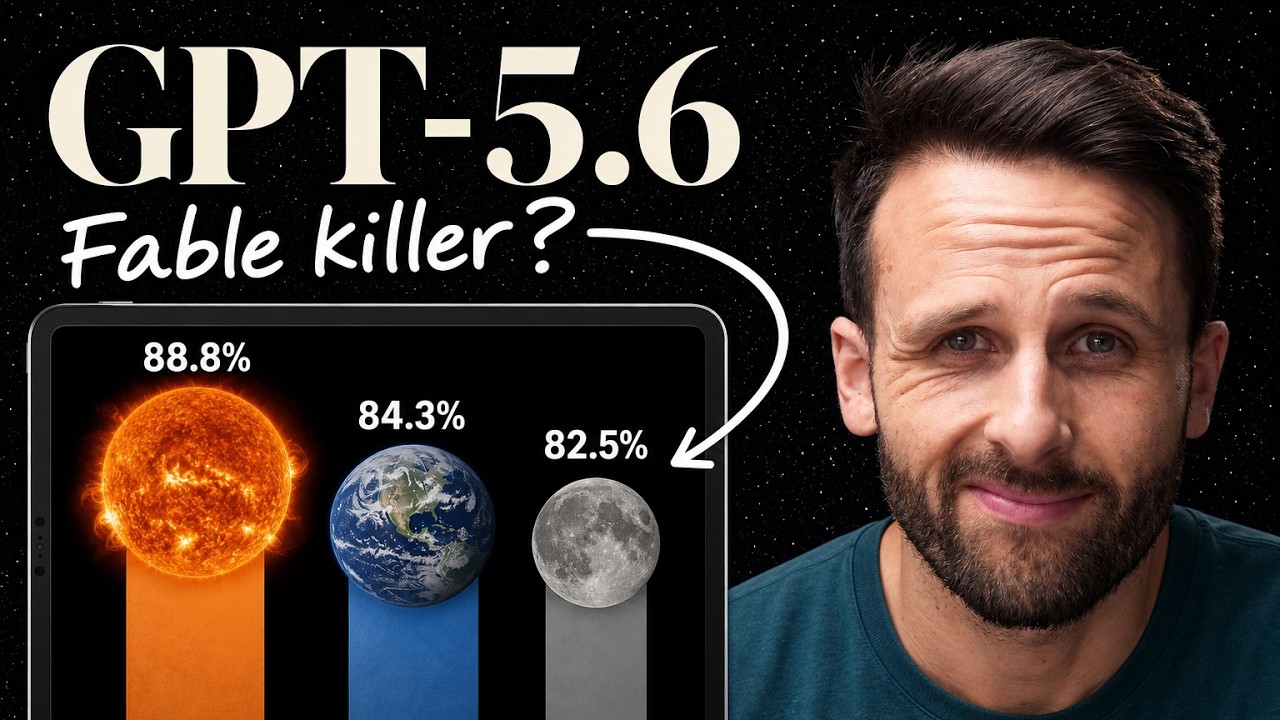
GPT 5.6 Sol: No-Hype Full Review & Testing
Keywords
Summary
165 words
Critical Evaluation
Value of the Information & Strength of the Argument
The information is highly valuable for AI users, offering real-world performance data beyond official benchmarks. The blind-testing methodology is a strong point, reducing confirmation bias that often plagues model comparisons. The argumentation is solid: Pat Simmons clearly explains his test design, shows both successes and failures, and provides candid commentary on each output. He also contextualizes results with benchmark data, acknowledging discrepancies. The analysis is nuanced, recognizing that different models suit different tasks, and he avoids overhyping any single model. The inclusion of viewer-suggested tests adds practical relevance. The video’s structure—clearly segmenting coding vs. knowledge work—helps viewers understand the trade-offs. While not a controlled scientific experiment, the approach is transparent and the conclusions are reasoned, making the argumentation credible.
Scientific Rigor, Source Quality, Title Accuracy
The scientific rigor is commendable for a YouTube review: Pat Simmons conducts systematic testing with reproducible prompts (though not fully shared), uses blind conditions (though he later reveals which model he didn’t know for some tests, he sometimes guesses correctly, showing some awareness). The sources are primarily the models themselves and official documentation referenced indirectly; the video mentions benchmarks like Terminal Bench 2.1, Agent’s Last Exam, SweepBench Pro, and GDP Val, but specific source URLs are not provided, limiting verifiability. The description links only to his bootcamp and newsletter, which are commercial-oriented. The title is accurate, promising a ’no-hype’ review, which the content delivers. The video acknowledges potential tooling issues and invites correction, showing intellectual honesty. However, the lack of detailed citations for benchmark claims and the absence of a formal methodology appendix slightly reduce scientific rigor. Overall, it is a well-above-average technical review.
278 words
Title / Content Match
The title accurately reflects the content: a comprehensive, no-hype review and testing of GPT-5.6 Sol across multiple practical and knowledge-work tasks.
Quality & Reliability
8/10
The video provides extensive hands-on testing across 10 varied builds, with a clear blind-testing methodology and honest acknowledgment of limitations. While not a controlled scientific study, the approach reduces bias and offers practical insights, though reliance on personal observation and potential tooling issues tempers full reliability.
Chapters
- GPT-5.6 Sol, Terra & Luna are out
- Spinning up all the builds at once
- Sol, Terra & Luna explained
- Reasoning effort & parallel agents
- Cost & benchmarks
- The 10 tests (and your comment suggestions)
- Rubik's Cube solver
- Monica's apartment in 3D
- Interactive Milky Way map
- Counter-Strike 2 clone
- Cinema knowledge graph
- Interactive graphic novel
- Text-adventure dungeon
- A YouTube intro in my voice
- A PowerPoint on the launch
- Spirit Airlines rebrand
- The verdict: when to use which model
- Outro
Cited Sources
- AI Bootcamp — Mentioned in video description for enrollment.
- AI for Mortals Newsletter — Subscription link in video description.
Contribution & Novelties
60 words
Radar Profile
The scores indicate a well-rounded video with high information quantity and technical depth, but slightly lower reliability due to the informal, single-test nature. The quality of information is strong, reflecting thoughtful analysis and clear presentation, while the global reliability is moderately high, suggesting viewers can trust the general conclusions while remaining aware of the lack of controlled repetition.
💬 positive - Sur les 30 commentaires analysés, l'accueil est très positif : les spectateurs saluent la méthodologie de test en aveugle, la qualité de l'analyse et la transparence, avec quelques demandes de tests supplémentaires et des corrections techniques mineures.