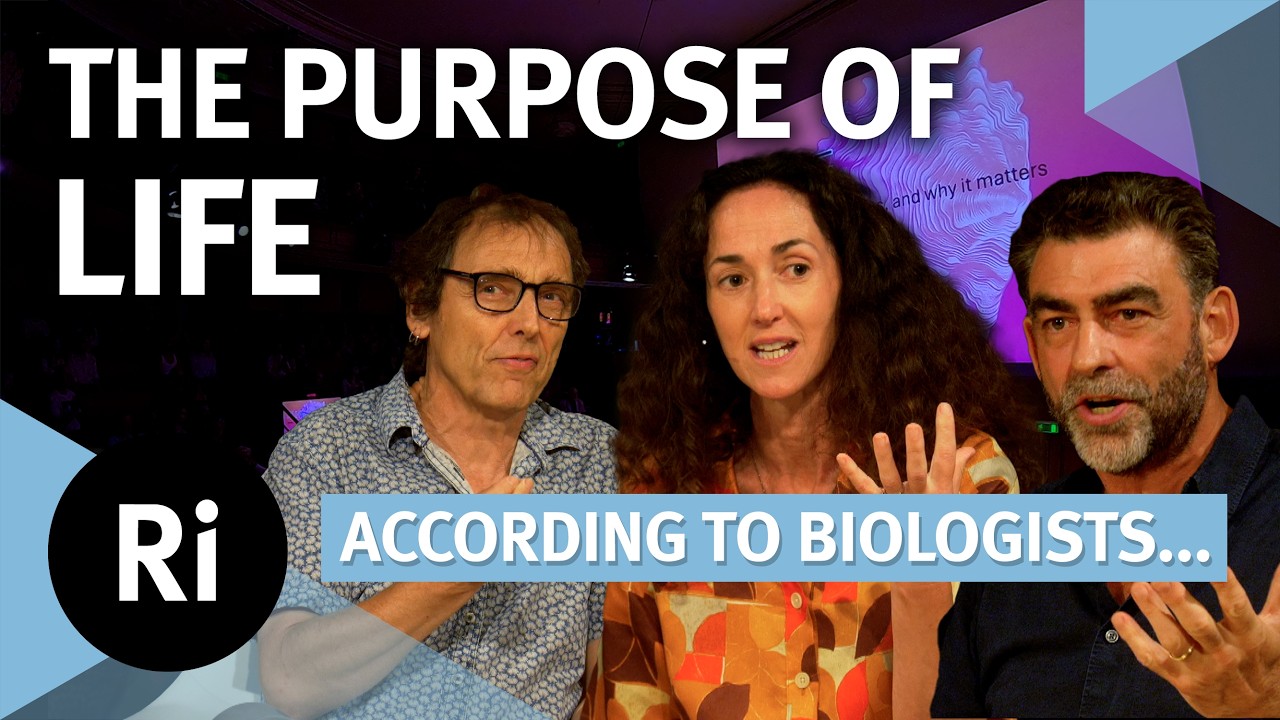
Do cells have goals? | with Melanie Challenger, Nick Lane & Philip Ball
Keywords
Summary
157 words
Critical Evaluation
Value of the Information & Strength of the Argument
The value of this discussion lies in its synthesis of historical, philosophical, and biochemical perspectives on the nature of life. The speakers build a coherent argument against a purely gene-centric or mechanistic view, presenting evidence from synthetic biology, bioenergetics, and evolutionary theory. Philip Ball’s historical overview clarifies how the concept of life has shifted, while Nick Lane’s focus on energy flow and membrane gradients provides a concrete biological mechanism that distinguishes living from non-living. Melanie Challenger’s challenge to Dawkins’s position is grounded in both philosophical reasoning and scientific examples. The argumentation is generally solid, though some points are more suggestive than fully substantiated, and the live format allows for only brief treatment of each topic. Nevertheless, the speakers maintain scientific rigor and avoid oversimplification.
Scientific Rigor, Source Quality, Title Accuracy
The scientific rigor is high, given the expertise of the participants and the institutional backing of the Royal Institution. The speakers reference specific examples such as the synthetic spud cells (work by Kate Adamala’s group) and Peter Mitchell’s chemiosmotic theory, grounding their claims in real research. The title accurately reflects the content, focusing on the question of goals in cells, and the inclusion of the speakers’ names is appropriate. No explicit external sources are cited within the talk itself, but the description provides links to relevant books and institutional pages. The discussion does not appear to have any major factual errors, and the tone is cautious where uncertainty exists. Overall, the title is a good match, and the content meets high standards of scientific communication.
264 words
Title / Content Match
The title accurately reflects the central question explored, and the speakers are accurately named.
Quality & Reliability
9/10
The discussion features three highly credible experts (a biochemist, a science writer, and a bioethicist) in a live Royal Institution event, providing a well-reasoned and scientifically grounded conversation on the nature of life.
Chapters
- Introduction: A Live Inquiry Into What Life Is
- Does Nature Have Purpose? The Dawkins Challenge
- Why Nobody Can Define Life
- Building Life From Scratch, and Why AI Raises the Stakes
- From Aristotle to "Man a Machine"
- Energy Flow: What a Dead Whale Is Missing
- Aristotle's Living Body and the Search for the Agent
- Is Biological Agency Real?
- How Life Works: Membrane Voltages and Hydrothermal Vents
- Why Science Sidelined the Body
- Beyond the Genetic Program
- Scaling Agency: Xenobots, Organoids and Ethics
Cited Sources
- Alive: what life is, how it works, and why it matters — Book by Melanie Challenger mentioned in the description
- The Ri podcast — Official podcast of the Royal Institution
- Ri editorial policy — Policy on editing talks and moderating comments
- Donate to the Ri — Support page for the Royal Institution
Contribution & Novelties
The video offers a fresh synthesis of historical and modern perspectives, arguing for a view of life as inherently purposive and embodied, challenging the gene-centric paradigm. It highlights Nick Lane’s work on energy flow and membrane bioenergetics as a unifying theme. The discussion also connects these biological ideas to contemporary issues in AI and ethics, suggesting that our understanding of life informs how we treat artificial systems.
Pour aller plus loin :
- Peter Mitchell and chemiosmosis — Nick Lane’s discussion of energy flow is grounded in Mitchell’s theory, central to understanding how cells generate ATP.
- Abiogenesis — The origin of life research mentioned, particularly hydrothermal vents, is a key topic here.
- Synthetic cells — The ‘spud cells’ discussed are an example of efforts to build lifelike systems from scratch.
- Agency (philosophy) — The philosophical concept of agency is central to the panel’s argument about living organisms.
146 words
Radar Profile
The profile shows high scores in information quantity and quality, moderate technical level, and high reliability, indicating a substantively rich and trustworthy discussion that is accessible but not oversimplified.